**Spoilers!!**
I'm basically done with The Faults in Our Stars, or FiOS, but I thought I may as well extend these responses until I've used all the content I can and responded to it until basically the end of the year, because for some reason I just don't want to charge my Nook and start the Curse Workers series again.
Sigh.
Okay, so first of all, I would like to say that even when I first read this book, from the moment they left for Amsterdam and Gus and Hazel's mom were acting fishy, I knew that he was going to get cancer.
And die.
Oh, this still gives me a lot of emotions, but anyhow, I've not technically read this part of the book yet. So back to where I am, which is-- actually wait, yes, I'm right past the eulogy Hazel tells Gus at his pre-funeral. So, Gus, is, unfortunately, dead.
The pre-funeral is one of my favorite moments in the book, pretty much because of the eulogy. The eulogy shows how someone who always know that death is always impending on their lives, and that they are forever bonded with the dark thing that is death, because they almost experienced it, views the world. Hazel is shown to see the world, or at least after she met Gus, as many infinities. I believe this is because a moment is not valued by the amount of time it takes up, or by the money it took. It's by all the beautiful and wonderful things that happened in these moments that are infinite, because they change us as people and shape us forever.
These moments that Hazel spent with Gus, they obviously weren't chronologically infinite (that is almost definitely not the correct use of that word). But Hazel knows that their little infinity, their little moments that made Hazel more happy, that made Hazel want to live more, that made Hazel love more, was one of her favorite infinities, favorite memories, favorite feelings, and was one of the 'biggest' infinities in her life, one that changed it for the better.
This scene made me want to live my life to the fullest. I would love to find some dashing Augustus Waters to bring me to Amsterdam and change my life and outlook on this said topic, but I most likely will not. I have to make my own little infinities to make my life as good as possible, and have to try to like the infinities I already have.
Also, John Green is an amazing human being.
Showing posts with label realistic fiction. Show all posts
Showing posts with label realistic fiction. Show all posts
Saturday, June 15, 2013

Sunday, May 26, 2013
"Other Words for Love" by Lorraine Zago Rosenthal
**Spoilers!**
Other Words for Love, by Lorraine Zago Rosenthal, follows Ari, who after earning an inheritance from her Uncle, attends a prestigious Manhattan prep school. She encounters glamorous and rich new people, and even gets Leigh, her new friend. With Leigh comes her enchanting cousins, Delsin and Blake. While Delsin is a smooth, slightly creepy ladies man, Blake is a warm hearted and undeniably handsome. He charms Ari until she falls for him. After blissful weeks of going out, Ari is suddenly broken-up with by Blake-- and left in a heart-broken trance. Why? Ari risked everything for Blake? Was Ari wrong all along about Blake?
This book was kind of good.
Great way to start a review.
 One thing I don't like is that the blurb is that at the end it says: "were their feelings true love... or something else?" Which immediately makes me think what? What else besides love? It leaves and open topic and readers questioning which blurbs are supposed to do, but in a stupid way. Anyways, after reading the book, you immediately know that it was love, not lust, or something more animal in desire than love that brought Blake and Ari together.
Ari's struggle with the breakup is justified slightly by how Blake was her 'first love' and everything, I do think Ari was too obsessed with him. I get it that she thought he was amazing and she really thought he was perfect, but every 'normal girl' (as Ari often says she is) knows that no boy is 'forever', and that you have to get over it. Ari literally could have changed the course of her life because one guy dumped her. She almost became a stay-at-home slouch who would be obsessed with Blake forever. Why would a smart girl like Ari fall so easily into that slump?
One explanation for the possible for this, however, is that Ari was not only enticed by the attractive boy, like Blake, but the lifestyle of his social class in general. They live in high rises, with fancy parties and classy suits, and have cool families and hip moms and go to private schools without needing a scholarship or their dead uncle's inheritance. This glitz and glam life most likely took Ari away from the life of a girl in Queens (or is it Brooklyn?), who has a middle class lifestyle with homely parents and a messed up family life. Also, a little more randomly, I feel like the 1980's setting ending up being less as important as it seemed in the beginning.
This book portrays girls as so weak, and so needy for love if they're not getting it that they will give up all their dreams for a guy. The actions of Ari, even after knowing Blake was just weak and couldn't stand up for himself, were unbelievable. She was lusting after him and crying for a guy who would appear unattractive, I think, to many girls, as he was someone who couldn't hold his ground and make life choices. The book also jumps back and forth around this theme, and shows these two sides with conflicting consistency.
I mean you have Leigh, who, however mistreated by Ari and Blake, was an immature character, and she was scarred by her boyfriends death, yet she didn't understand any of the other characters desire for affection. The author makes some moments with the characters so relatable, but some moments so awkward that you feel like you have to take a step back from the book to really get what was going on.
I think the relationship between Summer and Ari is very interesting, however, and was one of the more believable and interesting parts of the book. It was a classic 'friends breaking up' type of plot, but that happens in real life all the time, and was relatable. Also, Summer's character, no matter how unbearable, did make the story more interesting for me.
I was about 50/50 with this book, in terms of how much I liked/disliked it. I thought the author kind of spewed out the end and went a little too far into 'the obsession' of Ari with Blake. She made the characters too weak to believe. That bothered me. I like a book with strong characters with believable flaws that I can relate too. I wouldn't whine over a boy for a summer just because he broke up with me. I would probably mostly be angry, as Blake literally ruined Ari's future.
Other Words for Love, by Lorraine Zago Rosenthal, follows Ari, who after earning an inheritance from her Uncle, attends a prestigious Manhattan prep school. She encounters glamorous and rich new people, and even gets Leigh, her new friend. With Leigh comes her enchanting cousins, Delsin and Blake. While Delsin is a smooth, slightly creepy ladies man, Blake is a warm hearted and undeniably handsome. He charms Ari until she falls for him. After blissful weeks of going out, Ari is suddenly broken-up with by Blake-- and left in a heart-broken trance. Why? Ari risked everything for Blake? Was Ari wrong all along about Blake?
This book was kind of good.
Great way to start a review.
 One thing I don't like is that the blurb is that at the end it says: "were their feelings true love... or something else?" Which immediately makes me think what? What else besides love? It leaves and open topic and readers questioning which blurbs are supposed to do, but in a stupid way. Anyways, after reading the book, you immediately know that it was love, not lust, or something more animal in desire than love that brought Blake and Ari together.
 Ari's struggle with the breakup is justified slightly by how Blake was her 'first love' and everything, I do think Ari was too obsessed with him. I get it that she thought he was amazing and she really thought he was perfect, but every 'normal girl' (as Ari often says she is) knows that no boy is 'forever', and that you have to get over it. Ari literally could have changed the course of her life because one guy dumped her. She almost became a stay-at-home slouch who would be obsessed with Blake forever. Why would a smart girl like Ari fall so easily into that slump?
One explanation for the possible for this, however, is that Ari was not only enticed by the attractive boy, like Blake, but the lifestyle of his social class in general. They live in high rises, with fancy parties and classy suits, and have cool families and hip moms and go to private schools without needing a scholarship or their dead uncle's inheritance. This glitz and glam life most likely took Ari away from the life of a girl in Queens (or is it Brooklyn?), who has a middle class lifestyle with homely parents and a messed up family life. Also, a little more randomly, I feel like the 1980's setting ending up being less as important as it seemed in the beginning.
This book portrays girls as so weak, and so needy for love if they're not getting it that they will give up all their dreams for a guy. The actions of Ari, even after knowing Blake was just weak and couldn't stand up for himself, were unbelievable. She was lusting after him and crying for a guy who would appear unattractive, I think, to many girls, as he was someone who couldn't hold his ground and make life choices. The book also jumps back and forth around this theme, and shows these two sides with conflicting consistency.
I mean you have Leigh, who, however mistreated by Ari and Blake, was an immature character, and she was scarred by her boyfriends death, yet she didn't understand any of the other characters desire for affection. The author makes some moments with the characters so relatable, but some moments so awkward that you feel like you have to take a step back from the book to really get what was going on.
I think the relationship between Summer and Ari is very interesting, however, and was one of the more believable and interesting parts of the book. It was a classic 'friends breaking up' type of plot, but that happens in real life all the time, and was relatable. Also, Summer's character, no matter how unbearable, did make the story more interesting for me.
I was about 50/50 with this book, in terms of how much I liked/disliked it. I thought the author kind of spewed out the end and went a little too far into 'the obsession' of Ari with Blake. She made the characters too weak to believe. That bothered me. I like a book with strong characters with believable flaws that I can relate too. I wouldn't whine over a boy for a summer just because he broke up with me. I would probably mostly be angry, as Blake literally ruined Ari's future.
Saturday, May 18, 2013
"It's Not Summer Without You" by Jenny Han
**Spoilers!**
(I also read this book before, and decided to read it again.)

It's Not Summer Without You, by Jenny Han, is about Belly, or Isabel, is in her last year of high school. After her mother's best friend, and one of her best friends, Susannah, died of breast cancer, her life hasn't been the same. Her mother is breaking under the stress as executor of Susannah's will, and doesn't have any grieving time on her own. Belly's brother is far away, off at college, and almost non-existent in their current life. Her secret escape, Susannah's beach house, is now a memory, and Belly is dreading the summer without her time with her brother, mother, Susannah and Susannah's sons, Conrad and Jeremiah. To make matters worse, Conrad, the boy Belly has loved for forever, has broken up with her, and is detached and alone, not even talking to her, and dumping her right when Susannah died, when she needed him the most. But when Belly's told by Jeremiah Conrad is gone, she goes to find him without hesitation, and ends up at the beach house. This is her last chance to save her relationship with Conrad and finally come to terms with the death of the person that brought them all together.
This book was pretty good, but it wasn't as good as I remember. It was still better than the last book, The Summer I Turned Pretty. The book is well written, like the last book (tip off the hat to Jenny Han). The whole story is well formulated, the characters are believable, the love story is sigh worthy, and it has a nice, neat love triangle to top the story off.
These are also all very basic and well worn tools by authors of YA romance books.
The character set up and development, thought predictable, are very nicely written. It's a very straightforward book in theme and plot, but the little details, as in the last book, make me like it so much. I love, strangely enough, the 'annoyingness' (no better word) of Belly after her breakup with Conrad, and after Susannah's death. She tries to use guilt to get what she wants, and find excuses for what I must say so myself, is terrible behavior. Also I liked how other characters (such as Taylor) react by getting mad at her, and not forgiving her. The holding grudges, obsessing, depression, whining, and just emotions of this book is what makes this a very believable book. The ways the characters interact have a lot to do with this, and it made the book a lot more enjoyable to read, in my opinion.
Many of the themes in this book are really cheesy. The brother love triangle, the way the brothers fight over Belly, the unrealistic things the people will do for love, all things that sometimes ruin a so far romance book for me. Even the classic beach cover with attractive girl with windblown hair is fairly overused.
Reading this book again made me realize that many of the parts of the book that I loved last year made me a little queasy this year, and weren't as creative as I thought before. Though I obviously realized this book wasn't a greatest book ever, and that many plot points had been used before, it was just harder to enjoy when I realized it was glaringly obvious what would happen, not just because I had already read the story.
Overall, I very much enjoyed this book, and thought it balanced sappiness and real-life emotions. Jenny Han has a very specific writing type, and has a talent for books such as these, teenager-y romance plots involving summer romances. Her books are a guilty pleasure of mine, and I would be interested in reading the rest of this series.
(I also read this book before, and decided to read it again.)
It's Not Summer Without You, by Jenny Han, is about Belly, or Isabel, is in her last year of high school. After her mother's best friend, and one of her best friends, Susannah, died of breast cancer, her life hasn't been the same. Her mother is breaking under the stress as executor of Susannah's will, and doesn't have any grieving time on her own. Belly's brother is far away, off at college, and almost non-existent in their current life. Her secret escape, Susannah's beach house, is now a memory, and Belly is dreading the summer without her time with her brother, mother, Susannah and Susannah's sons, Conrad and Jeremiah. To make matters worse, Conrad, the boy Belly has loved for forever, has broken up with her, and is detached and alone, not even talking to her, and dumping her right when Susannah died, when she needed him the most. But when Belly's told by Jeremiah Conrad is gone, she goes to find him without hesitation, and ends up at the beach house. This is her last chance to save her relationship with Conrad and finally come to terms with the death of the person that brought them all together.
This book was pretty good, but it wasn't as good as I remember. It was still better than the last book, The Summer I Turned Pretty. The book is well written, like the last book (tip off the hat to Jenny Han). The whole story is well formulated, the characters are believable, the love story is sigh worthy, and it has a nice, neat love triangle to top the story off.
These are also all very basic and well worn tools by authors of YA romance books.
The character set up and development, thought predictable, are very nicely written. It's a very straightforward book in theme and plot, but the little details, as in the last book, make me like it so much. I love, strangely enough, the 'annoyingness' (no better word) of Belly after her breakup with Conrad, and after Susannah's death. She tries to use guilt to get what she wants, and find excuses for what I must say so myself, is terrible behavior. Also I liked how other characters (such as Taylor) react by getting mad at her, and not forgiving her. The holding grudges, obsessing, depression, whining, and just emotions of this book is what makes this a very believable book. The ways the characters interact have a lot to do with this, and it made the book a lot more enjoyable to read, in my opinion.
Many of the themes in this book are really cheesy. The brother love triangle, the way the brothers fight over Belly, the unrealistic things the people will do for love, all things that sometimes ruin a so far romance book for me. Even the classic beach cover with attractive girl with windblown hair is fairly overused.
Reading this book again made me realize that many of the parts of the book that I loved last year made me a little queasy this year, and weren't as creative as I thought before. Though I obviously realized this book wasn't a greatest book ever, and that many plot points had been used before, it was just harder to enjoy when I realized it was glaringly obvious what would happen, not just because I had already read the story.
Overall, I very much enjoyed this book, and thought it balanced sappiness and real-life emotions. Jenny Han has a very specific writing type, and has a talent for books such as these, teenager-y romance plots involving summer romances. Her books are a guilty pleasure of mine, and I would be interested in reading the rest of this series.
Sunday, April 14, 2013
"Half Moon Investigations" by Eoin Colfer
Half Moon Investigations is by far one of my favorite books. I read this in something like fourth or fifth grade, but I try to reread it every year or so. There are so many reasons why this is a great book, so I'll try to keep is brief.
 1) Eoin Colfer. Colfer is a really strong author, and is really well known, in my age group, most likely for the Artemis Fowl Chronicles, or series or whatever it's title is. The reason Colfer is such a successful youth writer is that he can keep the content youth appropriate, but make the story itself mature. What I mean by that is Colfer doesn't over sexual or over dramatize the pre-teen and teen experience to make it a good and still interesting read for teenagers and pre-teens, but doesn't make it hard to believe that these characters are, in fact, teenagers. He's able to make the tone of the story really mature, and develops these characters to be their own person, and doesn't try to make them 'squares.' These children are their own characters with their own wants and desires, that make them really believable.
2) Tone. I love the tone of this book, which has to do with the speil about tone and maturity I wrote up there. This book, to me, pretty much reads as a witty noir for teens. But the best thing about it, no matter how cheesy that may sound, or you may think it will be, Colfer retains really individual and interesting ideas in the story that keep it in modern context and in a relatable place for teenagers. He's able to take a mystery about a fiercely competitive talent show and add at least three fight scenes and menacing kidnapping scene, and a little bit of gore. Talent. Also, this book really makes me want to go to Ireland.
3) Mystery. Colfer is able to write a great mystery story. He leaves enough clues sprinkled around the book for people to deduce it on the own, but keeps you guessing the whole time. This makes the story really a great deal of fun to read, let alone the second or third time, when you start to really notice the little hints Colfer drops throughout the story.
So I guess the point of this was...
Eoin Colfer is a very good writer.
 1) Eoin Colfer. Colfer is a really strong author, and is really well known, in my age group, most likely for the Artemis Fowl Chronicles, or series or whatever it's title is. The reason Colfer is such a successful youth writer is that he can keep the content youth appropriate, but make the story itself mature. What I mean by that is Colfer doesn't over sexual or over dramatize the pre-teen and teen experience to make it a good and still interesting read for teenagers and pre-teens, but doesn't make it hard to believe that these characters are, in fact, teenagers. He's able to make the tone of the story really mature, and develops these characters to be their own person, and doesn't try to make them 'squares.' These children are their own characters with their own wants and desires, that make them really believable.
2) Tone. I love the tone of this book, which has to do with the speil about tone and maturity I wrote up there. This book, to me, pretty much reads as a witty noir for teens. But the best thing about it, no matter how cheesy that may sound, or you may think it will be, Colfer retains really individual and interesting ideas in the story that keep it in modern context and in a relatable place for teenagers. He's able to take a mystery about a fiercely competitive talent show and add at least three fight scenes and menacing kidnapping scene, and a little bit of gore. Talent. Also, this book really makes me want to go to Ireland.
3) Mystery. Colfer is able to write a great mystery story. He leaves enough clues sprinkled around the book for people to deduce it on the own, but keeps you guessing the whole time. This makes the story really a great deal of fun to read, let alone the second or third time, when you start to really notice the little hints Colfer drops throughout the story.
So I guess the point of this was...
Eoin Colfer is a very good writer.
Sunday, March 31, 2013
"Perfect" by Ellen Hopkins
**Spoilers!**
Perfect, by Ellen Hopkins, is the story of four high school students struggling with colleges, love, their futures, and what perfect really means.
 This was the first book to get me to cry. Ever. I'm so serious. As an ode to how important this fact is, I read The Five People You Meet in Heaven, and The Faults in Our Stars, both of which I like to think of as a downright sad books, and did not cry during those.
This book was amazing. When I first read the blurb, I thought it was going to be cheesy. But it was so intense and saddening and an amazing mix of poetry and narrative. The stories were so believable it hurt. You could feel all the raw emotion. Hopkins does some of the most amazing things I've ever seen with literature. I loved Crank, probably one of Hopkin's most famous books, but I think this book should be just up there with it.
The ending is what really did me in. It's so impossibly unhappy, but so terribly hopeful. Andre is ready to face his family, but Jenna is raped. Sean's life is permanently messed up and he's borderline crazy thanks to obsession and steroids, Conner dies, but Cara find her true self and finally finds love with Dani.
Kendra is torn and anorexic (and seems to stay that way), but has seen inside her family and admitted her feelings fully for maybe the first time.
It's the mix of jealousy, desire, love, hate, lust, anger, violence, sadness and maliciousness that make this book such a deliciously dark read, and reel you in. The characters seem to each represent something perfect people want in their lives, each one twisting this image painfully, making you realize how fast cracks can form from perfection. Each character gives you a different approach on perfect in people's lives.
I hated Sean. He was so self-involved, and childish, and by the end of the book, I was afraid of him, and afraid of what he thought was right in his twisted, broken mind. He's so creepy and insane at the end, it's hard to imagine anyone like that. His motives started off so pure. He was so in love with Cara, you feel sorry for the guy that she didn't try to justify herself to him at all. She just broke it off, then even though he was hung up over her and one of her best friends (as she mentions in the first part of the book), she doesn't try to explain anything
Cara was near the most relaxed character. Most of the story, she was just crazy in love, and handling it, or thinking about her older brother. I thought that her realizing she was lesbian was a little too fast (like when they're skiing she just automatically says 'Maybe' she's lesbian when Danielle asks? There is no hint of that she is before that. I think it's amazing that she found what she really wanted, but it was kind of forced, especially if it was her first time with a girl. I think she would have been a little more nervous. Though I also didn't read the first book, which could have exposition to this fact in it), but her sadness at the end of the book was just so real. Her crying, "Mommy" and, "Daddy" when Conner died, even though she hated them most of the time and resented them? It was so raw.
Kendra was in so much denial. I wanted an emotional breach. It was almost hard to get attached to her. Her problem was so much more than her eating disorder. She reminded me of a mild Sean, because she only thought of Conner. She used him to justify her own madness.
Andre was also fairly mild compared to everyone else. He should be himself. I think that his relationship with Jenna really made him interesting. He adored and loved her unconditionally. But she was too childish, and too scarred by her parents to reciprocate. It's almost a relief when you see she realizes this. And when she gets raped right after Andre breaks it off with her, it's so sad.
THE BOOK IS SAD.
But...
This book is one of my all time favorite, and always will be.
Perfect, by Ellen Hopkins, is the story of four high school students struggling with colleges, love, their futures, and what perfect really means.
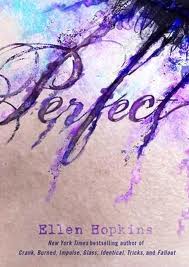 This was the first book to get me to cry. Ever. I'm so serious. As an ode to how important this fact is, I read The Five People You Meet in Heaven, and The Faults in Our Stars, both of which I like to think of as a downright sad books, and did not cry during those.
 This book was amazing. When I first read the blurb, I thought it was going to be cheesy. But it was so intense and saddening and an amazing mix of poetry and narrative. The stories were so believable it hurt. You could feel all the raw emotion. Hopkins does some of the most amazing things I've ever seen with literature. I loved Crank, probably one of Hopkin's most famous books, but I think this book should be just up there with it.
The ending is what really did me in. It's so impossibly unhappy, but so terribly hopeful. Andre is ready to face his family, but Jenna is raped. Sean's life is permanently messed up and he's borderline crazy thanks to obsession and steroids, Conner dies, but Cara find her true self and finally finds love with Dani.
Kendra is torn and anorexic (and seems to stay that way), but has seen inside her family and admitted her feelings fully for maybe the first time.
It's the mix of jealousy, desire, love, hate, lust, anger, violence, sadness and maliciousness that make this book such a deliciously dark read, and reel you in. The characters seem to each represent something perfect people want in their lives, each one twisting this image painfully, making you realize how fast cracks can form from perfection. Each character gives you a different approach on perfect in people's lives.
I hated Sean. He was so self-involved, and childish, and by the end of the book, I was afraid of him, and afraid of what he thought was right in his twisted, broken mind. He's so creepy and insane at the end, it's hard to imagine anyone like that. His motives started off so pure. He was so in love with Cara, you feel sorry for the guy that she didn't try to justify herself to him at all. She just broke it off, then even though he was hung up over her and one of her best friends (as she mentions in the first part of the book), she doesn't try to explain anything
Cara was near the most relaxed character. Most of the story, she was just crazy in love, and handling it, or thinking about her older brother. I thought that her realizing she was lesbian was a little too fast (like when they're skiing she just automatically says 'Maybe' she's lesbian when Danielle asks? There is no hint of that she is before that. I think it's amazing that she found what she really wanted, but it was kind of forced, especially if it was her first time with a girl. I think she would have been a little more nervous. Though I also didn't read the first book, which could have exposition to this fact in it), but her sadness at the end of the book was just so real. Her crying, "Mommy" and, "Daddy" when Conner died, even though she hated them most of the time and resented them? It was so raw.
Kendra was in so much denial. I wanted an emotional breach. It was almost hard to get attached to her. Her problem was so much more than her eating disorder. She reminded me of a mild Sean, because she only thought of Conner. She used him to justify her own madness.
Andre was also fairly mild compared to everyone else. He should be himself. I think that his relationship with Jenna really made him interesting. He adored and loved her unconditionally. But she was too childish, and too scarred by her parents to reciprocate. It's almost a relief when you see she realizes this. And when she gets raped right after Andre breaks it off with her, it's so sad.
THE BOOK IS SAD.
But...
This book is one of my all time favorite, and always will be.
Thursday, March 21, 2013
Update: "After Ever After" by Jordan Sonnenblick
**Spoilers!**
The book, After Ever After, by Jordan Sonnenblick is the sequel to Drums, Girls, and Dangerous Pie, following Jeffrey Alper, after his cancer went into remission, now in his eighth grade year, dealing with many of the same problems Steven Alper, his older brother, did in his eighth grade year in, Drums, Girls...
I really like this book so far. It reminds me a lot of the original story, and has extremely similar tones, probably due to that they're written by the same person, Jordan Sonnenblick. That's a pretty obvious explanation. But I like that Sonnenblick brings out new characters, and though in this story, as the last one, there's still the main boy character, his love interest, and the best friend.

One thing I would like to explore is the best friend in this story, Jeffrey's best friend, Thaddeus, or Tad. Tad is a really antisocial person, often really downright mean to people. He was even snide to Jeffrey when they first met, and to the girl he likes.
I believe that this is Tad's attitude at the beginning of the story, pretty much almost up to the point I'm at now in the book, because he was afraid to get close to people, and he wasn't sure even how long he would live to see them become friends.
Tad's cancer made him feel weak, and it made him afraid he wasn't going to live. This obviously made him look down on the world, probably seeing their problems as more insignificant than his, which explains his cynicism and sarcasm towards many in the book currently.
But I believe also that besides Tad's weakness bringing out this trait, it also made him question how much he wanted to do in his life, or if there was any point to it. He gave up trying to walk, and he was just complacent with the life he had. He knew that he had his best friend to get by with, so he didn't think he needed to go out of his way to be friendly to anyone else. I think that Tad is fully aware that is cancer could return in the story, which it does, so he tries not to get closer to anyone and uses his cynicism as a shield.
This also explains why Tad wants Jeffrey to pass Jeffrey's state tests so much. He wants to make sure that Jeffrey gets to do at least everything Tad does, and make sure that Jeffrey doesn't give up like Tad does. This also shows that Tad is not truly mean, and is actually quite compassionate, spending a lot of his own time working with Jeffrey on math.
The book, After Ever After, by Jordan Sonnenblick is the sequel to Drums, Girls, and Dangerous Pie, following Jeffrey Alper, after his cancer went into remission, now in his eighth grade year, dealing with many of the same problems Steven Alper, his older brother, did in his eighth grade year in, Drums, Girls...
I really like this book so far. It reminds me a lot of the original story, and has extremely similar tones, probably due to that they're written by the same person, Jordan Sonnenblick. That's a pretty obvious explanation. But I like that Sonnenblick brings out new characters, and though in this story, as the last one, there's still the main boy character, his love interest, and the best friend.

One thing I would like to explore is the best friend in this story, Jeffrey's best friend, Thaddeus, or Tad. Tad is a really antisocial person, often really downright mean to people. He was even snide to Jeffrey when they first met, and to the girl he likes.
I believe that this is Tad's attitude at the beginning of the story, pretty much almost up to the point I'm at now in the book, because he was afraid to get close to people, and he wasn't sure even how long he would live to see them become friends.
Tad's cancer made him feel weak, and it made him afraid he wasn't going to live. This obviously made him look down on the world, probably seeing their problems as more insignificant than his, which explains his cynicism and sarcasm towards many in the book currently.
But I believe also that besides Tad's weakness bringing out this trait, it also made him question how much he wanted to do in his life, or if there was any point to it. He gave up trying to walk, and he was just complacent with the life he had. He knew that he had his best friend to get by with, so he didn't think he needed to go out of his way to be friendly to anyone else. I think that Tad is fully aware that is cancer could return in the story, which it does, so he tries not to get closer to anyone and uses his cynicism as a shield.
This also explains why Tad wants Jeffrey to pass Jeffrey's state tests so much. He wants to make sure that Jeffrey gets to do at least everything Tad does, and make sure that Jeffrey doesn't give up like Tad does. This also shows that Tad is not truly mean, and is actually quite compassionate, spending a lot of his own time working with Jeffrey on math.
Saturday, February 9, 2013
"After" by Amy Efaw
**Spoilers!**
After, by Amy Efaw, tells the story of Devon. Devon has always been the "good girl". Straight A's. Master goalie on the soccer field. Quiet and well-behaved, even with her slightly obnoxious and childish mother who goes through men just a little bit too fast. But when a new-born baby is found in a trash can behind Devon's house, left to die, and Devon is the one to blame, her life will change forever. But how could Devon herself have not known about the baby as she claims? When she was pregnant, gaining weight and throwing up?
 This was actually a really good book. I heard some bad reviews about it and wanted to see if it was as terrible as people were saying. Though really the only thing that bothered me was that Amy Efaw used too many soccer references in it. I'm kind of laughing at that now, because that's a very silly thing to think of a book. But I guess it was very soccer oriented? I did think Devon, as a character was a little useless at times, and some of her motivations were confusing me. But I know very little on the subject of the book, pregnancy and rejecting your child after birth, so I may not have the full picture.
I thought this was a really intriguing book about how far humans will go to keep their personal image. I hated Devon at the beginning. It seemed so obvious that she was pregnant, and all the things that were put up against her as evidence, mostly the details in the flashbacks, shows that she did know that it was likely she was pregnant. She even seemed to hide it from other people actively, which means that she did know! I understand that denial over traumatic events can occur, but it seemed so obvious that she knew that she was with child, and that she could have done something about it.
One of the reasons this book ended up being really satisfying for me is that at the end, Devon does realize all of the things I said above. She knows that even if she was denying it to herself, at some level she knew she was pregnant. She knew what she was subconsciously trying to do when wearing baggy clothes, or what she realized when she had cramps from sit-ups. That she knew that she had to pay and do something about almost killing her child was what really showed that Devon was still Devon. She knew she wanted the baby gone when she gave birth. She knew she was trying to make it go away by hurting the baby. If I tried to do get rid of a child in secret, I wouldn't be able to get it off my mind- that I tried to kill something as precious as a baby, but I didn't pay any consequences.
As I said before as well, I didn't like that there were so many random soccer references in the book. I get that soccer was important to Devon as a character, but would someone realistically think that everything was like soccer? I got all the little anecdotes about hard games and practicing and tough foul shots, but it kind of took me out of a story that was really about what humans can and will do and denial, and made me think it was one of those children's shorter chapter books all about some kid and his baseball team, and the conflict is all about how some other guy on another team cheat and he has to prove it or something. It just felt wrong. It was a weird tonal change in the book. I expect that from sports books, but do even professional soccer players always think in soccer metaphors, similes and analogies?
After, by Amy Efaw, tells the story of Devon. Devon has always been the "good girl". Straight A's. Master goalie on the soccer field. Quiet and well-behaved, even with her slightly obnoxious and childish mother who goes through men just a little bit too fast. But when a new-born baby is found in a trash can behind Devon's house, left to die, and Devon is the one to blame, her life will change forever. But how could Devon herself have not known about the baby as she claims? When she was pregnant, gaining weight and throwing up?
This was actually a really good book. I heard some bad reviews about it and wanted to see if it was as terrible as people were saying. Though really the only thing that bothered me was that Amy Efaw used too many soccer references in it. I'm kind of laughing at that now, because that's a very silly thing to think of a book. But I guess it was very soccer oriented? I did think Devon, as a character was a little useless at times, and some of her motivations were confusing me. But I know very little on the subject of the book, pregnancy and rejecting your child after birth, so I may not have the full picture.I thought this was a really intriguing book about how far humans will go to keep their personal image. I hated Devon at the beginning. It seemed so obvious that she was pregnant, and all the things that were put up against her as evidence, mostly the details in the flashbacks, shows that she did know that it was likely she was pregnant. She even seemed to hide it from other people actively, which means that she did know! I understand that denial over traumatic events can occur, but it seemed so obvious that she knew that she was with child, and that she could have done something about it.
One of the reasons this book ended up being really satisfying for me is that at the end, Devon does realize all of the things I said above. She knows that even if she was denying it to herself, at some level she knew she was pregnant. She knew what she was subconsciously trying to do when wearing baggy clothes, or what she realized when she had cramps from sit-ups. That she knew that she had to pay and do something about almost killing her child was what really showed that Devon was still Devon. She knew she wanted the baby gone when she gave birth. She knew she was trying to make it go away by hurting the baby. If I tried to do get rid of a child in secret, I wouldn't be able to get it off my mind- that I tried to kill something as precious as a baby, but I didn't pay any consequences.
As I said before as well, I didn't like that there were so many random soccer references in the book. I get that soccer was important to Devon as a character, but would someone realistically think that everything was like soccer? I got all the little anecdotes about hard games and practicing and tough foul shots, but it kind of took me out of a story that was really about what humans can and will do and denial, and made me think it was one of those children's shorter chapter books all about some kid and his baseball team, and the conflict is all about how some other guy on another team cheat and he has to prove it or something. It just felt wrong. It was a weird tonal change in the book. I expect that from sports books, but do even professional soccer players always think in soccer metaphors, similes and analogies?
Saturday, January 26, 2013
"Girl in Translation" by Jean Kwok
**Spoilers!!! (MASSIVE SPOILERS!)**
Girl in Translation is the story of Kimberly Chang, a Chinese immigrant from Hong Kong, who travels to New York City with her mother in hopes of a better life. The story follows Kimberly and her mother as they struggle to survive with almost no money and very little opportunity. I really enjoyed this book. I thought it was an interesting and very readable story of a modern immigrant. The characters were interesting to read, and the culture and topic was interesting to learn about.
 One thing I really liked was how Kimberly and Mrs. Chang's culture influenced their decisions. They could have had a much better situation, perhaps as soon as they moved to America, if Mrs. Chang had not felt "in debt" to her sister. Most people in America would think this is strange. Why would you stick around someone who is so obviously not caring about you? Who intentionally hurts your progress towards a better life? But that's the thing about this book, you have to take into account the other culture that is a giant theme and powerful force in the book. I really liked learning about Chinese family dynamic and culture, but thought it wasn't too forced upon the reader. It just let the reader see the logic in the characters minds, and maybe even learn a little like I did.
I usually am not satisfied by endings in stories. However, I was pleased with the ending here. It wasn't shocking or amazing, but it was sweet and short. I really like how the author used the prologue to make is seem as though Kimberly would keep her and Matt's baby that she was pregnant with, and live with Matt. The small twist that she was not living with Matt, but still had the baby at the end of the story as an adult, was also nice.
That's another thing about the book that I like. The author keeps you guessing and reading the entire book. There wasn't one slow part of the book. Kwok had amazing pacing, glazing over whole months to years at a time, but then knowing just when to return to the story. Kwok also knows how to write these sequences, making sure it isn't unsatisfying to be reading something like, "The winter passed quickly...", and just giving enough description so you still know what's happening. It makes the story much more realistic, and easier to follow.
Kwok also sends you a message of you can do what you put your mind to. This book, at it's core, is a classic rags to riches story. She also shows that you can be in tough situations, like poverty, pregnancy, and even sweat shop or other excessive working, and you can still do what you want in school or out of it, and accomplish your goals if you try hard enough. I recommend this book to those who like historical fiction, and just a good realistic fiction story as well.
Girl in Translation is the story of Kimberly Chang, a Chinese immigrant from Hong Kong, who travels to New York City with her mother in hopes of a better life. The story follows Kimberly and her mother as they struggle to survive with almost no money and very little opportunity. I really enjoyed this book. I thought it was an interesting and very readable story of a modern immigrant. The characters were interesting to read, and the culture and topic was interesting to learn about.
 One thing I really liked was how Kimberly and Mrs. Chang's culture influenced their decisions. They could have had a much better situation, perhaps as soon as they moved to America, if Mrs. Chang had not felt "in debt" to her sister. Most people in America would think this is strange. Why would you stick around someone who is so obviously not caring about you? Who intentionally hurts your progress towards a better life? But that's the thing about this book, you have to take into account the other culture that is a giant theme and powerful force in the book. I really liked learning about Chinese family dynamic and culture, but thought it wasn't too forced upon the reader. It just let the reader see the logic in the characters minds, and maybe even learn a little like I did.
I usually am not satisfied by endings in stories. However, I was pleased with the ending here. It wasn't shocking or amazing, but it was sweet and short. I really like how the author used the prologue to make is seem as though Kimberly would keep her and Matt's baby that she was pregnant with, and live with Matt. The small twist that she was not living with Matt, but still had the baby at the end of the story as an adult, was also nice.
That's another thing about the book that I like. The author keeps you guessing and reading the entire book. There wasn't one slow part of the book. Kwok had amazing pacing, glazing over whole months to years at a time, but then knowing just when to return to the story. Kwok also knows how to write these sequences, making sure it isn't unsatisfying to be reading something like, "The winter passed quickly...", and just giving enough description so you still know what's happening. It makes the story much more realistic, and easier to follow.
Kwok also sends you a message of you can do what you put your mind to. This book, at it's core, is a classic rags to riches story. She also shows that you can be in tough situations, like poverty, pregnancy, and even sweat shop or other excessive working, and you can still do what you want in school or out of it, and accomplish your goals if you try hard enough. I recommend this book to those who like historical fiction, and just a good realistic fiction story as well.
Sunday, January 13, 2013
Update: "Girl in Translation" by Jean Kwok
Girl in Translation is the story of Kimberly, a Chinese immigrant from Hong Kong who moves to New York City with her mother.
So far, I'm pleasantly surprised by Girl in Translation. Usually, I'm not the greatest fan of historical fiction (even though this is not that far in the past) or immigrant stories. I usually feel like they're too played out and a lot of the time, not that well written. It's really hard to relate to these characters because of their situation for me, which makes me not enjoy the book as much.
In Girl..., possibly because of the relative modern-ness of the story, I can pretty easily relate to Kimberly as a character. She is a smart, aware character who still has normal wants as an eleven or twelve year old, but is not taken over by these actions. She knows the importance of family, another thing I like about Kimberly.
Also layers of the story are interesting. Kim wants to be accepted by her peers at school and in the factory, but her strong Chinese upbringing is keeping her from totally assimilating. She also wants to please her traditionalist Chinese mother, but at the same time it's hard to do that when you're trying to become more American so you can do well in school and make new friends, even talk to your crush. Kim is a torn character, and I can't wait to watch her as she grows and sees which path she takes.
I was also interested in the Aunt's role in this. Kim's Aunt, Paula, seems very reluctant to help her sister and her niece, for reasons that have been hinted at, but not totally explained. The customs of the Chinese don't let Kim's mother complain about her sister not helping them as much as was promised, but I want to see if the sheer terribleness of Kim and her moms condition makes Kim's mother break away from their customs for a little while.
So far, I'm pleasantly surprised by Girl in Translation. Usually, I'm not the greatest fan of historical fiction (even though this is not that far in the past) or immigrant stories. I usually feel like they're too played out and a lot of the time, not that well written. It's really hard to relate to these characters because of their situation for me, which makes me not enjoy the book as much.
In Girl..., possibly because of the relative modern-ness of the story, I can pretty easily relate to Kimberly as a character. She is a smart, aware character who still has normal wants as an eleven or twelve year old, but is not taken over by these actions. She knows the importance of family, another thing I like about Kimberly.
Also layers of the story are interesting. Kim wants to be accepted by her peers at school and in the factory, but her strong Chinese upbringing is keeping her from totally assimilating. She also wants to please her traditionalist Chinese mother, but at the same time it's hard to do that when you're trying to become more American so you can do well in school and make new friends, even talk to your crush. Kim is a torn character, and I can't wait to watch her as she grows and sees which path she takes.
I was also interested in the Aunt's role in this. Kim's Aunt, Paula, seems very reluctant to help her sister and her niece, for reasons that have been hinted at, but not totally explained. The customs of the Chinese don't let Kim's mother complain about her sister not helping them as much as was promised, but I want to see if the sheer terribleness of Kim and her moms condition makes Kim's mother break away from their customs for a little while.
Thursday, December 20, 2012
Update: "Maus I..." by Art Spiegelman
Maus I: A Survivor's Tale: My Father Bleeds History is a book chronicling the true story of the author's father's life during the Nazi occupation of Poland and the Holocaust during World War II.
I love this book so far. I really can't wait to read the next on, and I'm sad that I'm almost done with this one. The art is so detailed and enthralling, and the story is so real. The illustrations make obvious symbols that somehow don't make the story as disturbing, but still holds that terrible truths behind it.
For example, the clear "cat and mouse" illustrations represent the way the Nazi's came after the pretty much helpless Jews. They played with them when they were around them like a cat plays with it's prey. This symbol, and others like it, make the story have a deeper meaning, but also, in my opinion, make the book slightly less disturbing for younger readers who may not be comfortable with the Holocaust in detail.
The animals playing the parts of humans also make the book easier to read and follow for younger readers like me, and engaging. Though I think I would be able to understand the plot okay, the physical change in appearance helps me distinguish and label characters in the story.
I would like to know why the other nationalities and ethnicities are represented as such. Like why are the Poles pigs? Was there any specific reasoning, like with the cats and Nazi's and Jewish people as mice (or rats, I can't really tell). I also thought I saw a frog and a lizard in a scene where a party was happening. Maybe more animals will be featured in the next book, or at the end of this one. Until then, read on!
I love this book so far. I really can't wait to read the next on, and I'm sad that I'm almost done with this one. The art is so detailed and enthralling, and the story is so real. The illustrations make obvious symbols that somehow don't make the story as disturbing, but still holds that terrible truths behind it.
For example, the clear "cat and mouse" illustrations represent the way the Nazi's came after the pretty much helpless Jews. They played with them when they were around them like a cat plays with it's prey. This symbol, and others like it, make the story have a deeper meaning, but also, in my opinion, make the book slightly less disturbing for younger readers who may not be comfortable with the Holocaust in detail.
The animals playing the parts of humans also make the book easier to read and follow for younger readers like me, and engaging. Though I think I would be able to understand the plot okay, the physical change in appearance helps me distinguish and label characters in the story.
I would like to know why the other nationalities and ethnicities are represented as such. Like why are the Poles pigs? Was there any specific reasoning, like with the cats and Nazi's and Jewish people as mice (or rats, I can't really tell). I also thought I saw a frog and a lizard in a scene where a party was happening. Maybe more animals will be featured in the next book, or at the end of this one. Until then, read on!
Thursday, November 22, 2012
"The Faults in Our Stars" by John Green
**Spoilers!!**
I recently finished The Faults in Our Stars by John Green. This book is about Hazel Grace, a sixteen-year old cancer patient who knows she might not live until her next birthday. She meets the charismatic, attractive Augustus Waters at a cancer support group, and her life is changed forever.
 I really loved this book. I loved the narration style and the characters voices, and the ending especially. It was really touching and sad, but really hopeful too.I though it was following Hazel's character that she wouldn't be blubbering over Gus for weeks. She would be sad, but strong and now that he was in terrible pain before, and he wasn't anymore. But she also knew that he would much rather be alive than dead.
I thought a symbol for life in the book was Mr. Van Houten. He was what Hazel was looking forwards to, and thought that he was the best thing that ever happened to her. She ended up seeing that he was often terrible and not fair. For example, Hazel thought he would be smart and kind and a wise, good person. Just by reading his books, she assumed this about him. In reality, he was a kind of crazy messed up old man who didn't know how to handle grief.
This is corresponding with the moment in life Hazel found out she had cancer. She, as a child, was looking forward to life and all it had, but she soon realized that life isn't fair, and most of the time tragic. Following Hazel's attitude towards cancer, she doesn't give up on or to Mr. Van Houten, she stand up to him, and just does what makes her happy. She doesn't pretend as if it doesn't hurt her that Van Houten ended up being annoying and sad, but she knows that she can't change him.
Van Houten represents the main events of Hazel's life in one three-day trip. At the end of the book, after Augustus dies, Van Houten shows that he (or life) is disappointing for reasons, and that it can always redeem itself. The near-redemption of Van Houten is representing Hazel meeting Augustus.
Again, this book is amazing. Really, just amazing, and it's just so... AMAZING. I recommend to fans of books like 13 Reasons Why and definitely any other John Green books. Also, just saying, I was right with my prediction from the last post.
I recently finished The Faults in Our Stars by John Green. This book is about Hazel Grace, a sixteen-year old cancer patient who knows she might not live until her next birthday. She meets the charismatic, attractive Augustus Waters at a cancer support group, and her life is changed forever.
I really loved this book. I loved the narration style and the characters voices, and the ending especially. It was really touching and sad, but really hopeful too.I though it was following Hazel's character that she wouldn't be blubbering over Gus for weeks. She would be sad, but strong and now that he was in terrible pain before, and he wasn't anymore. But she also knew that he would much rather be alive than dead.I thought a symbol for life in the book was Mr. Van Houten. He was what Hazel was looking forwards to, and thought that he was the best thing that ever happened to her. She ended up seeing that he was often terrible and not fair. For example, Hazel thought he would be smart and kind and a wise, good person. Just by reading his books, she assumed this about him. In reality, he was a kind of crazy messed up old man who didn't know how to handle grief.
This is corresponding with the moment in life Hazel found out she had cancer. She, as a child, was looking forward to life and all it had, but she soon realized that life isn't fair, and most of the time tragic. Following Hazel's attitude towards cancer, she doesn't give up on or to Mr. Van Houten, she stand up to him, and just does what makes her happy. She doesn't pretend as if it doesn't hurt her that Van Houten ended up being annoying and sad, but she knows that she can't change him.
Van Houten represents the main events of Hazel's life in one three-day trip. At the end of the book, after Augustus dies, Van Houten shows that he (or life) is disappointing for reasons, and that it can always redeem itself. The near-redemption of Van Houten is representing Hazel meeting Augustus.
Again, this book is amazing. Really, just amazing, and it's just so... AMAZING. I recommend to fans of books like 13 Reasons Why and definitely any other John Green books. Also, just saying, I was right with my prediction from the last post.
Wednesday, November 7, 2012
"Wintergirls" by Laurie Halse Anderson
**Spoilers!!**
I recently finished Wintergirls by Laurie Halse Anderson. Wintergirls tells the story of Lia, a girl whose best friend recently just died. Lia struggles with dealing with the sudden and strange absence in her life, while having to deal with her own problems.
 I thought this book was beautiful, and very poetic. It was a lot like Speak, also by Laurie Halse Anderson, but also completely different. This was almost the complete opposite of Speak in writing style, as Speak was mostly in the future, never looking back, straight forwards. Wintergirls led the reader through Lia's whole mind before we can get to her real problems and guilt. Halse Anderson's style still shines through. In some ways, I enjoyed this book more than Speak, for many reasons.
I thought the word wintergirls by itself was amazing. It wrapped up the book in a tight little ribbon. I was really confused about the title at first, but pretty soon I understood way too well.
This book is morbid, and sad, and hopeful, and scary. It broke my heart when Elijah left Lia by herself in the hotel room. He knew what had happened there. He knew she was on the edge of death. He knew she was seeing things, and she lied to him about being "okay." I imagined what it would be like if Lia went with Elijah, because Cassie wouldn't haunt her. I realized that she would probably have gotten better. But Elijah did the right thing. Lia loved her family too much to leave them behind, and she might not have gotten better it she was out on the road, not being able to come to terms with Cassie's death.
Another thing I liked was the strong character voice in the book. In the beginning, Lia shows no remorse. No regret. She wants to be skinny. Halse Anderson doesn't write it from a person free from eating disorders, she writes like she had one. Lia's character never gives herself some slack, or even thinks about stopping while she's at her worst, in the middle of the book.
I really loved this book so much, and recommend it to fans of Speak and 13 Reasons Why. I hope the next book I read lives up to Wintergirls.
I recently finished Wintergirls by Laurie Halse Anderson. Wintergirls tells the story of Lia, a girl whose best friend recently just died. Lia struggles with dealing with the sudden and strange absence in her life, while having to deal with her own problems.
I thought this book was beautiful, and very poetic. It was a lot like Speak, also by Laurie Halse Anderson, but also completely different. This was almost the complete opposite of Speak in writing style, as Speak was mostly in the future, never looking back, straight forwards. Wintergirls led the reader through Lia's whole mind before we can get to her real problems and guilt. Halse Anderson's style still shines through. In some ways, I enjoyed this book more than Speak, for many reasons.I thought the word wintergirls by itself was amazing. It wrapped up the book in a tight little ribbon. I was really confused about the title at first, but pretty soon I understood way too well.
This book is morbid, and sad, and hopeful, and scary. It broke my heart when Elijah left Lia by herself in the hotel room. He knew what had happened there. He knew she was on the edge of death. He knew she was seeing things, and she lied to him about being "okay." I imagined what it would be like if Lia went with Elijah, because Cassie wouldn't haunt her. I realized that she would probably have gotten better. But Elijah did the right thing. Lia loved her family too much to leave them behind, and she might not have gotten better it she was out on the road, not being able to come to terms with Cassie's death.
Another thing I liked was the strong character voice in the book. In the beginning, Lia shows no remorse. No regret. She wants to be skinny. Halse Anderson doesn't write it from a person free from eating disorders, she writes like she had one. Lia's character never gives herself some slack, or even thinks about stopping while she's at her worst, in the middle of the book.
I really loved this book so much, and recommend it to fans of Speak and 13 Reasons Why. I hope the next book I read lives up to Wintergirls.
Sunday, October 28, 2012
"Speak", by Laurie Halse Anderson
I think one symbol in Speak by Laurie Halse Anderson is Melinda's lips. They represent Melinda's inability to speak about her traumatic experience, and physically represent the raw and hurt feelings she has towards them.
 For instance, when Melinda is still repressing her acceptance that she was raped, her lips are a large part of the book. She always notes people commenting on them, how they're scabbed and chapped. She picks them and bites with them, making it worse by delayed healing. This represents Melinda delaying her healing from her rape by not taking initiative to heal her internal wounds. This makes Melinda's trauma worse, and she wasn't helping herself by avoiding it.
Towards the end of the book, Melinda has almost no thoughts about her lips. The scabbing is not even mentioned, and doesn't bite them anymore. This is also a time where Melinda accepts her experience, and wants to help herself. She starts the healing of her lips and her trauma from her assault. This also makes Melinda more confident and able to cope better, and become part of the society at her high school again.
This also symbolizes Melinda's character development physically, where you can see it if you pay close enough attention.
Speak is an amazing book. It represents a difficult topic well, and that's one of the reasons it became so popular. I loved the book, and really appreciate Halse Anderson's other work. I think that the book is so wittily written, harshly true and really just sad. It's a really strong story of redemption and healing, and shows that when you experience something traumatic it can haunt you forever.
Every should really read this book, and though it's a girl narrator, it's a really easily relatable character in general. I loved it!
 For instance, when Melinda is still repressing her acceptance that she was raped, her lips are a large part of the book. She always notes people commenting on them, how they're scabbed and chapped. She picks them and bites with them, making it worse by delayed healing. This represents Melinda delaying her healing from her rape by not taking initiative to heal her internal wounds. This makes Melinda's trauma worse, and she wasn't helping herself by avoiding it.
Towards the end of the book, Melinda has almost no thoughts about her lips. The scabbing is not even mentioned, and doesn't bite them anymore. This is also a time where Melinda accepts her experience, and wants to help herself. She starts the healing of her lips and her trauma from her assault. This also makes Melinda more confident and able to cope better, and become part of the society at her high school again.
This also symbolizes Melinda's character development physically, where you can see it if you pay close enough attention.
Speak is an amazing book. It represents a difficult topic well, and that's one of the reasons it became so popular. I loved the book, and really appreciate Halse Anderson's other work. I think that the book is so wittily written, harshly true and really just sad. It's a really strong story of redemption and healing, and shows that when you experience something traumatic it can haunt you forever.
Every should really read this book, and though it's a girl narrator, it's a really easily relatable character in general. I loved it!
Sunday, October 14, 2012
"Perks of Being a Wallflower" by Stephen Chbosky
I recently read Perks of Being a Wallflower, by Stephen Chbosky, a book about an anonymous boy, dubbed "Charlie" in the letters he sends to a friends friends. The story tells of the boys first year in high school.
I thought this was a great book. I loved the realistic tone and style of the authors writing, which for a professional author, must have been kind of frustrating to not include commas, not very vivid words or using run on sentences. It made the book so much more realistic when the boy is struggling with things that all teens are learning at his age. I think that's one of the things that made the book so popular, how relatable it was.
One other thing that I think made the book relatable, as well as awesome, is the main character, Charlie. He's pretty much a normal kid who has gone through some awful things, but he gets over them for the most part with help from his friends and trying to fix himself. It's really the combined elements of the story that make it great. The tragedy of dealing with a traumatic event, and begin a loner at school. So many kids are all alone like Charlie was, with no friends for some reason or another. The book teaches that you can pull out of tough situations if you really try and have people who support you along the way. All those kids who feel really lonely should know that there is always someone there who cares about you.
 Recent events, like the Amanda Todd suicide makes me doubt how far the kindness of people could go, however. Amanda made one mistake and was haunted by it her whole life. I think that though Charlie's situation is different in cause, the main difference is that everyone judged Amanda Todd, yet Charlie had people to support him.
It delivers a message to kids having a hard time out there, and gives them hope, even if their situation isn't as bad as Charlie's, or even worse. The anonymity of Charlie's character (his common name) also kind of lets the reader put them into Charlie's shoes.
Other things that were interesting in the book was Charlie's constant crying. This sometimes made me feel pushed back and alienated from the story, but it speaks to kids who do things that are awkward, and don't know why.
One thing I noticed in the movie is that they took away some of Charlie's idiosyncrasies, probably to make him less "weird", and so the characters will be more appealing to the general audience to make money, which still makes it a good story, but also saddens me slightly that they're taking away from the beautiful story.
Overall, this was a great and book, and I recommend it to anyone looking for a good and touching book. It's a difficult book to read, sometimes even estranging, but it's totally worth it. The movie was good too, so I definitely recommend that to anyone who wants to view a good movie that's out now.
I thought this was a great book. I loved the realistic tone and style of the authors writing, which for a professional author, must have been kind of frustrating to not include commas, not very vivid words or using run on sentences. It made the book so much more realistic when the boy is struggling with things that all teens are learning at his age. I think that's one of the things that made the book so popular, how relatable it was.
One other thing that I think made the book relatable, as well as awesome, is the main character, Charlie. He's pretty much a normal kid who has gone through some awful things, but he gets over them for the most part with help from his friends and trying to fix himself. It's really the combined elements of the story that make it great. The tragedy of dealing with a traumatic event, and begin a loner at school. So many kids are all alone like Charlie was, with no friends for some reason or another. The book teaches that you can pull out of tough situations if you really try and have people who support you along the way. All those kids who feel really lonely should know that there is always someone there who cares about you.
Recent events, like the Amanda Todd suicide makes me doubt how far the kindness of people could go, however. Amanda made one mistake and was haunted by it her whole life. I think that though Charlie's situation is different in cause, the main difference is that everyone judged Amanda Todd, yet Charlie had people to support him.It delivers a message to kids having a hard time out there, and gives them hope, even if their situation isn't as bad as Charlie's, or even worse. The anonymity of Charlie's character (his common name) also kind of lets the reader put them into Charlie's shoes.
Other things that were interesting in the book was Charlie's constant crying. This sometimes made me feel pushed back and alienated from the story, but it speaks to kids who do things that are awkward, and don't know why.
One thing I noticed in the movie is that they took away some of Charlie's idiosyncrasies, probably to make him less "weird", and so the characters will be more appealing to the general audience to make money, which still makes it a good story, but also saddens me slightly that they're taking away from the beautiful story.
Overall, this was a great and book, and I recommend it to anyone looking for a good and touching book. It's a difficult book to read, sometimes even estranging, but it's totally worth it. The movie was good too, so I definitely recommend that to anyone who wants to view a good movie that's out now.
Sunday, October 7, 2012
"Am I Blue?" By Bruce Coville
In the short story, Am I Blue?, by Bruce Coville, the main character, Vince, is dealing with homosexuality and his possible homosexuality. A theme in this story is growing up. By growing up, Coville shows how Vince matures internally and learns to accept himself.
At the beginning of the story Vince is very ashamed of possibly being gay. He's reluctant to be openly associated with someone who is gay. For example, when Melvin, his "fairy godfather", winks a college student, Coville writes as Vince, "'Will you stop that!' I hiss. 'What, afraid of guilt by association?' 'No, I'm afraid that he'll come over here and beat us up...'" Another example that shows Vince is afraid of being associated with gay people is when Melvin starts walking "So swishy", Vince is blushing, and embarrassed by Melvin's actions.
In the middle of the story, Vince begins to accept his possibly homosexuality and think more maturely about homosexuality. An example of this is when asked for a wish, Vince could have asked for anything, but he asked for "Gay Fantasy Number 3", which is to make everyone who is gay blue. This shows that Vince is maturing because one of Vince's biggest fear is being found out by everyone as being gay. By wishing for this, even when he's putting himself in physical and emotional danger, he's showing he's being more and more mature.
At the end of the story, Vince is fully accepting his homosexuality. This is shown by the final lines of the story, which are, "And my third wish? I'm going to save it for when I really need it- like when I meet the girl of my dreams. Or prince charming. Whichever." This shows that Vince is fully accepting his sexuality. He makes this statement and it clearly shows that he has matured and now accepts himself as a whole person.
In conclusion, growing up is shown as a theme in the story is that Coville gives us three distinct stages of internal development in Vince, which shows him maturing and growing up. The story shows that growing up isn't only physical, but internal, and to fully accept yourself, you might want to do some growing up. I remember when I was really little, I wanted to be like everyone else, actors, singers, my role models. But now, usually I feel like I want to make my own mark on the world- by just being myself. I know that I'm still not done growing, but I hope I'll be able to totally accept myself for who I am, and will able to accept all of myself because I'm grown inside.
At the beginning of the story Vince is very ashamed of possibly being gay. He's reluctant to be openly associated with someone who is gay. For example, when Melvin, his "fairy godfather", winks a college student, Coville writes as Vince, "'Will you stop that!' I hiss. 'What, afraid of guilt by association?' 'No, I'm afraid that he'll come over here and beat us up...'" Another example that shows Vince is afraid of being associated with gay people is when Melvin starts walking "So swishy", Vince is blushing, and embarrassed by Melvin's actions.
In the middle of the story, Vince begins to accept his possibly homosexuality and think more maturely about homosexuality. An example of this is when asked for a wish, Vince could have asked for anything, but he asked for "Gay Fantasy Number 3", which is to make everyone who is gay blue. This shows that Vince is maturing because one of Vince's biggest fear is being found out by everyone as being gay. By wishing for this, even when he's putting himself in physical and emotional danger, he's showing he's being more and more mature.
At the end of the story, Vince is fully accepting his homosexuality. This is shown by the final lines of the story, which are, "And my third wish? I'm going to save it for when I really need it- like when I meet the girl of my dreams. Or prince charming. Whichever." This shows that Vince is fully accepting his sexuality. He makes this statement and it clearly shows that he has matured and now accepts himself as a whole person.
In conclusion, growing up is shown as a theme in the story is that Coville gives us three distinct stages of internal development in Vince, which shows him maturing and growing up. The story shows that growing up isn't only physical, but internal, and to fully accept yourself, you might want to do some growing up. I remember when I was really little, I wanted to be like everyone else, actors, singers, my role models. But now, usually I feel like I want to make my own mark on the world- by just being myself. I know that I'm still not done growing, but I hope I'll be able to totally accept myself for who I am, and will able to accept all of myself because I'm grown inside.
Thursday, September 27, 2012
"The Rivals" by Daisy Whitney
**Spoilers!
First of all, I just want to say this was an amazing book. Besides the ending, which was fine, I just really wanted to Ms. Merritt, the oblivious and frustrating dean of the school, be forced to kick them out, possibly waking her up as well as all the doubters of the Mockingbirds. I really just like the whole mood of the series in general so far. For a seemingly silly topic (a book about a student vigilante group could have easily turned into a cheesy superhero-esque book), Daisy Whitney handled it really well, even with the introduction of a 'villain' organization. It deals with a lot of fresh and important issues for teens today too, like date-rape and academic drugs.
One thing I thought was really great in this book was it's conflict. The conflict tested the main character, Alex. She was a victim in her own case, so she immediately tried to help any other "victims", like Beat (who ended up being a terrible person), or Delaney, and later Theo. But then the supposed criminal was just like her- Theo was an aspiring artist- He loved dancing more than his life. It was his life. Alex could relate to this, as she loved piano. This made it harder for her to believe the terrible things being accused of him. This drove her to make silly mistakes- like not convicting her friend Maia, when she was suspected. I mean, I feel bad about saying this, as Maia was framed, but still, Alex was worrying about being respected as leader, right? She kept making stupid mistakes, and didn't function as a court should, even if it's just a really screwed up private boarding school. Thought this did all lead up to the right perpetrator, she still should have tried to be more professional if she wanted to be taken seriously.

That's one of the few things that annoyed me about the book. Alex messes up multiple times, but it all ends up well, with basically no consequences, and none of the characters care about it. The book is all about justice, but not much justice is done to right the wrongs that Alex did. Everything is just ending up dandy. The whole book is about how if adults were basically taken out of a kids world, how would they function? Even with adults in control of punishment, there is never a perfect ending. It's a disappointing change in a very harsh and realistic book that the book has a fairy-tale ending.
Of course, that is another thing that made the book more realistic, all the mistakes that the main character makes. It makes you relate more to the characters, and feel for them.
And on the note of themes (kind of), I want to talk about a theme in the book. The book really, I think, shows well what kids would do if they didn't have adults to control them. There would be the ones who just cause havoc, and bully, and cheat because they can get away with it. Then there were those that would rise up and try to fight. I kind of noticed this in the Hunger Games, but in a different way. When they didn't have a fit government, the people of Panem rose to the occasion, or specifically one entity/thing did (Distric 13/the separate districts), just like Alex's sister did when she created the Mockingbirds.
Overall, I thought this book was great, and I'm really excited to see if there's another one! (Though I doubt it.)
One thing I thought was really great in this book was it's conflict. The conflict tested the main character, Alex. She was a victim in her own case, so she immediately tried to help any other "victims", like Beat (who ended up being a terrible person), or Delaney, and later Theo. But then the supposed criminal was just like her- Theo was an aspiring artist- He loved dancing more than his life. It was his life. Alex could relate to this, as she loved piano. This made it harder for her to believe the terrible things being accused of him. This drove her to make silly mistakes- like not convicting her friend Maia, when she was suspected. I mean, I feel bad about saying this, as Maia was framed, but still, Alex was worrying about being respected as leader, right? She kept making stupid mistakes, and didn't function as a court should, even if it's just a really screwed up private boarding school. Thought this did all lead up to the right perpetrator, she still should have tried to be more professional if she wanted to be taken seriously.
That's one of the few things that annoyed me about the book. Alex messes up multiple times, but it all ends up well, with basically no consequences, and none of the characters care about it. The book is all about justice, but not much justice is done to right the wrongs that Alex did. Everything is just ending up dandy. The whole book is about how if adults were basically taken out of a kids world, how would they function? Even with adults in control of punishment, there is never a perfect ending. It's a disappointing change in a very harsh and realistic book that the book has a fairy-tale ending.
Of course, that is another thing that made the book more realistic, all the mistakes that the main character makes. It makes you relate more to the characters, and feel for them.
And on the note of themes (kind of), I want to talk about a theme in the book. The book really, I think, shows well what kids would do if they didn't have adults to control them. There would be the ones who just cause havoc, and bully, and cheat because they can get away with it. Then there were those that would rise up and try to fight. I kind of noticed this in the Hunger Games, but in a different way. When they didn't have a fit government, the people of Panem rose to the occasion, or specifically one entity/thing did (Distric 13/the separate districts), just like Alex's sister did when she created the Mockingbirds.
Overall, I thought this book was great, and I'm really excited to see if there's another one! (Though I doubt it.)
Thursday, September 20, 2012
Update: "The Rivals", by Daisy Whitney
Right now I'm reading The Rivals, by Daisy Whitney, sequel to, The Mockingbirds. It's a great book, and I really love how Daisy Whitney stays strong with the events from the first book to the second.
**Slight spoilers
For one thing, the conflict in Alex's heart is so realistic, and painful to watch her go through. Just seeing her have the images and memories of Carter flash through the head of Alex whenever she's with Martin is really hard, even for a reader with no experience in this issue. Alex's inner conflict of proving herself carries on to the second book with the same fears and basis, but a totally different goal, which is amazing. I really dislike it in books when former conflicts or problems that the character had are kind of throw out. For instance, the thing that drove Alex to prove herself in the first book was that she didn't want to be called a 'whore', or a 'slut' when she was date-raped. It still affected her when people didn't believe her, but she wanted to clear her name and serve justice to Carter for what he did. In the second book, so far, Alex wants to prove to her fellow Mockingbirds that though she was appointed because she was a former victim who worked with the Mockingbirds, she could hold her own as a leader because she had that experience, and can deal with others who feel victimized. Not just to people who doubt her (Parker), but to the people she knows she can trust as well (Martin, Amy).
The 'case' itself in the second book is very interesting because though Alex still wants to help, the case has no clear victim(s). Frankly, I think there was no better way of doing a sequel, because it would have been, though probably interesting, no where near as interesting as Alex's conflict now. She tries to investigate, but so far, she's continually frustrated because she's only relying on her previous feelings about her case with Carter. She's not taking in the whole picture, and being a little stupid sometimes because she trusts too much in the people who she thinks are victimized.
That's another thing I like about this book so far. Alex is wrong. I really don't like it when characters just guess everything right, or are wrong for stupid reasons, and refuse to believe anything else. Alex knows she's wrong, but she can't help it, like with her frustration with Parker accusing Maia. She let her personal attachment clear her judgement, making it easier to relate to her. It was kinda of frustrating for me seeing Alex make silly mistakes for no good reason, but it just shows that the book is good enough it can make you clearly react to the character's actions.
Overall, so far this book is really, really good, and I can't wait to finish it!
**Slight spoilers
For one thing, the conflict in Alex's heart is so realistic, and painful to watch her go through. Just seeing her have the images and memories of Carter flash through the head of Alex whenever she's with Martin is really hard, even for a reader with no experience in this issue. Alex's inner conflict of proving herself carries on to the second book with the same fears and basis, but a totally different goal, which is amazing. I really dislike it in books when former conflicts or problems that the character had are kind of throw out. For instance, the thing that drove Alex to prove herself in the first book was that she didn't want to be called a 'whore', or a 'slut' when she was date-raped. It still affected her when people didn't believe her, but she wanted to clear her name and serve justice to Carter for what he did. In the second book, so far, Alex wants to prove to her fellow Mockingbirds that though she was appointed because she was a former victim who worked with the Mockingbirds, she could hold her own as a leader because she had that experience, and can deal with others who feel victimized. Not just to people who doubt her (Parker), but to the people she knows she can trust as well (Martin, Amy).
The 'case' itself in the second book is very interesting because though Alex still wants to help, the case has no clear victim(s). Frankly, I think there was no better way of doing a sequel, because it would have been, though probably interesting, no where near as interesting as Alex's conflict now. She tries to investigate, but so far, she's continually frustrated because she's only relying on her previous feelings about her case with Carter. She's not taking in the whole picture, and being a little stupid sometimes because she trusts too much in the people who she thinks are victimized.
That's another thing I like about this book so far. Alex is wrong. I really don't like it when characters just guess everything right, or are wrong for stupid reasons, and refuse to believe anything else. Alex knows she's wrong, but she can't help it, like with her frustration with Parker accusing Maia. She let her personal attachment clear her judgement, making it easier to relate to her. It was kinda of frustrating for me seeing Alex make silly mistakes for no good reason, but it just shows that the book is good enough it can make you clearly react to the character's actions.
Overall, so far this book is really, really good, and I can't wait to finish it!
Thursday, September 13, 2012
"The Future of Us", By Carolyn Mackler and Jay Asher
"The Future of Us", by Carolyn Mackler and Jay Asher, is about two high school students and ex-best friends who discover modern-day Facebook on an early internet browser in 1996. Personally, I thought this was a great book that commented on the almost obsession teenagers have with social networking today. I thought that a theme in the book was that teens and kids shouldn't worry so much about the future, and live in today.
 For instance, one of the main conflicts (or conflict starters? I don't know) in the book was that the character, Emma, is messing with the time stream, changing things about her life that she doesn't like, such as her husbands, her job, even small things like where she lives. She makes unwarranted assumptions about the future based on 420 characters or less wall posts. She experiments with the small changes, or 'ripples', in her time to the Facebook's future because she's insanely concerned about having a perfect life in the future. Now I don't know much about college applications, which I can assume are much more stressful than high school applications, but I can relate to stress over the future. So many kids in my grade and really riding on one specific high school they want to go to, or freaking out over hypothetically not getting into a high school (not saying that I'm not), and I think "The Future of Us" is trying to say that you can still have a happy life if not everything goes exactly the way you want it to.
For instance, one of the main conflicts (or conflict starters? I don't know) in the book was that the character, Emma, is messing with the time stream, changing things about her life that she doesn't like, such as her husbands, her job, even small things like where she lives. She makes unwarranted assumptions about the future based on 420 characters or less wall posts. She experiments with the small changes, or 'ripples', in her time to the Facebook's future because she's insanely concerned about having a perfect life in the future. Now I don't know much about college applications, which I can assume are much more stressful than high school applications, but I can relate to stress over the future. So many kids in my grade and really riding on one specific high school they want to go to, or freaking out over hypothetically not getting into a high school (not saying that I'm not), and I think "The Future of Us" is trying to say that you can still have a happy life if not everything goes exactly the way you want it to.
The book also says something about spending too much time on the internet, which is pretty funny, because the book is set in 1996, and the problem is really massive in 2012.
I think this book was great, and had a nice mix of romance and great concept, as so many seemingly cool books get lost in sappy love triangles and obsessive girlfriends these days. Jay Asher is the bomb, and I'm definitely more interested in checking out Carolyn Mackler's books.
Subscribe to:
Posts (Atom)