Showing posts with label review. Show all posts

Sunday, May 26, 2013

"Other Words for Love" by Lorraine Zago Rosenthal

**Spoilers!**

Other Words for Love, by Lorraine Zago Rosenthal, follows Ari, who after earning an inheritance from her Uncle, attends a prestigious Manhattan prep school. She encounters glamorous and rich new people, and even gets Leigh, her new friend. With Leigh comes her enchanting cousins, Delsin and Blake. While Delsin is a smooth, slightly creepy ladies man, Blake is a warm hearted and undeniably handsome. He charms Ari until she falls for him. After blissful weeks of going out, Ari is suddenly broken-up with by Blake-- and left in a heart-broken trance. Why? Ari risked everything for Blake? Was Ari wrong all along about Blake?


This book was kind of good. 

Great way to start a review.


 One thing I don't like is that the blurb is that at the end it says: "were their feelings true love... or something else?" Which immediately makes me think what? What else besides love? It leaves and open topic and readers questioning which blurbs are supposed to do, but in a stupid way. Anyways, after reading the book, you immediately know that it was love, not lust, or something more animal in desire than love that brought Blake and Ari together. 

Ari's struggle with the breakup is justified slightly by how Blake was her 'first love' and everything, I do think Ari was too obsessed with him.  I get it that she thought he was amazing and she really thought he was perfect, but every 'normal girl' (as Ari often says she is) knows that no boy is 'forever', and that you have to get over it. Ari literally could have changed the course of her life because one guy dumped her. She almost became a stay-at-home slouch who would be obsessed with Blake forever. Why would a smart girl like Ari fall so easily into that slump?


One explanation for the possible for this, however, is that Ari was not only enticed by the attractive boy, like Blake, but the lifestyle of his social class in general. They live in high rises, with fancy parties and classy suits, and have cool families and hip moms and go to private schools without needing a scholarship or their dead uncle's inheritance. This glitz and glam life most likely took Ari away from the life of a girl in Queens (or is it Brooklyn?), who has a middle class lifestyle with homely parents and a messed up family life. Also, a little more randomly, I feel like the 1980's setting ending up being less as important as it seemed in the beginning.


This book portrays girls as so weak, and so needy for love if they're not getting it that they will give up all their dreams for a guy. The actions of Ari, even after knowing Blake was just weak and couldn't stand up for himself, were unbelievable. She was lusting after him and crying for a guy who would appear unattractive, I think, to many girls, as he was someone who couldn't hold his ground and make life choices. The book also jumps back and forth around this theme, and shows these two sides with conflicting consistency.

I mean you have Leigh, who, however mistreated by Ari and Blake, was an immature character, and she was scarred by her boyfriends death, yet she didn't understand any of the other characters desire for affection.  The author makes some moments with the characters so relatable, but some moments so awkward that you feel like you have to take a step back from the book to really get what was going on.


I think the relationship between Summer and Ari is very interesting, however, and was one of the more believable and interesting parts of the book. It was a classic 'friends breaking up' type of plot, but that happens in real life all the time, and was relatable. Also, Summer's character, no matter how unbearable, did make the story more interesting for me.

I was about 50/50 with this book, in terms of how much I liked/disliked it. I thought the author kind of spewed out the end and went a little too far into 'the obsession' of Ari with Blake. She made the characters too weak to believe. That bothered me. I like a book with strong characters with believable flaws that I can relate too. I wouldn't whine over a boy for a summer just because he broke up with me. I would probably mostly be angry, as Blake literally ruined Ari's future. 

Saturday, May 18, 2013

"It's Not Summer Without You" by Jenny Han

**Spoilers!**

(I also read this book before, and decided to read it again.)


It's Not Summer Without You
, by Jenny Han, is about Belly, or Isabel, is in her last year of high school. After her mother's best friend, and one of her best friends, Susannah, died of breast cancer, her life hasn't been the same. Her mother is breaking under the stress as executor of Susannah's will, and doesn't have any grieving time on her own. Belly's brother is far away, off at college, and almost non-existent in their current life. Her secret escape, Susannah's beach house, is now a memory, and Belly is dreading the summer without her time with her brother, mother, Susannah and Susannah's sons, Conrad and Jeremiah. To make matters worse, Conrad, the boy Belly has loved for forever, has broken up with her, and is detached and alone, not even talking to her, and dumping her right when Susannah died, when she needed him the most. But when Belly's told by Jeremiah Conrad is gone, she goes to find him without hesitation, and ends up at the beach house. This is her last chance to save her relationship with Conrad and finally come to terms with the death of the person that brought them all together. 


This book was pretty good, but it wasn't as good as I remember. It was still better than the last book, The Summer I Turned Pretty. The book is well written, like the last book (tip off the hat to Jenny Han). The whole story is well formulated, the characters are believable, the love story is sigh worthy, and it has a nice, neat love triangle to top the story off.


These are also all very basic and well worn tools by authors of YA romance books.

The character set up and development, thought predictable, are very nicely written. It's a very straightforward book in theme and plot, but the little details, as in the last book, make me like it so much. I love, strangely enough, the 'annoyingness' (no better word) of Belly after her breakup with Conrad, and after Susannah's death. She tries to use guilt to get what she wants, and find excuses for what I must say so myself, is terrible behavior. Also I liked how other characters (such as Taylor) react by getting mad at her, and not forgiving her. The holding grudges, obsessing, depression, whining, and just emotions of this book is what makes this a very believable book. The ways the characters interact have a lot to do with this, and it made the book a lot more enjoyable to read, in my opinion.

Many of the themes in this book are really cheesy. The brother love triangle, the way the brothers fight over Belly, the unrealistic things the people will do for love, all things that sometimes ruin a so far romance book for me. Even the classic beach cover with attractive girl with windblown hair is fairly overused. 


Reading this book again made me realize that many of the parts of the book that I loved last year made me a little queasy this year, and weren't as creative as I thought before. Though I obviously realized this book wasn't a greatest book ever, and that many plot points had been used before, it was just harder to enjoy when I realized it was glaringly obvious what would happen, not just because I had already read the story.

Overall, I very much enjoyed this book, and thought it balanced sappiness and real-life emotions. Jenny Han has a very specific writing type, and has a talent for books such as these, teenager-y romance plots involving summer romances. Her books are a guilty pleasure of mine, and I would be interested in reading the rest of this series.

Sunday, May 12, 2013

"Why We Broke Up" by Daniel Handler (Illustrations by Maira Kalman)

**Spoilers!**


Why We Broke Up, by Daniel Handler is the story of young love, and probably more importantly, young heartbreak.

The story follows 'artsy' Min, and jock-ish Ed Slaterton as they go out.

...

That's one of the reasons I didn't exactly like this book.

I mean, the book itself was very well written, and I loved a lot of the beautiful moments in the book. Some of Min's lines from her letters, or her narrations I suppose, were seemingly simple, but entirely gorgeous. Many of these included lines at the ends of portions of the letters, which gave the overall reasons why Min and Ed broke up. I loved the simple-ness of the illustrations as well, because though very well painted/drawn, they were simple pictures of only one or two items. But what they meant in the story and to the characters were the important.

A couple things I didn't like about the story was Min and Ed's relationship, or at least how it began. I think Min, so focused on not being, but still being artsy, and so openly knowing of her and Ed's differences, should have not fallen for Ed as hard as she did. I do understand, that these are teenagers. Us teens to stupid, and crazy things, but still, most people would realize, "Oh, this is a jock who I really have nothing in common with, I mean, he's hot, but really?" Min seemed to dive into this relationship knowing almost nothing about Ed, and then was surprised after only a month of dating, and barely knowing him, and almost always seemingly internally dissatisfied with the relationship, that he had cheated on her.

The relationship itself only really lasted a month too. Would anyone really get that attached to a person they only know as a popular figure in their school in a month?

In response to my comment on top, about how I didn't like the subject of the book, I feel like the book had no deeper meaning, and just kind of left the story there, almost just a pretty picture.

I understand this is a story of young, fast paced, head over heels love, but as a teenager in modern society, I can't imagine people getting this 'in love' (well, not really, but kind of, but not really, you know?) in a month!

I still very much enjoyed this book, however, and it creates a fairly beautiful image of a relationship and people walking into such relationships without really knowing what they're doing.

Sunday, April 28, 2013

"There is No Dog" by Meg Rosoff

When Bob, the adolescent god of Earth, a small, unwanted planet (Simply placed upon Bob as none of the other celestial deities wanted it), falls in love with a human, and more importantly mortal, girl, the world turns upside down. Bob wreaks havoc on the little planet, and his under rewarded, fed up assistant, Mr. B, can do nothing to stop it. At the same time, his much ignored pet, Eck, the last one of the Ecks, is gambled off by Bob's mother to be eaten, and Bob does not care in the least. It falls on the shoulders of Estelle, a logical young immortal being, who is the daughter of the very god trying to eat Eck, and of course, Mr. B, while they also try to stop the world from being thrown into an environmental disaster from hormones. 

I just reread this book, and I am disappointed by the amount of appreciation I gave it. Though, the things I don't like about it still stand, I enjoy it much more than I did when I first read it. The book is funny, sarcastic, dynamic, and borderline blasphemous. All things I enjoy (though not specifically blasphemy, I just enjoy questioning beliefs and norms given to humans).  The book, though silly at times, takes up a couple serious questions. First of all, obviously, "Does God exist?" Followed by, "Why does God, if he does exist, do what he does?" "Who gave God the right to do these things?" All of these are woven quite nicely into the plot, and leave you with something to think about at the end.

Some problems that I had with this book were that the pace changed drastically at the end. They sped it up too much! I don't like when people rush books, especially at the end, which makes it seem like they weren't committed, and just threw it out there when they got bored. 

The actually end, in theory, was great however. It wasn't executed well, but it worked very well for the plot. It told so sweetly the companionship- love-friendship-(?) of Mr. B and Estelle. I wanted them to be together the whole book. I also wanted to punch Bob in the face. He was one of the most annoying, bratty characters I've ever read. Which I guess was the point, but, oh, God, did I want him to get thrown into space. Also, what is with the bureaucracy of these immortal, all powerful beings? They just throw the obviously worst choice into the job? Who does that? Don't they take any sort of progress report? I mean Bob did great things at first, but he was a whiny baby, not even capable of taking care of himself, let alone a whole planet. 

Some of the writing style of the author put me off a bit too, which had to do with the skimmed end of the book, but it was still enjoyable.

Wednesday, April 17, 2013

"Romeo and Juliet" by William Shakespeare

I finally have officially finished Romeo and Juliet, by, of course, Shakespeare.

Of course, this is a really famous piece of literature, and set a lot of standards, and is a super-classic, and is one the most produced pieces of theater ever.

I'm going to try to review, respond, whatever these are, to it without acknowledging this.

So first of all, I have to say that personally, I don't really like Romeo... or Juliet... Their characters, I feel, are fairly weak in the overall play. Of course, 'fate' and the 'the stars' are giant themes in this play, but I feel like they barely did anything besides die.

This is some kind of blasphemy, I know it.

But, I suppose some disbelief must be suspended. The time period this was written in was as much superstitiously believing in fate as it was believing in the Church. But still, I think that Romeo and Juliet's characters are mostly whiney and then dead the whole play. Juliet starts out fairly bearable, but gets as bad and bland as Romeo at the end. I'm not saying she didn't love Romeo, she committed suicide for him (though I do believe this was mostly due to her dislike of being controlled by her parents and not making her own decisions. Which is a little funny as the fates control her anyway the whole play.), but I think that if it would have been more interesting for me, as a character, if Juliet had been more active in trying to prevent her wedding to Paris, or more active in reuniting with Romeo. 

Some have claimed that they are the ideal representation of young love and the brashness of teenagers, but I doth protest. I know many teenagers that would have handled any situation similar to those of these Capulets and Montagues better then they would have, and smarter than they would have as well.

I think the rest of the characters were very well built, and all had clear motives and wants for their actions. This made the characters more easy to believe, even with fate intervening. I guess my biggest problem was with fate. I think that's fate hand is too much involved in Romeo and Juliet's relationship forming without enough thought from either one fo them them to make it myself really feel for their hardships or relationship.

This all is, of course, my opinion, which is clearly skewed as I live in a different time than when the play was written. Many of these behaviors were much more normal, such as quick courtships, or arranged marriages (by the stars or by parents). Just this play, to me, in my current postion as a person in this world, is just really touching the surface of what it could have been. I would have loved to see more of Juliet's struggle against marrying Paris (there's really nothing wrong with Paris, and she's known him for longer than Romeo. The only problem I see is that it seems she didn't want to do what her parents wanted her to.), and I think more of how Romeo views his and Juliet's family's quarrel. 

People kept talking about how this play has been relevant for such a long time because of it's themes when I read it with my class, but I think that some of these themes will be less and less easy to relate to as we progress in society and culture. 

Sunday, April 7, 2013

"White Cat" by Holly Black (Curse Workers Series #1)

I've almost come to the end of the book, "White Cat" by Holly Black, the first book of the Curse Workers series. The book tells the story of Cassel, a non-worker in a well known family of workers who work for one infamous working crime families. In the world of the book, "workers" are gifted individuals who can manipulate certain elements of a person- whether it is their emotions, luck, or even their very life. I've really enjoyed this book so far for multiple reasons.

I really liked the unique mythology and magic in this book, specifically the workers. Though the abilities they possess aren't unique only to the book, the way the author portrays these powers make them very interesting. I like the idea of "blowback" being established in the book, putting a limit on these very powerful powers. I also love that the powers are used in a mob or mafia style setting. In many books using magic, most of the people using this magic are good, but when you think about it, unfortunately, most would be using the magic for their own advantage, such as crime in the mob. People are selfish, it's the bottom line.

I also like how Holly Black wrote the characters in the book. She made the main chara
cter, Cassel, quite weak, but is a boy. It breaks the boundaries of female characters having to be weak, and men always having to save them. In fact, towards the end of the book, a stronger female character mostly controls the events that occur that change the plot. Holly Black as an author, to me, has shown she can write many different kind of characters as well. I've read a lot of her work and am further impressed with the diversity in her characters that make each one of them interesting on their own way. Many authors seem to reuse the same kind of character in each other their books.

As I've mentioned before in posts about Holly Black and her work, she creates an amazing universe around her books, one that makes sense and that you can get lost in, which is one of my favorite parts of her books. I can't wait to read the rest of the series, and to further 'get lost' in the Curse Workers world!

Sunday, March 31, 2013

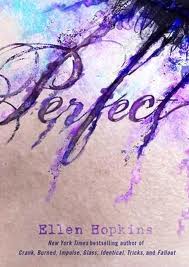
"Perfect" by Ellen Hopkins

**Spoilers!**

Perfect, by Ellen Hopkins, is the story of four high school students struggling with colleges, love, their futures, and what perfect really means.


This was the first book to get me to cry. Ever. I'm so serious. As an ode to how important this fact is, I read The Five People You Meet in Heaven, and The Faults in Our Stars, both of which I like to think of as a downright sad books, and did not cry during those. 

This book was amazing. When I first read the blurb, I thought it was going to be cheesy. But it was so intense and saddening and an amazing mix of poetry and narrative. The stories were so believable it hurt. You could feel all the raw emotion. Hopkins does some of the most amazing things I've ever seen with literature. I loved Crank, probably one of Hopkin's most famous books, but I think this book should be just up there with it.

The ending is what really did me in. It's so impossibly unhappy, but so terribly hopeful. Andre is ready to face his family, but Jenna is raped. Sean's life is permanently messed up and he's borderline crazy thanks to obsession and steroids, Conner dies, but Cara find her true self and finally finds love with Dani. 

Kendra is torn and anorexic (and seems to stay that way), but has seen inside her family and admitted her feelings fully for maybe the first time.

It's the mix of jealousy, desire, love, hate, lust, anger, violence, sadness and maliciousness that make this book such a deliciously dark read, and reel you in. The characters seem to each represent something perfect people want in their lives, each one twisting this image painfully, making you realize how fast cracks can form from perfection. Each character gives you a different approach on perfect in people's lives.

I hated Sean. He was so self-involved, and childish, and by the end of the book, I was afraid of him, and afraid of what he thought was right in his twisted, broken mind. He's so creepy and insane at the end, it's hard to imagine anyone like that. His motives started off so pure. He was so in love with Cara, you feel sorry for the guy that she didn't try to justify herself to him at all. She just broke it off, then even though he was hung up over her and one of her best friends (as she mentions in the first part of the book), she doesn't try to explain anything

Cara was near the most relaxed character. Most of the story, she was just crazy in love, and handling it, or thinking about her older brother. I thought that her realizing she was lesbian was a little too fast (like when they're skiing she just automatically says 'Maybe' she's lesbian when Danielle asks? There is no hint of that she is before that. I think it's amazing that she found what she really wanted, but it was kind of forced, especially if it was her first time with a girl. I think she would have been a little more nervous. Though I also didn't read the first book, which could have exposition to this fact in it), but her sadness at the end of the book was just so real. Her crying, "Mommy" and, "Daddy" when Conner died, even though she hated them most of the time and resented them? It was so raw.

Kendra was in so much denial. I wanted an emotional breach. It was almost hard to get attached to her. Her problem was so much more than her eating disorder. She reminded me of a mild Sean, because she only thought of Conner. She used him to justify her own madness.

Andre was also fairly mild compared to everyone else. He should be himself. I think that his relationship with Jenna really made him interesting. He adored and loved her unconditionally. But she was too childish, and too scarred by her parents to reciprocate. It's almost a relief when you see she realizes this. And when she gets raped right after Andre breaks it off with her, it's so sad. 

THE BOOK IS SAD.


But...
This book is one of my all time favorite, and always will be.

Sunday, March 10, 2013

"Evermore" by Alyson Noel

**Spoilers!**

Evermore by Alyson Noel is the story of Ever Bloom, a fairly normal teen, except she can see people's auras, see the dead, and mind read by touch. When Damen transfers to her high school, she is immediately drawn to him, and his terrible secrets.


This book is tired out and predictable. It's the same as Fallen, Twilight, and many other YA fantasy-hottie books that are today. Though, truthfully, this was printed in 2009, as were those other two books, but still, the point stands. If you're ever seen Twilight or read it, the book is boring from the first page. At least Twilight made an impact by being the first really big YA/romance/teenager/angst/fantasy/supernatural book to come out, though, admittedly, Twilight wasn't even remarkably good.

Ever, as many other of the main characters in these types of books, is sullen and a loner, but beautiful, conveniently, and so hot that only if she reached out she could be happy! But sadly, she doesn't, and neither does she try to fix herself. She only has to await the rescuing arms of some hottie (Damen) to do what you would never have thought to do: Actually try to fix your own problems to make you happy, instead of being anti-social and sullen. The things that annoy me the most about books like these is that they make women look like anxious wrecks who need men to come in and save them whenever pretty much anything happens. No girl that I have ever met has not been able to handle at least some of their problems on their own. An all these girls have amazing powers, like reading minds, or talking to the dead, or being vampire proof, or something else that makes them, possibly, the most valuable person in-book universe.

Back to the book...

Take these unmotivated, flailing female character aforementioned, then add some incredibly random BS myths, weirdo, unbelievably unmotivated antagonists, gullible characters, very vague descriptions about pasts of many peoples, and voila, you have a whole book that's extremely repetitive and washed-out.

Why does Noel have to add the random thing with Drina at the end? I hated that part. It was like she needed Drina to blurt out all the exposition she couldn't explain through the narration or through character dialogue, plot points, hints, or anything. And really? Drina pushed the deer in front of her family's car? Why? It's so random. Why doesn't Drina just sneak into her room in the middle of the night and slit her throat, like a normal murderer would? There is also no explanation to why Drina is so obsessed with Damen. He saved her, and they were married. But divorced people find others! They move along? Why does Noel drop the hint of alchemy being involved in Damen being an immortal, but then veers off and doesn't explain jack-squat? So much pointlessness!

Also, really? I don't get in these books how quickly people believe all the stuff their boyfriends tell them.

The book:

''I'm... An Immortal!''

''OMG NO WAY YOU'RE CRAZY''

''Nooo!!!!''

''Back to normal life!... wait oh no I'm being attacked!''

''Here I come to save the day!''

'Thank you! So what's up with you?''

''Oh, I've just been following you around for the past six hundred years because you're so hot... and I've never gotten in your pants, which I keep mentioning and you don't get creeped out at all about!''

''Oh, it's true! I knew it! I'm not skeptical, or need any more clarification! Let's go be together! Also I'm still underage! And you're six-hundred!''

That's basically all you need to know about Evermore.

Why do even bother reading these books anymore.

HOW WAS THIS A BEST SELLER? Thank god for people like John Green. Can we please have more books like Looking for Alaska, or Paper Towns on the best seller lists?

Sunday, February 24, 2013

"Scarlet" by Marissa Meyer

**Spoilers!**

In the book, Scarlet, by Marissa Meyer, she continues to expand the story and world she set in Cinder, the first book in the Lunar Chronicles. Scarlet focuses on a retelling of the "Little Red Riding Hood" fairytale, introducing Scarlet Benoit, a young woman whose grandmother has mysteriously disappeared. Soon, Scarlet realizes that this mystery is much larger than just her grandmother, and enfolds years of agression and tension built up between Earth and the Lunars, as well as the one person who could stop the threat of war. The missing Lunar, Princess Selene.

I finally read it! Yeah me!

So this book has been sitting on my Nook for weeks, and last week, I finally started to read it. I was so excited, and the book lived up to my expectations greatly.

As I mentioned in the first Lunar Chronicles book, the books are futuristic retellings of some of the most familiar fairytales, Cinderella, Little Red Riding Hood, Rapunzel, and Snow White. One of my favorite part of these books so far is the imaginative setting revamp. The world of the five nations in future-Earth is so vivid and well planned out. The prejudices, actions and thoughts of them as a society have been really thought out and still resonated clearly in Scarlet, which was interesting. I thought maybe because it was a whole different country, and each country was so large, the cultures would vary largely country to country.

One thing I did want to learn a little more about was France, specifically, in the book. We learned a lot about New Beijing in the first book, and had vivid imagery to go along with the new culture we learned about. Though this book was still descriptive, I wanted to learn more about Paris, farmland area France, and customs of the French in this universe.

Another thing I wanted to see, though less of, is the Wolf-Scarlet romance. I enjoy the relationship, and it was fun to see grow, and I have nothing against it, it was a little cheesy to see the last couple scenes with them and even the middle of the book. They barely know each other, but almost seem ready to get married. I get that the Prince Kai-Cinder relationship couldn't continue as a key plot point, but it kind of set the mood of the story. This is a series about girls not obsessed with love, ready to do what is important overall first. Scarlet is a strong character, but how fast she changes from not trusting Wolf, at all, to being head-over-heels for him, seems completely out of the character established at the beginning of the book. The Wolf and Scarlet relationship made this feel a little bit like Twilight. Oh no!

Overall, I still loved the book, and would recommend it to fans of the Hunger Games, fairytales, and sci-fi. Please, if you find this interesting, read the first book first. It won't make much sense otherwise!

Wednesday, February 13, 2013

"Breathing Underwater" by Alex Flinn

**Spoilers!**


Breathing Underwater is the story of Nick, a seemingly perfect and popular high school student who is charged with a restraining order on his ex-girlfriend, Caitlin. But why? Nick doesn't think he did anything wrong. He just taught her a lesson. The book chronicles his journey to his anger management classes that will "help him", and overall just his journey to redemption.

I enjoyed this book a lot. My favorite moments were the letters, and seeing how bad the abuse got in the relationship. I couldn't really imagine anyone besides some alcoholic father (like Nick's dad) abusing anyone, but this really shows me that abuse can happen for lots of reasons, and isn't always the reasons we think. I also was surprised about the relationship itself, and gave me an insight to an abusive relationship. The book showed me a lot about the kind of people who get caught in relationships like this, people like Caitlin who don't think they're good enough because of someone (Caitlin's mom), who think the person will be their only hope at a relationship. Also it was interesting that Nick didn't think he was being that harsh, or that we was wrong. It made me really worried for others who are in situations like this, and how they might not even know what they're doing is wrong.

Also is made me sad that Caitlin's or Nick's friends didn't try to help Caitlin when they saw something wrong about the relationship. I think if I ever saw a friend in trouble I would have to tell them, even if it meant losing a friendship. 

Overall, this book was really interesting and emotional to read, and I enjoyed it. The movement to Nick's "redemption" was well written, as Alex Flinn is awesome. Read it!

Saturday, February 9, 2013

"After" by Amy Efaw

**Spoilers!**

After, by Amy Efaw, tells the story of Devon. Devon has always been the "good girl". Straight A's. Master goalie on the soccer field. Quiet and well-behaved, even with her slightly obnoxious and childish mother who goes through men just a little bit too fast. But when a new-born baby is found in a trash can behind Devon's house, left to die, and Devon is the one to blame, her life will change forever. But how could Devon herself have not known about the baby as she claims? When she was pregnant, gaining weight and throwing up? 


This was actually a really good book. I heard some bad reviews about it and wanted to see if it was as terrible as people were saying. Though really the only thing that bothered me was that Amy Efaw used too many soccer references in it. I'm kind of laughing at that now, because that's a very silly thing to think of a book. But I guess it was very soccer oriented? I did think Devon, as a character was a little useless at times, and some of her motivations were confusing me. But I know very little on the subject of the book, pregnancy and rejecting your child after birth, so I may not have the full picture.

I thought this was a really intriguing book about how far humans will go to keep their personal image. I hated Devon at the beginning. It seemed so obvious that she was pregnant, and all the things that were put up against her as evidence, mostly the details in the flashbacks, shows that she did know that it was likely she was pregnant. She even seemed to hide it from other people actively, which means that she did know! I understand that denial over traumatic events can occur, but it seemed so obvious that she knew that she was with child, and that she could have done something about it.


One of the reasons this book ended up being really satisfying for me is that at the end, Devon does realize all of the things I said above. She knows that even if she was denying it to herself, at some level she knew she was pregnant. She knew what she was subconsciously trying to do when wearing baggy clothes, or what she realized when she had cramps from sit-ups. That she knew that she had to pay and do something about almost killing her child was what really showed that Devon was still Devon. She knew she wanted the baby gone when she gave birth. She knew she was trying to make it go away by hurting the baby. If I tried to do get rid of a child in secret, I wouldn't be able to get it off my mind- that I tried to kill something as precious as a baby, but I didn't pay any consequences.


As I said before as well, I didn't like that there were so many random soccer references in the book. I get that soccer was important to Devon as a character, but would someone realistically think that everything was like soccer? I got all the little anecdotes about hard games and practicing and tough foul shots, but it kind of took me out of a story that was really about what humans can and will do and denial, and made me think it was one of those children's shorter chapter books all about some kid and his baseball team, and the conflict is all about how some other guy on another team cheat and he has to prove it or something. It just felt wrong. It was a weird tonal change in the book. I expect that from sports books, but do even professional soccer players always think in soccer metaphors, similes and analogies?

Saturday, January 26, 2013

"Girl in Translation" by Jean Kwok

**Spoilers!!! (MASSIVE SPOILERS!)**

Girl in Translation is the story of Kimberly Chang, a Chinese immigrant from Hong Kong, who travels to New York City with her mother in hopes of a better life. The story follows Kimberly and her mother as they struggle to survive with almost no money and very little opportunity. I really enjoyed this book. I thought it was an interesting and very readable story of a modern immigrant. The characters were interesting to read, and the culture and topic was interesting to learn about.

One thing I really liked was how Kimberly and Mrs. Chang's culture influenced their decisions. They could have had a much better situation, perhaps as soon as they moved to America, if Mrs. Chang had not felt "in debt" to her sister. Most people in America would think this is strange. Why would you stick around someone who is so obviously not caring about you? Who intentionally hurts your progress towards a better life? But that's the thing about this book, you have to take into account the other culture that is a giant theme and powerful force in the book. I really liked learning about Chinese family dynamic and culture, but thought it wasn't too forced upon the reader. It just let the reader see the logic in the characters minds, and maybe even learn a little like I did.

I usually am not satisfied by endings in stories. However, I was pleased with the ending here. It wasn't shocking or amazing, but it was sweet and short. I really like how the author used the prologue to make is seem as though Kimberly would keep her and Matt's baby that she was pregnant with, and live with Matt. The small twist that she was not living with Matt, but still had the baby at the end of the story as an adult, was also nice.

That's another thing about the book that I like. The author keeps you guessing and reading the entire book. There wasn't one slow part of the book. Kwok had amazing pacing, glazing over whole months to years at a time, but then knowing just when to return to the story. Kwok also knows how to write these sequences, making sure it isn't unsatisfying to be reading something like, "The winter passed quickly...", and just giving enough description so you still know what's happening. It makes the story much more realistic, and easier to follow.

Kwok also sends you a message of you can do what you put your mind to. This book, at it's core, is a classic rags to riches story. She also shows that you can be in tough situations, like poverty, pregnancy, and even sweat shop or other excessive working, and you can still do what you want in school or out of it, and accomplish your goals if you try hard enough. I recommend this book to those who like historical fiction, and just a good realistic fiction story as well.


Sunday, January 6, 2013

"What's Left of Me" by Kat Zhang

**Slight Spoilers!**

What's Left of Me, by Kat Zhang, describes a world where humans are born with two souls, and the country America, now containing both South and North America, has been all but cut off from the rest of the world. These two-souled humans, called "hybrids" are seen as dangers to society, outcasts, and illegal in the U.S. The book follows Addie, who's know a freshman in high school. Her sister soul, Eva, had trouble"settling", or receding so Addie could live as one person. But Addie holds a deep secret- Eva never settled. She still lives deep inside Addie, paralyzed, as she watches the world through their eyes.

I liked this book, I guess. It was an interesting enough idea to base a book off of, and I enjoyed to read it, but I just felt like the plot was recycled, the characters didn't really make realistic choices, and there were some holes in the lore and history of the world.

The first two reasons I didn't exactly love this book go hand in hand. The plot was so predictable. There were little insignificant plot twists everywhere, but I felt like nothing really made me want to re-read a chapter or something. This was partly because of the predictability of the characters. For instance, it would have been far more interesting if Addie/Eva (how I will refer to them from now on) would have ran after Devon/Ryan told her to. I mean, Addie/Eva knew they were going to be taken away from their family either way, so why be taken to a horrible place where children are said to be institutionalized? Who knows. I'm not exactly going to say the character was a Mary-Sue, but it was a little clear that Eva represented a more adventurous side, possibly what the author wanted to be, and Addie represented who the author thought she was. This was also the author's first book, which further enforces my idea.

Also, possibly because this was her book, the author skimped on much background information that would have made the story clearer. One thing, why is the government against hybrids? It's very loosely explained. "Oh, other countries have them, and we don't like other countries!" "People can sometimes go insane from them!" (which ended up not even being true). It just confused me. I guess we can assume that people in this world were just afraid of what they didn't know, but that would also just make the whole scenario a lot more boring. Possibly a more substantial explanation would be revealed later in the series, as I assume it will be.

Overall, I enjoyed the book, but it didn't impress me. I will try to read the rest of the series, just to finish the story, but it wouldn't be on my top ten list of best books this year or anything.

Tuesday, December 11, 2012

"Out of Sight, Out of Time" by Ally Carter

**Spoilers!!**

Out of Sight, Out of Time, by Ally Carter, is the fifth book in the Gallagher Girls book series. In the last book, Cammie made her decision to leave Gallagher Academy, in hopes to find answers to why the secretive Circle of Cavan wants her, and to protect those around her. The book begins with Cammie waking up in a nunnery in the Alps with no memory of her summer, and her whole appearance changed. Cammie has to figure out what she found out over the summer to lead her there, and how to get back to her home and her old self.

Okay, as I said in the last post, GIRLY BOOK! However, though with a jokey premise and general characterizations for each character (the smart one, the tough/sexy one, the invisible one, the fashionable one), these books continue to amaze and impress me.

The best part of this book was Cammie's character development. She goes through the stage that every character in a series, in my opinion, goes through, her break. After years of being comfortable with herself and her position, she continues to leave her "invisible" shell that she started to exit in the last book, and has to reassure herself. The confirmed loss of her father, her memory loss, and the attitude towards her from her friends all shake Cammie really deeply. She has to reestablish herself as a character. Breaks like this happen in the end of the Hunger Games, Twilight, Percy Jackson, Lord of the Rings, and all other strong series that have been very popular. This gives the reader a refreshing take on the character and doesn't bore them with the same thing in every book.

Cammie's development in this book also has to do with identity and finding herself, as the last book did. Her memory loss makes her lose the idea of who she is, mostly because of the things she doesn't know she did. She ends up knowing how to assemble a rifle, having torture scars, and just being a more emotionally fragile person. The affect this has on her friends and her general sanity makes her have to start from scratch again with her personality. The death of her father also makes her reassess her life. She was content with just not knowing where her father was and assuming he was dead, but not wanting to confirm it. The change in her lifestyle made her break further. The affect it had on her sanity and her friends was really intense and interesting to read.

The more mature and dark content of this book also makes me very happy with this series. Percy Jackson, another book made for kids (also published by Disney-Hyperion), starts out very kid-like, but matures as the series and characters do. You think that Carter would have dealt with this sooner, but death is large part of the books, due to the situation with Cam's father, and in spies life. Cammie kills men, loses friends, almost commits suicide (though through hypnotism), loses herself and deals with her dad's death in this book.

Of course, there are  aspects of the series that will be silly and unrealistic, and there will always be. I cannot stress enough that this is a book for tweenage girls. But by far, this book impressed me the most in the series so far. The action and pacing stay AMAZING, and the characters still hold their intensity and snarky-ness, with believable with problems and reactions that you can relate to. Five Stars!


Saturday, December 1, 2012

"Cinder" by Marissa Meyer

**Slight Spoilers!**

Cinder, by Marissa Meyer, is a futuristic sci-fi retelling of the classic fairy tale Cinderella. Cinder is a cyborg mechanic in New Beijing far in the future. Adopted by her current family from Europe when she was eleven, Cinder has been forced to work for her stay since her adoptive father died fromt the fatal disease lemutosis, or the blue fever. Lemutosis has reached epidemic outbreak levels in the Eastern Commonwealth.  Cinder, with her natural affinity for technology, has risen to become the best mechanic in New Beijing, even with her second class citizen position as a cyborg. When the handsome and charming crown prince Kai comes to her shop with an android containing mysterious intel, she begins to learn that not everything is as it seems about her past.

I LOVED this book so much. For one thing, I love spins on stories. Creative retelling is something I like. It adds a new level to the story. I find that it's also just really fun to read and point out the little reference to the story. I also like spin-off books for this reason. Meyer creates a vivid world that I just want to know more about. Even stuff in real life I wouldn't really be interested in I want to know, like details about the history of each country (all 7 of them), where their borders end, their full relationship with the Lunars, and whether they colonized any other planets. I really liked the characters in this book as well. Cinder is strong as a character, but also has normal wishes and wants. Because she's a cyborg, it makes you want to root for her even more.

The book, because mainly of the cyborg issue, deals with discrimination as well. I would think that people who were part-mechanical (cyborg), though they would be strange, would be accepted. Cinder says in the book all cyborgs were basically just the way they were because of a nearly fatal accident. I would think that because they're not using their condition for their personal advancement, no one would have a problem. This is a little like the discrimination after the Civil Rights Act was passed. The African Americans were still treated badly, though now, legally, they could do whatever white people in American could. I guess even in the future, people are afraid of what they don't understand.

Just a note, I love that the author was a Sailor Moon fan fiction writer before she even published this book, which is her first book. I love the subtle Sailor Moon references too... people with "magical" powers who live on the moon... have a lost princess who lives on Earth... it's awesome.

The next books are equally as exciting as this one. Though, since it's a new series, I have to wait for them to come out (which is the problem with reading new series), they're supposed to be about Little Red Riding Hood, Rapunzel, then Snow White. I'm getting pumped just thinking about it...

I can't wait for Scarlet, the next book in the Lunar Chronicles, to come out in February 2013. I already pre-ordered it, but I'm dying without knowing what happens. I have literally read the first chapter preview twenty times. I recommend this to fans of Wither, Hunger Games, and other futuristic books that follow that pattern... except this one has better characters and background.

Thursday, November 15, 2012

"The Fox Inhertitance" by Mary E. Pearson

**Spoilers!!**

Today I finished The Fox Inheritance, by Mary E. Pearson, a sequel to The Adoration of Jenna Fox. The book is set 260 years in the future from where The Adoration of Jenna Fox was set. This was one of the factors that originally made me intrigued by the book. The new book came with a new panel of characters, and a new setting set even further in the future than the original. Sadly, I was really only disappointed by the book. I liked that the book did use new characters, and those who had experienced all of what Jenna Fox hadn't. It was almost a, "What if..." story. I did like the new setting and words and  whole new culture introduced. It made it more interesting to read the book.
The setting also was one of the down falls however. I don't really know how far in the future the original book was set, but they clearly didn't have any of the Bots, Non-pacts, cloning or the Network that they have in the first book. Pearson just kind of glides over this, and thought it's explained to Locke, you stay guessing (in a bad way) a lot of the time because of the generality of all the descriptions.
The story was really predictable. That was one of the things that I loved about The Adoration of Jenna Fox, it was new and fresh and dealt with issues in a new way. This book, while still dealing with issues like survivors guilt, teenage angst, and biotechnology, puts a lot of this stuff to the side, and when the author does bring this up, it's the same note that Locke hits over and over again. The plot was really easy to figure out. I kept guessing with Jenna Fox, and it had an air of mystery around it. With The Fox Inheritance, I pretty much knew from the beginning: Kara is now crazy, Locke is in love with Jenna, and Kara will end up killing herself. Whilst speaking of the death scene, I can't begin to tell you how painfully shallow it was. It was basically Kara saying the same things we had already figured out, and then pulling Dr. Gatsbro off a cliff. I mean, it was sad, but Locke barely reacted, and they all went on with their lives like nothing happened.

I found myself almost skipping through pages in the "epic traveling adventure" part of the book, where Locke is trying to get from Boston to California. It's just not epic, action or emotion packed enough to be added in as an "epic traveling adventure" sequence.

The characters felt so transparent to what they were in the first book. Jenna barely responded to Locke returning, and when she did, it was only one huge blast of crying then it was over. Wouldn't she have more questions? Even if she is extremely old now, and has experience with loss, she would still try to defend herself, wouldn't she?
Overall, it was an okay book, not living up to the first book however. I'll still read the second book, just so I finish off the story line. Speaking of finishing series, I have to get to reading all the "Time Quintet's" spin-offs... Arm of the Starfish, House of Lotus, Meet the Austins... etc.

Wednesday, November 14, 2012

"The Adoration of Jenna Fox" by Mary E. Pearson

**Spoilers! Small Spoiler for the Fox Inheritance**

I just finished The Adoration of Jenna Fox by Mary E Pearson. The book was about how Jenna Fox, a teenage girl who just woke up from a year long coma after a terrible accident, tries to find the mystery surrounding her "old" life, the tense and strange activities of her family, and why exactly so suddenly she moved away from the only life she ever knew. Exactly how much happened to Jenna so she could survive from the critical condition she was in at the hospital?

I loved this book! It was full of mystery, and had a lot of amazing story telling and world building in it too. That's one of my favorite things about books or TV shows, imagining the world the characters live in and trying to establish a whole history for it. The futuristic world Jenna Fox lives in is really interesting too, as Pearson incorporates modern issue now and evolves them, not just making up random issues. She also completely immerses you into the world, not trying to tell readers what happened, but show them, and let them draw their own conclusions.

One thing I didn't like about this book was the ending. Sure, it was a good ending to the story itself, but I feel like that the epilogue was kind of just written off. It's a pet peeve of mine when a story has a non-suspenseful ending, or just a ending that kind of ends on a flat note. It's okay if the ending it happy, but I want it to make sense with the characters. It kind of just skipped to "Now it's 260 years later!!" Maybe if it was longer, or I don't know, less Jenna just talking directly to the reader and talking about how her and Ethan marry, have kids, and her life story, and more her implying all these things as Pearson did so well before, would have made me happier.

I do know that this is a series, and I am already reading the second book, The Fox Inheritance. It hasn't lived up to the first book yet, but I do like Locke as a character, and like Kara as a parallel to Locke. Kind of spoiling the second book, but I'm pretty sure that's in the blurb.

All in all, this was a pretty great book, and recommend it to the fans of books like Hunger Games, Wither, and The Uglies trilogy.

Wednesday, November 7, 2012

"Wintergirls" by Laurie Halse Anderson

**Spoilers!!**

I recently finished Wintergirls by Laurie Halse Anderson. Wintergirls tells the story of Lia, a girl whose best friend recently just died. Lia struggles with dealing with the sudden and strange absence in her life, while having to deal with her own problems.

I thought this book was beautiful, and very poetic. It was a lot like Speak, also by Laurie Halse Anderson, but also completely different. This was almost the complete opposite of Speak in writing style, as Speak was mostly in the future, never looking back, straight forwards. Wintergirls led the reader through Lia's whole mind before we can get to her real problems and guilt. Halse Anderson's style still shines through. In some ways, I enjoyed this book more than Speak, for many reasons.

I thought the word wintergirls by itself was amazing. It wrapped up the book in a tight little ribbon. I was really confused about the title at first, but pretty soon I understood way too well.

This book is morbid, and sad, and hopeful, and scary. It broke my heart when Elijah left Lia by herself in the hotel room. He knew what had happened there. He knew she was on the edge of death. He knew she was seeing things, and she lied to him about being "okay." I imagined what it would be like if Lia went with Elijah, because Cassie wouldn't haunt her. I realized that she would probably have gotten better. But Elijah did the right thing. Lia loved her family too much to leave them behind, and she might not have gotten better it she was out on the road, not being able to come to terms with Cassie's death.

Another thing I liked was the strong character voice in the book. In the beginning, Lia shows no remorse. No regret. She wants to be skinny. Halse Anderson doesn't write it from a person free from eating disorders, she writes like she had one. Lia's character never gives herself some slack, or even thinks about stopping while she's at her worst, in the middle of the book.

I really loved this book so much, and recommend it to fans of Speak and 13 Reasons Why. I hope the next book I read lives up to Wintergirls.

Monday, October 22, 2012

"The Awakening" by Kelley Armstrong

The book "The Awakening" by Kelley Armstrong is about a group of young supernaturals that are on the run from the dangerous Edison Group, a group hunting them down for their enhanced supernatural abilities, supposedly potentially dangerous.

I thought this book was a great addition to the series, and a pretty good sequel. I think, though, the each book is missing key points that make a story really unbearable.

The book has great elements, a nice writing style, and very interesting mythology. The characters are unique and not exactly falling into the common mold for the YA-fiction-with-female-lead archetypes, but coming pretty close. I mean, that character type draws people in, so the book is interpreted easily in people who like that kind of book (like myself), and people who like a deeper story and background as well (like myself).

Some things I didn't like about it was that the story was missing climactic moments. I will admit that the story had me following it very closely, excited, but I never had a, "wow" moment. I always felt like either the book should have been longer or added to another book. I guess that author knew that this was a series when she wrote it.

Books like this aren't necessarily a bad thing, but are worse in my opinion when the books are made so to impress the publisher or reader, so they demand a second, third or fourth. This isn't always the case obviously, but it feels like it sometimes.

The books also hit many of the same danger moments, or conflicts. Sure, there's character development and internal conflicts, but between this book and the first, no major changes were made. Even the physical conflicts were the same, being chased. It's the main conflict, but no really new additions were made besides discoveries in the background, which was interesting.

I'm in the midst of reading the third book now, and it's almost the same deal. I love it, and really hope to see how the two series intertwine in the third book of the Darkness Rising series. I also am hopefully anticipating a mash-up of the two in the future... very excited. :)

Sunday, October 14, 2012

"Perks of Being a Wallflower" by Stephen Chbosky

I recently read Perks of Being a Wallflower, by Stephen Chbosky, a book about an anonymous boy, dubbed "Charlie" in the letters he sends to a friends friends. The story tells of the boys first year in high school.

I thought this was a great book. I loved the realistic tone and style of the authors writing, which for a professional author, must have been kind of frustrating to not include commas, not very vivid words or using run on sentences. It made the book so much more realistic when the boy is struggling with things that all teens are learning at his age. I think that's one of the things that made the book so popular, how relatable it was.

One other thing that I think made the book relatable, as well as awesome, is the main character, Charlie. He's pretty much a normal kid who has gone through some awful things, but he gets over them for the most part with help from his friends and trying to fix himself. It's really the combined elements of the story that make it great. The tragedy of dealing with a traumatic event, and begin a loner at school. So many kids are all alone like Charlie was, with no friends for some reason or another. The book teaches that you can pull out of tough situations if you really try and have people who support you along the way. All those kids who feel really lonely should know that there is always someone there who cares about you.

Recent events, like the Amanda Todd suicide makes me doubt how far the kindness of people could go, however. Amanda made one mistake and was haunted by it her whole life. I think that though Charlie's situation is different in cause, the main difference is that everyone judged Amanda Todd, yet Charlie had people to support him.

It delivers a message to kids having a hard time out there, and gives them hope, even if their situation isn't as bad as Charlie's, or even worse. The anonymity of Charlie's character (his common name) also kind of lets the reader put them into Charlie's shoes.

Other things that were interesting in the book was Charlie's constant crying. This sometimes made me feel pushed back and alienated from the story, but it speaks to kids who do things that are awkward, and don't know why.

One thing I noticed in the movie is that they took away some of Charlie's idiosyncrasies, probably to make him less "weird", and so the characters will be more appealing to the general audience to make money, which still makes it a good story, but also saddens me slightly that they're taking away from the beautiful story.

Overall, this was a great and book, and I recommend it to anyone looking for a good and touching book. It's a difficult book to read, sometimes even estranging, but it's totally worth it. The movie was good too, so I definitely recommend that to anyone who wants to view a good movie that's out now.