Showing posts with label conflict. Show all posts

Sunday, June 16, 2013

"The Faults in Our Stars" by John Green

The Faults in Our Stars, by John Green, is a book following Hazel Grace Lancaster, a 16-year-old cancer survivor who meets the charming, witty and dashingly handsome Augustus Waters at her cancer support group. This book, which I have previously read, is consistently one of my favorite books of all time, refreshed in my mind as being a wonderful, powerful, charming, emotional book every time I read it. I read this book for book clubs, and one of the questions my club had before we started reading was, "What keeps the character motivated?" I thought this question was really important to the plot of the The Faults in Our Stars. Many of the characters are driven by each other, and mutual want of respect and love, in this book.

For instance, Hazel is driven by Gus to do more with her life. Hazel has a fine life before she met Gus, but Gus helped her live more. Augustus introduces the idea to her that she can go to Amsterdam to visit their favorite author, Van Houten, the author of An Imperial Affliction, a fictional book in the world of TFiOS. Gus introduces a new, exciting sort of energy into Hazel's life, someone who has been living for so long prepared to die, and energy that makes her want to live. I think this is also cause for Hazel not wanting to get too close to Gus, as she thinks that she'll just break his heart by dying, and that their time together, the new energy he brought to her life, will just go to waste. However, overall in the book, I think Gus motivates Hazel to do more with her life than she could have imagined to do otherwise.

The parents in this book are also driven by love for their children. The parents of these teenagers with cancer want to make their kid's live as good as possible, and they help them in so many amazing ways. Hazel's mom, for instance, almost organizes all of the trip to Amsterdam to make her daughter happy. Knowing that her daughter may die at any time also motivates Hazel's mother to take good care of Hazel, and try hard to make her daughter's life better. She wants her to go to cancer support groups to help Hazel with any problems she's having, she supports Hazel in her relationship with Gus, a near stranger, and goes to Amsterdam with Hazel just so Hazel can meet one of her favorite authors.

I think that in this book, the characters are also motivated by their wanting to have made an impact on people's lives. They want to be remembered, as all humans do. So many of the characters in this book are given such short strings on life, because of cancer, they want to make sure they are remembered for something other than cancer. Hazel and Gus often talking about philosophy, I think, is an ode to this, as they want to discover something more about the world. They want to know that they weren't just defined by their cancer, but by something else, something important, something that changed people. Gus, especially, has this want, as he comes into people's lives, such as Isaac, or Hazel, and just tries his best to make them better. As Gus says, "The marks humans leaves are too often scars." Gus doesn't just want to be a 'grenade' that left scars in people lives. He wants people to live as much as he wants to live, and he wants people to know that he wanted them to live. I think in the end, everyone wants that, but as people who were told from the beginning, "You will most likely die", to have that terrible weight on your chest most of your life, they want to know that people remember them not just as, "The girl with cancer."

This book tackles with so many issues, so many, deep, basic human wants and emotions, it's really hard to talk about only one of them. I'm sure I could write hundreds of essays on the different themes in The Faults in Our Stars. The characters in this book are one of my favorite parts of it, which is one of the reasons I chose to respond this question. They're so strong, so inspiring, and so lovin
g. Each one of them made whoever they touched a better person. They're each are so motivated to help others, and to help each other. The book deals with mortality and sacrifice and so many more issues in a relatable, unique, funny, heartbreaking way. The characters in this book are almost doomed from the moment we meet them. These characters, however, these amazing, strong characters, are able to do so much more good in the world. They're not just angry (Though they are a little angry,), they're curious, intellectual, understanding, and compassionate. None of them ever gave up, and I think that's pretty great.

Tuesday, May 7, 2013

"Red Glove" by Holly Black (Curse Workers Series #2)

**Spoilers!**

In this continuation of the Curse Workers series by Holly Black, and follows Cassel struggle with not only trying to maintain is normal life at school in this last couple years, but dealing with the discovery of his new Transformative powers. Things get more difficult when Lila joins his school, making it even harder to separate his lives, as well as his confusing feelings for Lila. But a new mystery emerges when Cassel learns that his brother, Phillip, has been murdered, and all they know about the killer is that she's  a woman. A woman with Red Gloves.

I really liked this book as a continuation of the series. The book at many strong points that helped elaborate on the world of the story and the characters, their relationships.

Cassel and his mother's relationship is definitely developed, especially during the exchanges during Phillip's funeral and toward the beginning of the book when Cassel discovers his mother has curse-worked Lila into 'loving' him. Cassel's mother is seemingly trying to help, but at this same time, knowingly not helping Cassel much at all in the long run. Lila's feelings, being produced by emotion working, will fade, so no matter how much Cassel's mother wants or thinks she is helping, she must know this will happen. The mother's character itself is very fickle and irresponsible. I also find it interesting her interactions with the other family, like Barron, and family friends, during many of the scenes involving Phillip's death. She seems obviously melodramatic, but it's clear she does love her children, and almost as though she just doesn't know how to get that message across.

I want to know about why the mother is like this. Maybe she felt bad about attaching to her children while she was bringing them up in such an unstable and corrupted environment, or maybe because of this environment she never had the time to learn how to communicate with her children.

I'm already started with the next book, Black Heart, but I'm very excited to see where this story goes!

Sunday, March 31, 2013

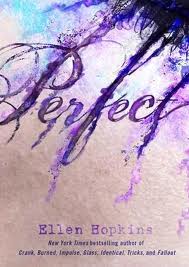
"Perfect" by Ellen Hopkins

**Spoilers!**

Perfect, by Ellen Hopkins, is the story of four high school students struggling with colleges, love, their futures, and what perfect really means.


This was the first book to get me to cry. Ever. I'm so serious. As an ode to how important this fact is, I read The Five People You Meet in Heaven, and The Faults in Our Stars, both of which I like to think of as a downright sad books, and did not cry during those. 

This book was amazing. When I first read the blurb, I thought it was going to be cheesy. But it was so intense and saddening and an amazing mix of poetry and narrative. The stories were so believable it hurt. You could feel all the raw emotion. Hopkins does some of the most amazing things I've ever seen with literature. I loved Crank, probably one of Hopkin's most famous books, but I think this book should be just up there with it.

The ending is what really did me in. It's so impossibly unhappy, but so terribly hopeful. Andre is ready to face his family, but Jenna is raped. Sean's life is permanently messed up and he's borderline crazy thanks to obsession and steroids, Conner dies, but Cara find her true self and finally finds love with Dani. 

Kendra is torn and anorexic (and seems to stay that way), but has seen inside her family and admitted her feelings fully for maybe the first time.

It's the mix of jealousy, desire, love, hate, lust, anger, violence, sadness and maliciousness that make this book such a deliciously dark read, and reel you in. The characters seem to each represent something perfect people want in their lives, each one twisting this image painfully, making you realize how fast cracks can form from perfection. Each character gives you a different approach on perfect in people's lives.

I hated Sean. He was so self-involved, and childish, and by the end of the book, I was afraid of him, and afraid of what he thought was right in his twisted, broken mind. He's so creepy and insane at the end, it's hard to imagine anyone like that. His motives started off so pure. He was so in love with Cara, you feel sorry for the guy that she didn't try to justify herself to him at all. She just broke it off, then even though he was hung up over her and one of her best friends (as she mentions in the first part of the book), she doesn't try to explain anything

Cara was near the most relaxed character. Most of the story, she was just crazy in love, and handling it, or thinking about her older brother. I thought that her realizing she was lesbian was a little too fast (like when they're skiing she just automatically says 'Maybe' she's lesbian when Danielle asks? There is no hint of that she is before that. I think it's amazing that she found what she really wanted, but it was kind of forced, especially if it was her first time with a girl. I think she would have been a little more nervous. Though I also didn't read the first book, which could have exposition to this fact in it), but her sadness at the end of the book was just so real. Her crying, "Mommy" and, "Daddy" when Conner died, even though she hated them most of the time and resented them? It was so raw.

Kendra was in so much denial. I wanted an emotional breach. It was almost hard to get attached to her. Her problem was so much more than her eating disorder. She reminded me of a mild Sean, because she only thought of Conner. She used him to justify her own madness.

Andre was also fairly mild compared to everyone else. He should be himself. I think that his relationship with Jenna really made him interesting. He adored and loved her unconditionally. But she was too childish, and too scarred by her parents to reciprocate. It's almost a relief when you see she realizes this. And when she gets raped right after Andre breaks it off with her, it's so sad. 

THE BOOK IS SAD.


But...
This book is one of my all time favorite, and always will be.

Thursday, March 21, 2013

Update: "After Ever After" by Jordan Sonnenblick

**Spoilers!**

The book, After Ever After, by Jordan Sonnenblick is the sequel to Drums, Girls, and Dangerous Pie, following Jeffrey Alper, after his cancer went into remission, now in his eighth grade year, dealing with many of the same problems Steven Alper, his older brother, did in his eighth grade year in, Drums, Girls...

I really like this book so far. It reminds me a lot of the original story, and has extremely similar tones, probably due to that they're written by the same person, Jordan Sonnenblick. That's a pretty obvious explanation. But I like that Sonnenblick brings out new characters, and though in this story, as the last one, there's still the main boy character, his love interest, and the best friend.

One thing I would like to explore is the best friend in this story, Jeffrey's best friend, Thaddeus, or Tad. Tad is a really antisocial person, often really downright mean to people. He was even snide to Jeffrey when they first met, and to the girl he likes.

I believe that this is Tad's attitude at the beginning of the story, pretty much almost up to the point I'm at now in the book, because he was afraid to get close to people, and he wasn't sure even how long he would live to see them become friends.

Tad's cancer made him feel weak, and it made him afraid he wasn't going to live. This obviously made him look down on the world, probably seeing their problems as more insignificant than his, which explains his cynicism and sarcasm towards many in the book currently.

But I believe also that besides Tad's weakness bringing out this trait, it also made him question how much he wanted to do in his life, or if there was any point to it. He gave up trying to walk, and he was just complacent with the life he had. He knew that he had his best friend to get by with, so he didn't think he needed to go out of his way to be friendly to anyone else. I think that Tad is fully aware that is cancer could return in the story, which it does, so he tries not to get closer to anyone and uses his cynicism as a shield.

This also explains why Tad wants Jeffrey to pass Jeffrey's state tests so much. He wants to make sure that Jeffrey gets to do at least everything Tad does, and make sure that Jeffrey doesn't give up like Tad does. This also shows that Tad is not truly mean, and is actually quite compassionate, spending a lot of his own time working with Jeffrey on math.


Sunday, March 10, 2013

"Evermore" by Alyson Noel

**Spoilers!**

Evermore by Alyson Noel is the story of Ever Bloom, a fairly normal teen, except she can see people's auras, see the dead, and mind read by touch. When Damen transfers to her high school, she is immediately drawn to him, and his terrible secrets.


This book is tired out and predictable. It's the same as Fallen, Twilight, and many other YA fantasy-hottie books that are today. Though, truthfully, this was printed in 2009, as were those other two books, but still, the point stands. If you're ever seen Twilight or read it, the book is boring from the first page. At least Twilight made an impact by being the first really big YA/romance/teenager/angst/fantasy/supernatural book to come out, though, admittedly, Twilight wasn't even remarkably good.

Ever, as many other of the main characters in these types of books, is sullen and a loner, but beautiful, conveniently, and so hot that only if she reached out she could be happy! But sadly, she doesn't, and neither does she try to fix herself. She only has to await the rescuing arms of some hottie (Damen) to do what you would never have thought to do: Actually try to fix your own problems to make you happy, instead of being anti-social and sullen. The things that annoy me the most about books like these is that they make women look like anxious wrecks who need men to come in and save them whenever pretty much anything happens. No girl that I have ever met has not been able to handle at least some of their problems on their own. An all these girls have amazing powers, like reading minds, or talking to the dead, or being vampire proof, or something else that makes them, possibly, the most valuable person in-book universe.

Back to the book...

Take these unmotivated, flailing female character aforementioned, then add some incredibly random BS myths, weirdo, unbelievably unmotivated antagonists, gullible characters, very vague descriptions about pasts of many peoples, and voila, you have a whole book that's extremely repetitive and washed-out.

Why does Noel have to add the random thing with Drina at the end? I hated that part. It was like she needed Drina to blurt out all the exposition she couldn't explain through the narration or through character dialogue, plot points, hints, or anything. And really? Drina pushed the deer in front of her family's car? Why? It's so random. Why doesn't Drina just sneak into her room in the middle of the night and slit her throat, like a normal murderer would? There is also no explanation to why Drina is so obsessed with Damen. He saved her, and they were married. But divorced people find others! They move along? Why does Noel drop the hint of alchemy being involved in Damen being an immortal, but then veers off and doesn't explain jack-squat? So much pointlessness!

Also, really? I don't get in these books how quickly people believe all the stuff their boyfriends tell them.

The book:

''I'm... An Immortal!''

''OMG NO WAY YOU'RE CRAZY''

''Nooo!!!!''

''Back to normal life!... wait oh no I'm being attacked!''

''Here I come to save the day!''

'Thank you! So what's up with you?''

''Oh, I've just been following you around for the past six hundred years because you're so hot... and I've never gotten in your pants, which I keep mentioning and you don't get creeped out at all about!''

''Oh, it's true! I knew it! I'm not skeptical, or need any more clarification! Let's go be together! Also I'm still underage! And you're six-hundred!''

That's basically all you need to know about Evermore.

Why do even bother reading these books anymore.

HOW WAS THIS A BEST SELLER? Thank god for people like John Green. Can we please have more books like Looking for Alaska, or Paper Towns on the best seller lists?

Saturday, February 9, 2013

"After" by Amy Efaw

**Spoilers!**

After, by Amy Efaw, tells the story of Devon. Devon has always been the "good girl". Straight A's. Master goalie on the soccer field. Quiet and well-behaved, even with her slightly obnoxious and childish mother who goes through men just a little bit too fast. But when a new-born baby is found in a trash can behind Devon's house, left to die, and Devon is the one to blame, her life will change forever. But how could Devon herself have not known about the baby as she claims? When she was pregnant, gaining weight and throwing up? 


This was actually a really good book. I heard some bad reviews about it and wanted to see if it was as terrible as people were saying. Though really the only thing that bothered me was that Amy Efaw used too many soccer references in it. I'm kind of laughing at that now, because that's a very silly thing to think of a book. But I guess it was very soccer oriented? I did think Devon, as a character was a little useless at times, and some of her motivations were confusing me. But I know very little on the subject of the book, pregnancy and rejecting your child after birth, so I may not have the full picture.

I thought this was a really intriguing book about how far humans will go to keep their personal image. I hated Devon at the beginning. It seemed so obvious that she was pregnant, and all the things that were put up against her as evidence, mostly the details in the flashbacks, shows that she did know that it was likely she was pregnant. She even seemed to hide it from other people actively, which means that she did know! I understand that denial over traumatic events can occur, but it seemed so obvious that she knew that she was with child, and that she could have done something about it.


One of the reasons this book ended up being really satisfying for me is that at the end, Devon does realize all of the things I said above. She knows that even if she was denying it to herself, at some level she knew she was pregnant. She knew what she was subconsciously trying to do when wearing baggy clothes, or what she realized when she had cramps from sit-ups. That she knew that she had to pay and do something about almost killing her child was what really showed that Devon was still Devon. She knew she wanted the baby gone when she gave birth. She knew she was trying to make it go away by hurting the baby. If I tried to do get rid of a child in secret, I wouldn't be able to get it off my mind- that I tried to kill something as precious as a baby, but I didn't pay any consequences.


As I said before as well, I didn't like that there were so many random soccer references in the book. I get that soccer was important to Devon as a character, but would someone realistically think that everything was like soccer? I got all the little anecdotes about hard games and practicing and tough foul shots, but it kind of took me out of a story that was really about what humans can and will do and denial, and made me think it was one of those children's shorter chapter books all about some kid and his baseball team, and the conflict is all about how some other guy on another team cheat and he has to prove it or something. It just felt wrong. It was a weird tonal change in the book. I expect that from sports books, but do even professional soccer players always think in soccer metaphors, similes and analogies?

Sunday, December 16, 2012

"Anya's Ghost" by Vera Brosgol

**Lots of Spoilers!**

Anya's Ghost, by Vera Brosgol is a graphic novel about a girl named Anya. Anya is ashamed about standing out in her little New England town, which includes hiding her hard to pronounce Russian last name and keeping the secret that she used to have a weird accent in kindergarten before she went to ESL, let alone dieting to keep off her muffin top. When Anya falls down an old well to discover a 98-year old body of a young woman, she's scared, yeah. But what's scarier is that the ghost of this certain corpse, named Emily Reilly, starts following Anya around...

This is the first graphic novel I read this year, and I'm insanely happy with this book. The story and artistic design of the book was awesome and really entertaining to read. It was dark, but not dark enough to give me nightmares. It also had a nice neat message to all us teenage girls in there. I especially connected with Anya.

The book starts off with Anya being really self-conscious, and not a very nice person. She wants to be accepted by the "cool" crowds at school, and does stuff she doesn't want to do, like smoking or dieting so she can work towards that. She is so embarrassed about her family and heritage, which is a giant part of who someone is, that she lies about her last name.

When Emily's character comes in, this pushes Anya to become the person she wants to be, because now she basically knows everything she could hope to. She has her own personal spy. But this also shows Anya the bad side of the "cool" kids. Sure, Anya may not be popular, but she doesn't cheat on her boyfriend like Sean, Anya's crush, did to his girlfriend Elizabeth. Anya has people she can trust. There's a bad side to everything, and you can't want one part of it and not the whole package.
a little preview of the art style :)

This is what makes Emily's character the antagonist in the end (or the past? I don't know). She can't accept that she can't have what she wants, like Anya did after the party at Matt's house, so Emily snapped. She killed her crush and his girlfriend then died, kind of in the spirit of karma. When she tries to live her life through Anya and that doesn't go the way she wanted it to either, she snaps again, and returns to violence as an answer. Only when Anya explains that you have to be happy with what you have and that you can't have everything you want is when Emily realizes all she's done and leaves the Earth.

Elizabeth, queen bee at Anya's high school, almost did the opposite of Emily, she found out Sean's unfaithfulness and that she couldn't get him the way she wanted, but instead of snapping, she bent so she could still "have" Sean and the image that came with him. She sits idly by while Sean hooks up with other girls. Elizabeth bent so far she broke in a different sense.

 I love the illustration too, because it's simple, but descriptive and clear. The color palate is awesome, matches the story perfectly.

Overall, this was a AMAZING book, with an excellent message. You have to be happy with what you have, and make the best of it. I recommend this book to Neil Gaiman and Hellboy fans and anyone (especially girls) who like a good, dark comic book.

Tuesday, December 11, 2012

"Out of Sight, Out of Time" by Ally Carter

**Spoilers!!**

Out of Sight, Out of Time, by Ally Carter, is the fifth book in the Gallagher Girls book series. In the last book, Cammie made her decision to leave Gallagher Academy, in hopes to find answers to why the secretive Circle of Cavan wants her, and to protect those around her. The book begins with Cammie waking up in a nunnery in the Alps with no memory of her summer, and her whole appearance changed. Cammie has to figure out what she found out over the summer to lead her there, and how to get back to her home and her old self.

Okay, as I said in the last post, GIRLY BOOK! However, though with a jokey premise and general characterizations for each character (the smart one, the tough/sexy one, the invisible one, the fashionable one), these books continue to amaze and impress me.

The best part of this book was Cammie's character development. She goes through the stage that every character in a series, in my opinion, goes through, her break. After years of being comfortable with herself and her position, she continues to leave her "invisible" shell that she started to exit in the last book, and has to reassure herself. The confirmed loss of her father, her memory loss, and the attitude towards her from her friends all shake Cammie really deeply. She has to reestablish herself as a character. Breaks like this happen in the end of the Hunger Games, Twilight, Percy Jackson, Lord of the Rings, and all other strong series that have been very popular. This gives the reader a refreshing take on the character and doesn't bore them with the same thing in every book.

Cammie's development in this book also has to do with identity and finding herself, as the last book did. Her memory loss makes her lose the idea of who she is, mostly because of the things she doesn't know she did. She ends up knowing how to assemble a rifle, having torture scars, and just being a more emotionally fragile person. The affect this has on her friends and her general sanity makes her have to start from scratch again with her personality. The death of her father also makes her reassess her life. She was content with just not knowing where her father was and assuming he was dead, but not wanting to confirm it. The change in her lifestyle made her break further. The affect it had on her sanity and her friends was really intense and interesting to read.

The more mature and dark content of this book also makes me very happy with this series. Percy Jackson, another book made for kids (also published by Disney-Hyperion), starts out very kid-like, but matures as the series and characters do. You think that Carter would have dealt with this sooner, but death is large part of the books, due to the situation with Cam's father, and in spies life. Cammie kills men, loses friends, almost commits suicide (though through hypnotism), loses herself and deals with her dad's death in this book.

Of course, there are  aspects of the series that will be silly and unrealistic, and there will always be. I cannot stress enough that this is a book for tweenage girls. But by far, this book impressed me the most in the series so far. The action and pacing stay AMAZING, and the characters still hold their intensity and snarky-ness, with believable with problems and reactions that you can relate to. Five Stars!


Saturday, December 1, 2012

"Cinder" by Marissa Meyer

**Slight Spoilers!**

Cinder, by Marissa Meyer, is a futuristic sci-fi retelling of the classic fairy tale Cinderella. Cinder is a cyborg mechanic in New Beijing far in the future. Adopted by her current family from Europe when she was eleven, Cinder has been forced to work for her stay since her adoptive father died fromt the fatal disease lemutosis, or the blue fever. Lemutosis has reached epidemic outbreak levels in the Eastern Commonwealth.  Cinder, with her natural affinity for technology, has risen to become the best mechanic in New Beijing, even with her second class citizen position as a cyborg. When the handsome and charming crown prince Kai comes to her shop with an android containing mysterious intel, she begins to learn that not everything is as it seems about her past.

I LOVED this book so much. For one thing, I love spins on stories. Creative retelling is something I like. It adds a new level to the story. I find that it's also just really fun to read and point out the little reference to the story. I also like spin-off books for this reason. Meyer creates a vivid world that I just want to know more about. Even stuff in real life I wouldn't really be interested in I want to know, like details about the history of each country (all 7 of them), where their borders end, their full relationship with the Lunars, and whether they colonized any other planets. I really liked the characters in this book as well. Cinder is strong as a character, but also has normal wishes and wants. Because she's a cyborg, it makes you want to root for her even more.

The book, because mainly of the cyborg issue, deals with discrimination as well. I would think that people who were part-mechanical (cyborg), though they would be strange, would be accepted. Cinder says in the book all cyborgs were basically just the way they were because of a nearly fatal accident. I would think that because they're not using their condition for their personal advancement, no one would have a problem. This is a little like the discrimination after the Civil Rights Act was passed. The African Americans were still treated badly, though now, legally, they could do whatever white people in American could. I guess even in the future, people are afraid of what they don't understand.

Just a note, I love that the author was a Sailor Moon fan fiction writer before she even published this book, which is her first book. I love the subtle Sailor Moon references too... people with "magical" powers who live on the moon... have a lost princess who lives on Earth... it's awesome.

The next books are equally as exciting as this one. Though, since it's a new series, I have to wait for them to come out (which is the problem with reading new series), they're supposed to be about Little Red Riding Hood, Rapunzel, then Snow White. I'm getting pumped just thinking about it...

I can't wait for Scarlet, the next book in the Lunar Chronicles, to come out in February 2013. I already pre-ordered it, but I'm dying without knowing what happens. I have literally read the first chapter preview twenty times. I recommend this to fans of Wither, Hunger Games, and other futuristic books that follow that pattern... except this one has better characters and background.

Monday, November 12, 2012

Update: "The Adoration of Jenna Fox" by Mary E. Pearson

**Spoilers!**

I'm currently reading The Adoration of Jenna Fox, by Mary E. Pearson. Unfortunately, I was not correct with my clone theory. It makes me a little sad, but the alternative I guess, though not as much as a plot twist as Jenna being a clone, makes more sense.

I noticed I was partly right though. Jenna's whole body is basically a clone of herself, and her brain and body has been changed to be more perfect, like how someone could change a clone to perfection.

The conflict that this presents to Jenna is really interesting, and I love watching Jenna grow. Though personally, I don't see anything wrong with her, Jenna first found herself disgusting, and can't trust her own body. Finally, when she comes to accept this and when she was in a state where she could just live her life safely and legally from then on, she lets Allys discover her secret. I know, it's not like Jenna told Allys, but she knew she couldn't hide it, and didn't do anything about it. I don't really understand why Jenna did this. I think it was the fact that Jenna knew that she had to move on from the "perfect" world if she wanted to move on with her life. She couldn't live under her mother and father forever, because they would treat her like a piece of fine art, just put her away and admire her. They wouldn't want her to be used in real life.

I also think Allys, though having a point in her argument against significant biological enhancement, is angry about her own situation. Allys believe that it's unfair that some people should have more than she does. She needed more than limbs, but she couldn't get them, and is dying because of it. She doesn't think anyone should have more than what she did. I do agree that one person, like Jenna, shouldn't be enhanced, and that death should be expected almost as much as life. People can't avoid death forever, and Allys knows that. What Jenna's parents did was wrong, sure, but I think if someone's life is in the balance, and you can pretty much restore them to normal by giving them organs they need, you shouldn't need to consider how many "points" they have to do it.

Allys knew she was dying, and I do believe that she believed what she thought, but I think Allys shouldn't have told her parents that Jenna was illegal just to make her life harder, and that her view points were clouded by her anger towards her own disease and the way it was handled.

Wednesday, November 7, 2012

"Wintergirls" by Laurie Halse Anderson

**Spoilers!!**

I recently finished Wintergirls by Laurie Halse Anderson. Wintergirls tells the story of Lia, a girl whose best friend recently just died. Lia struggles with dealing with the sudden and strange absence in her life, while having to deal with her own problems.

I thought this book was beautiful, and very poetic. It was a lot like Speak, also by Laurie Halse Anderson, but also completely different. This was almost the complete opposite of Speak in writing style, as Speak was mostly in the future, never looking back, straight forwards. Wintergirls led the reader through Lia's whole mind before we can get to her real problems and guilt. Halse Anderson's style still shines through. In some ways, I enjoyed this book more than Speak, for many reasons.

I thought the word wintergirls by itself was amazing. It wrapped up the book in a tight little ribbon. I was really confused about the title at first, but pretty soon I understood way too well.

This book is morbid, and sad, and hopeful, and scary. It broke my heart when Elijah left Lia by herself in the hotel room. He knew what had happened there. He knew she was on the edge of death. He knew she was seeing things, and she lied to him about being "okay." I imagined what it would be like if Lia went with Elijah, because Cassie wouldn't haunt her. I realized that she would probably have gotten better. But Elijah did the right thing. Lia loved her family too much to leave them behind, and she might not have gotten better it she was out on the road, not being able to come to terms with Cassie's death.

Another thing I liked was the strong character voice in the book. In the beginning, Lia shows no remorse. No regret. She wants to be skinny. Halse Anderson doesn't write it from a person free from eating disorders, she writes like she had one. Lia's character never gives herself some slack, or even thinks about stopping while she's at her worst, in the middle of the book.

I really loved this book so much, and recommend it to fans of Speak and 13 Reasons Why. I hope the next book I read lives up to Wintergirls.

Thursday, September 27, 2012

"The Rivals" by Daisy Whitney

**Spoilers!

First of all, I just want to say this was an amazing book. Besides the ending, which was fine, I just really wanted to Ms. Merritt, the oblivious and frustrating dean of the school, be forced to kick them out, possibly waking her up as well as all the doubters of the Mockingbirds. I really just like the whole mood of the series in general so far. For a seemingly silly topic (a book about a student vigilante group could have easily turned into a cheesy superhero-esque book), Daisy Whitney handled it really well, even with the introduction of a 'villain' organization. It deals with a lot of fresh and important issues for teens today too, like date-rape and academic drugs.

One thing I thought was really great in this book was it's conflict. The conflict tested the main character, Alex. She was a victim in her own case, so she immediately tried to help any other "victims", like Beat (who ended up being a terrible person), or Delaney, and later Theo. But then the supposed criminal was just like her- Theo was an aspiring artist- He loved dancing more than his life. It was his life. Alex could relate to this, as she loved piano. This made it harder for her to believe the terrible things being accused of him. This drove her to make silly mistakes- like not convicting her friend Maia, when she was suspected. I mean, I feel bad about saying this, as Maia was framed, but still, Alex was worrying about being respected as leader, right? She kept making stupid mistakes, and didn't function as a court should, even if it's just a really screwed up private boarding school. Thought this did all lead up to the right perpetrator, she still should have tried to be more professional if she wanted to be taken seriously.

That's one of the few things that annoyed me about the book. Alex messes up multiple times, but it all ends up well, with basically no consequences, and none of the characters care about it. The book is all about justice, but not much justice is done to right the wrongs that Alex did. Everything is just ending up dandy. The whole book is about how if adults were basically taken out of a kids world, how would they function? Even with adults in control of punishment, there is never a perfect ending. It's a disappointing change in a very harsh and realistic book that the book has a fairy-tale ending.

Of course, that is another thing that made the book more realistic, all the mistakes that the main character makes. It makes you relate more to the characters, and feel for them.

And on the note of themes (kind of), I want to talk about a theme in the book. The book really, I think, shows well what kids would do if they didn't have adults to control them. There would be the ones who just cause havoc, and bully, and cheat because they can get away with it. Then there were those that would rise up and try to fight. I kind of noticed this in the Hunger Games, but in a different way. When they didn't have a fit government, the people of Panem rose to the occasion, or specifically one entity/thing did (Distric 13/the separate districts), just like Alex's sister did when she created the Mockingbirds.

Overall, I thought this book was great, and I'm really excited to see if there's another one! (Though I doubt it.)

Thursday, September 20, 2012

Update: "The Rivals", by Daisy Whitney

Right now I'm reading The Rivals, by Daisy Whitney, sequel to, The Mockingbirds. It's a great book, and I really love how Daisy Whitney stays strong with the events from the first book to the second.

**Slight spoilers
For one thing, the conflict in Alex's heart is so realistic, and painful to watch her go through. Just seeing her have the images and memories of Carter flash through the head of Alex whenever she's with Martin  is really hard, even for a reader with no experience in this issue. Alex's inner conflict of proving herself carries on to the second book with the same fears and basis, but a totally different goal, which is amazing. I really dislike it in books when former conflicts or problems that the character had are kind of throw out. For instance, the thing that drove Alex to prove herself in the first book was that she didn't want to be called a 'whore', or a 'slut' when she was date-raped. It still affected her when people didn't believe her, but she wanted to clear her name and serve justice to Carter for what he did. In the second book, so far, Alex wants to prove to her fellow Mockingbirds that though she was appointed because she was a former victim who worked with the Mockingbirds, she could hold her own as a leader because she had that experience, and can deal with others who feel victimized. Not just to people who doubt her (Parker), but to the people she knows she can trust as well (Martin, Amy).

The 'case' itself in the second book is very interesting because though Alex still wants to help, the case has no clear victim(s). Frankly, I think there was no better way of doing a sequel, because it would have been, though probably interesting, no where near as interesting as Alex's conflict now. She tries to investigate, but so far, she's continually frustrated because she's only relying on her previous feelings about her case with Carter. She's not taking in the whole picture, and being a little stupid sometimes because she trusts too much in the people who she thinks are victimized.

That's another thing I like about this book so far. Alex is wrong. I really don't like it when characters just guess everything right, or are wrong for stupid reasons, and refuse to believe anything else. Alex knows she's wrong, but she can't help it, like with her frustration with Parker accusing Maia. She let her personal attachment clear her judgement, making it easier to relate to her. It was kinda of frustrating for me seeing Alex make silly mistakes for no good reason, but it just shows that the book is good enough it can make you clearly react to the character's actions.

Overall, so far this book is really, really good, and I can't wait to finish it!