Showing posts with label themes. Show all posts

Sunday, May 26, 2013

"Other Words for Love" by Lorraine Zago Rosenthal

**Spoilers!**

Other Words for Love, by Lorraine Zago Rosenthal, follows Ari, who after earning an inheritance from her Uncle, attends a prestigious Manhattan prep school. She encounters glamorous and rich new people, and even gets Leigh, her new friend. With Leigh comes her enchanting cousins, Delsin and Blake. While Delsin is a smooth, slightly creepy ladies man, Blake is a warm hearted and undeniably handsome. He charms Ari until she falls for him. After blissful weeks of going out, Ari is suddenly broken-up with by Blake-- and left in a heart-broken trance. Why? Ari risked everything for Blake? Was Ari wrong all along about Blake?


This book was kind of good. 

Great way to start a review.


 One thing I don't like is that the blurb is that at the end it says: "were their feelings true love... or something else?" Which immediately makes me think what? What else besides love? It leaves and open topic and readers questioning which blurbs are supposed to do, but in a stupid way. Anyways, after reading the book, you immediately know that it was love, not lust, or something more animal in desire than love that brought Blake and Ari together. 

Ari's struggle with the breakup is justified slightly by how Blake was her 'first love' and everything, I do think Ari was too obsessed with him.  I get it that she thought he was amazing and she really thought he was perfect, but every 'normal girl' (as Ari often says she is) knows that no boy is 'forever', and that you have to get over it. Ari literally could have changed the course of her life because one guy dumped her. She almost became a stay-at-home slouch who would be obsessed with Blake forever. Why would a smart girl like Ari fall so easily into that slump?


One explanation for the possible for this, however, is that Ari was not only enticed by the attractive boy, like Blake, but the lifestyle of his social class in general. They live in high rises, with fancy parties and classy suits, and have cool families and hip moms and go to private schools without needing a scholarship or their dead uncle's inheritance. This glitz and glam life most likely took Ari away from the life of a girl in Queens (or is it Brooklyn?), who has a middle class lifestyle with homely parents and a messed up family life. Also, a little more randomly, I feel like the 1980's setting ending up being less as important as it seemed in the beginning.


This book portrays girls as so weak, and so needy for love if they're not getting it that they will give up all their dreams for a guy. The actions of Ari, even after knowing Blake was just weak and couldn't stand up for himself, were unbelievable. She was lusting after him and crying for a guy who would appear unattractive, I think, to many girls, as he was someone who couldn't hold his ground and make life choices. The book also jumps back and forth around this theme, and shows these two sides with conflicting consistency.

I mean you have Leigh, who, however mistreated by Ari and Blake, was an immature character, and she was scarred by her boyfriends death, yet she didn't understand any of the other characters desire for affection.  The author makes some moments with the characters so relatable, but some moments so awkward that you feel like you have to take a step back from the book to really get what was going on.


I think the relationship between Summer and Ari is very interesting, however, and was one of the more believable and interesting parts of the book. It was a classic 'friends breaking up' type of plot, but that happens in real life all the time, and was relatable. Also, Summer's character, no matter how unbearable, did make the story more interesting for me.

I was about 50/50 with this book, in terms of how much I liked/disliked it. I thought the author kind of spewed out the end and went a little too far into 'the obsession' of Ari with Blake. She made the characters too weak to believe. That bothered me. I like a book with strong characters with believable flaws that I can relate too. I wouldn't whine over a boy for a summer just because he broke up with me. I would probably mostly be angry, as Blake literally ruined Ari's future. 

Saturday, May 18, 2013

"It's Not Summer Without You" by Jenny Han

**Spoilers!**

(I also read this book before, and decided to read it again.)


It's Not Summer Without You
, by Jenny Han, is about Belly, or Isabel, is in her last year of high school. After her mother's best friend, and one of her best friends, Susannah, died of breast cancer, her life hasn't been the same. Her mother is breaking under the stress as executor of Susannah's will, and doesn't have any grieving time on her own. Belly's brother is far away, off at college, and almost non-existent in their current life. Her secret escape, Susannah's beach house, is now a memory, and Belly is dreading the summer without her time with her brother, mother, Susannah and Susannah's sons, Conrad and Jeremiah. To make matters worse, Conrad, the boy Belly has loved for forever, has broken up with her, and is detached and alone, not even talking to her, and dumping her right when Susannah died, when she needed him the most. But when Belly's told by Jeremiah Conrad is gone, she goes to find him without hesitation, and ends up at the beach house. This is her last chance to save her relationship with Conrad and finally come to terms with the death of the person that brought them all together. 


This book was pretty good, but it wasn't as good as I remember. It was still better than the last book, The Summer I Turned Pretty. The book is well written, like the last book (tip off the hat to Jenny Han). The whole story is well formulated, the characters are believable, the love story is sigh worthy, and it has a nice, neat love triangle to top the story off.


These are also all very basic and well worn tools by authors of YA romance books.

The character set up and development, thought predictable, are very nicely written. It's a very straightforward book in theme and plot, but the little details, as in the last book, make me like it so much. I love, strangely enough, the 'annoyingness' (no better word) of Belly after her breakup with Conrad, and after Susannah's death. She tries to use guilt to get what she wants, and find excuses for what I must say so myself, is terrible behavior. Also I liked how other characters (such as Taylor) react by getting mad at her, and not forgiving her. The holding grudges, obsessing, depression, whining, and just emotions of this book is what makes this a very believable book. The ways the characters interact have a lot to do with this, and it made the book a lot more enjoyable to read, in my opinion.

Many of the themes in this book are really cheesy. The brother love triangle, the way the brothers fight over Belly, the unrealistic things the people will do for love, all things that sometimes ruin a so far romance book for me. Even the classic beach cover with attractive girl with windblown hair is fairly overused. 


Reading this book again made me realize that many of the parts of the book that I loved last year made me a little queasy this year, and weren't as creative as I thought before. Though I obviously realized this book wasn't a greatest book ever, and that many plot points had been used before, it was just harder to enjoy when I realized it was glaringly obvious what would happen, not just because I had already read the story.

Overall, I very much enjoyed this book, and thought it balanced sappiness and real-life emotions. Jenny Han has a very specific writing type, and has a talent for books such as these, teenager-y romance plots involving summer romances. Her books are a guilty pleasure of mine, and I would be interested in reading the rest of this series.

Sunday, May 12, 2013

"Why We Broke Up" by Daniel Handler (Illustrations by Maira Kalman)

**Spoilers!**


Why We Broke Up, by Daniel Handler is the story of young love, and probably more importantly, young heartbreak.

The story follows 'artsy' Min, and jock-ish Ed Slaterton as they go out.

...

That's one of the reasons I didn't exactly like this book.

I mean, the book itself was very well written, and I loved a lot of the beautiful moments in the book. Some of Min's lines from her letters, or her narrations I suppose, were seemingly simple, but entirely gorgeous. Many of these included lines at the ends of portions of the letters, which gave the overall reasons why Min and Ed broke up. I loved the simple-ness of the illustrations as well, because though very well painted/drawn, they were simple pictures of only one or two items. But what they meant in the story and to the characters were the important.

A couple things I didn't like about the story was Min and Ed's relationship, or at least how it began. I think Min, so focused on not being, but still being artsy, and so openly knowing of her and Ed's differences, should have not fallen for Ed as hard as she did. I do understand, that these are teenagers. Us teens to stupid, and crazy things, but still, most people would realize, "Oh, this is a jock who I really have nothing in common with, I mean, he's hot, but really?" Min seemed to dive into this relationship knowing almost nothing about Ed, and then was surprised after only a month of dating, and barely knowing him, and almost always seemingly internally dissatisfied with the relationship, that he had cheated on her.

The relationship itself only really lasted a month too. Would anyone really get that attached to a person they only know as a popular figure in their school in a month?

In response to my comment on top, about how I didn't like the subject of the book, I feel like the book had no deeper meaning, and just kind of left the story there, almost just a pretty picture.

I understand this is a story of young, fast paced, head over heels love, but as a teenager in modern society, I can't imagine people getting this 'in love' (well, not really, but kind of, but not really, you know?) in a month!

I still very much enjoyed this book, however, and it creates a fairly beautiful image of a relationship and people walking into such relationships without really knowing what they're doing.

Wednesday, April 17, 2013

"Romeo and Juliet" by William Shakespeare

I finally have officially finished Romeo and Juliet, by, of course, Shakespeare.

Of course, this is a really famous piece of literature, and set a lot of standards, and is a super-classic, and is one the most produced pieces of theater ever.

I'm going to try to review, respond, whatever these are, to it without acknowledging this.

So first of all, I have to say that personally, I don't really like Romeo... or Juliet... Their characters, I feel, are fairly weak in the overall play. Of course, 'fate' and the 'the stars' are giant themes in this play, but I feel like they barely did anything besides die.

This is some kind of blasphemy, I know it.

But, I suppose some disbelief must be suspended. The time period this was written in was as much superstitiously believing in fate as it was believing in the Church. But still, I think that Romeo and Juliet's characters are mostly whiney and then dead the whole play. Juliet starts out fairly bearable, but gets as bad and bland as Romeo at the end. I'm not saying she didn't love Romeo, she committed suicide for him (though I do believe this was mostly due to her dislike of being controlled by her parents and not making her own decisions. Which is a little funny as the fates control her anyway the whole play.), but I think that if it would have been more interesting for me, as a character, if Juliet had been more active in trying to prevent her wedding to Paris, or more active in reuniting with Romeo. 

Some have claimed that they are the ideal representation of young love and the brashness of teenagers, but I doth protest. I know many teenagers that would have handled any situation similar to those of these Capulets and Montagues better then they would have, and smarter than they would have as well.

I think the rest of the characters were very well built, and all had clear motives and wants for their actions. This made the characters more easy to believe, even with fate intervening. I guess my biggest problem was with fate. I think that's fate hand is too much involved in Romeo and Juliet's relationship forming without enough thought from either one fo them them to make it myself really feel for their hardships or relationship.

This all is, of course, my opinion, which is clearly skewed as I live in a different time than when the play was written. Many of these behaviors were much more normal, such as quick courtships, or arranged marriages (by the stars or by parents). Just this play, to me, in my current postion as a person in this world, is just really touching the surface of what it could have been. I would have loved to see more of Juliet's struggle against marrying Paris (there's really nothing wrong with Paris, and she's known him for longer than Romeo. The only problem I see is that it seems she didn't want to do what her parents wanted her to.), and I think more of how Romeo views his and Juliet's family's quarrel. 

People kept talking about how this play has been relevant for such a long time because of it's themes when I read it with my class, but I think that some of these themes will be less and less easy to relate to as we progress in society and culture. 

Sunday, March 31, 2013

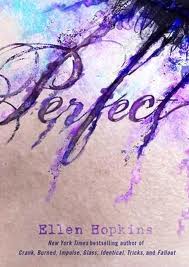
"Perfect" by Ellen Hopkins

**Spoilers!**

Perfect, by Ellen Hopkins, is the story of four high school students struggling with colleges, love, their futures, and what perfect really means.


This was the first book to get me to cry. Ever. I'm so serious. As an ode to how important this fact is, I read The Five People You Meet in Heaven, and The Faults in Our Stars, both of which I like to think of as a downright sad books, and did not cry during those. 

This book was amazing. When I first read the blurb, I thought it was going to be cheesy. But it was so intense and saddening and an amazing mix of poetry and narrative. The stories were so believable it hurt. You could feel all the raw emotion. Hopkins does some of the most amazing things I've ever seen with literature. I loved Crank, probably one of Hopkin's most famous books, but I think this book should be just up there with it.

The ending is what really did me in. It's so impossibly unhappy, but so terribly hopeful. Andre is ready to face his family, but Jenna is raped. Sean's life is permanently messed up and he's borderline crazy thanks to obsession and steroids, Conner dies, but Cara find her true self and finally finds love with Dani. 

Kendra is torn and anorexic (and seems to stay that way), but has seen inside her family and admitted her feelings fully for maybe the first time.

It's the mix of jealousy, desire, love, hate, lust, anger, violence, sadness and maliciousness that make this book such a deliciously dark read, and reel you in. The characters seem to each represent something perfect people want in their lives, each one twisting this image painfully, making you realize how fast cracks can form from perfection. Each character gives you a different approach on perfect in people's lives.

I hated Sean. He was so self-involved, and childish, and by the end of the book, I was afraid of him, and afraid of what he thought was right in his twisted, broken mind. He's so creepy and insane at the end, it's hard to imagine anyone like that. His motives started off so pure. He was so in love with Cara, you feel sorry for the guy that she didn't try to justify herself to him at all. She just broke it off, then even though he was hung up over her and one of her best friends (as she mentions in the first part of the book), she doesn't try to explain anything

Cara was near the most relaxed character. Most of the story, she was just crazy in love, and handling it, or thinking about her older brother. I thought that her realizing she was lesbian was a little too fast (like when they're skiing she just automatically says 'Maybe' she's lesbian when Danielle asks? There is no hint of that she is before that. I think it's amazing that she found what she really wanted, but it was kind of forced, especially if it was her first time with a girl. I think she would have been a little more nervous. Though I also didn't read the first book, which could have exposition to this fact in it), but her sadness at the end of the book was just so real. Her crying, "Mommy" and, "Daddy" when Conner died, even though she hated them most of the time and resented them? It was so raw.

Kendra was in so much denial. I wanted an emotional breach. It was almost hard to get attached to her. Her problem was so much more than her eating disorder. She reminded me of a mild Sean, because she only thought of Conner. She used him to justify her own madness.

Andre was also fairly mild compared to everyone else. He should be himself. I think that his relationship with Jenna really made him interesting. He adored and loved her unconditionally. But she was too childish, and too scarred by her parents to reciprocate. It's almost a relief when you see she realizes this. And when she gets raped right after Andre breaks it off with her, it's so sad. 

THE BOOK IS SAD.


But...
This book is one of my all time favorite, and always will be.

Sunday, February 17, 2013

Martin Espada Essay


Recurring Themes in Martin Espada’s Poetry

Martin Espada is a well known, educated and respected Puerto Rican poet from New York City. His poetry often deals with major issues and have recurring themes, which stretch between poems. One strong theme in Espada’s poetry is the idea of power, and the abuse of it.

For instance, in Espada’s poem, “The New Bathroom Policy at English High School,” the principal abuses his power over the school by banning the speaking of Spanish in the bathrooms. He has no incentive to do so besides the speaking of Spanish, and hearing his name in these conversations, constipating him. The principal in this poem is abusing his power as the principal, cutting of the Spanish speakers in the school of a location where they can express their culture and may speak the language most comfortable to them, if they learned Spanish as a first language. 

Another example of the theme of the abuse of power in Espada’s poetry is in his poem, “Revolutionary Spanish Lesson”. The people mispronouncing the narrators name are either using the power of the narrators name and purposefully mispronouncing it to frustrate him, or just not taking the time to ask them how his or her name is pronounced. When you have a choice to make, like the subjects of the poem mispronouncing the narrators name again, and again, you have power over the situation. Being careless with this power to make better choices is still an abuse of a, even if small power much of the time, power.

Lastly, the theme of abuse of power is an important theme in Martin Espadas poems in the poem, “Two Mexicanos Lynched in Santa Cruz, California, May 3, 1877”. This poem speaks of the lynching of two Mexicans by whites in California. The theme of abuse of power is extremely strong in this poem. Not only is the extreme racism and prejudice obvious in this situation, the “gringos” in the poem had much more power than these Mexicans. There were forty of them present at the hanging of the only two Mexican people, which means that the Mexicanos were almost certainly outnumbered to fight the whites who were trying to kill them. The whites were higher status and have a better situation than the Mexicans. They could've gone on to face little or no repercussions for what they did. It’s murder in every sense of the word, and all murders or deaths are terrible, but the way it was committed makes it even worse. The white subjects in the poem abused their physical and societal powers over the Mexicans. 

In conclusion, the abuse of power is a huge theme in Martin Espada’s poetry. He uses it clearly in three different poems of his, “The New Bathroom Policy at English High School”, “Revolutionary Spanish Lesson”, and “Two Mexicanos Lynched in Santa Cruz, California, May 3, 1877”. Espada used many different forms of abuse of power in his poems, showing that no matter what kind of power you abuse, it’s still wrong if you do it for the wrong reasons.

Tuesday, December 11, 2012

"Out of Sight, Out of Time" by Ally Carter

**Spoilers!!**

Out of Sight, Out of Time, by Ally Carter, is the fifth book in the Gallagher Girls book series. In the last book, Cammie made her decision to leave Gallagher Academy, in hopes to find answers to why the secretive Circle of Cavan wants her, and to protect those around her. The book begins with Cammie waking up in a nunnery in the Alps with no memory of her summer, and her whole appearance changed. Cammie has to figure out what she found out over the summer to lead her there, and how to get back to her home and her old self.

Okay, as I said in the last post, GIRLY BOOK! However, though with a jokey premise and general characterizations for each character (the smart one, the tough/sexy one, the invisible one, the fashionable one), these books continue to amaze and impress me.

The best part of this book was Cammie's character development. She goes through the stage that every character in a series, in my opinion, goes through, her break. After years of being comfortable with herself and her position, she continues to leave her "invisible" shell that she started to exit in the last book, and has to reassure herself. The confirmed loss of her father, her memory loss, and the attitude towards her from her friends all shake Cammie really deeply. She has to reestablish herself as a character. Breaks like this happen in the end of the Hunger Games, Twilight, Percy Jackson, Lord of the Rings, and all other strong series that have been very popular. This gives the reader a refreshing take on the character and doesn't bore them with the same thing in every book.

Cammie's development in this book also has to do with identity and finding herself, as the last book did. Her memory loss makes her lose the idea of who she is, mostly because of the things she doesn't know she did. She ends up knowing how to assemble a rifle, having torture scars, and just being a more emotionally fragile person. The affect this has on her friends and her general sanity makes her have to start from scratch again with her personality. The death of her father also makes her reassess her life. She was content with just not knowing where her father was and assuming he was dead, but not wanting to confirm it. The change in her lifestyle made her break further. The affect it had on her sanity and her friends was really intense and interesting to read.

The more mature and dark content of this book also makes me very happy with this series. Percy Jackson, another book made for kids (also published by Disney-Hyperion), starts out very kid-like, but matures as the series and characters do. You think that Carter would have dealt with this sooner, but death is large part of the books, due to the situation with Cam's father, and in spies life. Cammie kills men, loses friends, almost commits suicide (though through hypnotism), loses herself and deals with her dad's death in this book.

Of course, there are  aspects of the series that will be silly and unrealistic, and there will always be. I cannot stress enough that this is a book for tweenage girls. But by far, this book impressed me the most in the series so far. The action and pacing stay AMAZING, and the characters still hold their intensity and snarky-ness, with believable with problems and reactions that you can relate to. Five Stars!


Wednesday, December 5, 2012

"Don't Judge a Girl by Her Cover" by Ally Carter

**Spoilers!**

In Don't Judge a Girl by Her Cover, the third of the Gallagher Girls series by Ally Carter, Cammie and Macey are subjects of a kidnapping attempt over the summer break between their sophomore and junior years. Shaken up more than they have ever been, even for girls who go to a top secret book for aspiring female covert operatives, Cammie has to deal with the trauma and try to protect Macey as best as she can from the same danger as Macey's family goes on campaign for Macey's father's presidency, while trying not to break to many rules.

I know, this book is kind of cheesy and a little lame. THEY'RE MY LITTLE SECRET. I think these books are really fun to read, and though they do not lack in the cheese sometimes, they are well written and always have more than just action and female-empowering main characters.

For one thing, the theme of "fitting in" has a lot to do with this installment of the book. Even the title, Don't Judge a Girl by Her Cover, is talking about how people put on facades for other people. Everyone acts differently around people sometimes, whether you're trying to impress your friends or trying to fit in. The characters in books obviously use covers, mostly as spies, but with example like Macey, she uses them to make her family proud and to do what they want her to do.

The book also deals with losing control of your "cover." An example of this is Cammie is feeling less and less like her trade marked Chameleon nickname, and has to deal with what it's like to stand out, even if it's for a good reason. Macey also deals with fitting in. Even though she has friends, she's two years behind them academically, and as mentioned in the last part of the book, only went to Gallagher Academy because she was a descendant of Gilly Gallagher, and she starts to lose her "cool girl" personality when she shows her real emotions.

I think this book is great example of how not only super-serious books can have great meaning. The characters are believable and fun to follow along, and the series builds up mystery and tension as you read along. I liked this book especially because of the amount of action in it. I love books with good fighting scenes! Can't wait to read the next one.

Sunday, November 18, 2012

Update: "The Faults in Our Stars" by John Green

**Kind of Spoilers...**

I love The Faults in Our Stars so far. The characters are unique and strong, realistic and lovable. I've liked all of John Green that I have read so far, and I realized something while reading Faults in Our Stars (hereby referred to as Faults). Green uses the same basic theme and building blocks for all his stories. It sure works too, as Paper Towns and Looking for Alaska are big hits.

The "John Green format" is as follows:

1) The Quirky Characters-- the main characters of his books are usually ironic and cynical, kind at heart and down to earth, who have a lower social status. Their counterparts and free-spirited, quirky dreamers who don't care about what others think, who are popular or attractive. The chemistry between these two is so hot you could be physically be burned by them. And guess what- they fall in love!

2) The Adventure- there is always a manic adventure in Green's stories, usually, a search for someone. In Looking for Alaska, it was not necessarily a person, but the journey part still applies. This is maybe the bulk of the story, and often the most fast-paced part of the story.

3) The Loss- there is always a loss or disappointment at the end of Green's stories. It makes the story possibly even more quirky, veering away from the "happily ever after" story. It happened (kind of) in Looking for Alaska, and definitely in Paper Towns.

Don't get me wrong, I write this all out of pure admiration and love, because John Green is really talented young adult writer, and I love his stories. It works, and big enough change in characters and situations can still make the story fresh. It makes for a great read.

The format above is what leads me to believe that there will be a tragedy at the end of Faults. The whole story rotates around patients of cancer, and loss is a normal thing in their lives. They always know they're living on the edge of death and life. Because of Hazel, the main character's, situation, I believe that she will die at the end. Or, possibly, Augustus' cancer will return. This is a morbid theory, but I think it to be true.

One thing in Faults that bothers me so far is the way the characters deal with the tragedy in their lives. This is a really sensitive subject, and I have no experience in terminal illness, so I don't have any evidence. But I think that even though Hazel has been struggling with cancer for a couple years, I don't think she would be so oblivious of it. It changes you life forever, I know that much, and the way Green handles it, with wit and humor, though it makes for a good story, I don't think it accurately shows the pain and horrible things these people have to go through every day so they can survive. But I don't really know. I suppose it's different for everyone, but someone with as bad of a case as Hazel, I think that even in the beginning of the book, where she is for the most part stable, she would have a harder time handling it.

I really can't wait to finish this book, and I love the smart wit that Green sticks every where... Can't wait until they go to Amsterdam!

Sunday, October 14, 2012

"Perks of Being a Wallflower" by Stephen Chbosky

I recently read Perks of Being a Wallflower, by Stephen Chbosky, a book about an anonymous boy, dubbed "Charlie" in the letters he sends to a friends friends. The story tells of the boys first year in high school.

I thought this was a great book. I loved the realistic tone and style of the authors writing, which for a professional author, must have been kind of frustrating to not include commas, not very vivid words or using run on sentences. It made the book so much more realistic when the boy is struggling with things that all teens are learning at his age. I think that's one of the things that made the book so popular, how relatable it was.

One other thing that I think made the book relatable, as well as awesome, is the main character, Charlie. He's pretty much a normal kid who has gone through some awful things, but he gets over them for the most part with help from his friends and trying to fix himself. It's really the combined elements of the story that make it great. The tragedy of dealing with a traumatic event, and begin a loner at school. So many kids are all alone like Charlie was, with no friends for some reason or another. The book teaches that you can pull out of tough situations if you really try and have people who support you along the way. All those kids who feel really lonely should know that there is always someone there who cares about you.

Recent events, like the Amanda Todd suicide makes me doubt how far the kindness of people could go, however. Amanda made one mistake and was haunted by it her whole life. I think that though Charlie's situation is different in cause, the main difference is that everyone judged Amanda Todd, yet Charlie had people to support him.

It delivers a message to kids having a hard time out there, and gives them hope, even if their situation isn't as bad as Charlie's, or even worse. The anonymity of Charlie's character (his common name) also kind of lets the reader put them into Charlie's shoes.

Other things that were interesting in the book was Charlie's constant crying. This sometimes made me feel pushed back and alienated from the story, but it speaks to kids who do things that are awkward, and don't know why.

One thing I noticed in the movie is that they took away some of Charlie's idiosyncrasies, probably to make him less "weird", and so the characters will be more appealing to the general audience to make money, which still makes it a good story, but also saddens me slightly that they're taking away from the beautiful story.

Overall, this was a great and book, and I recommend it to anyone looking for a good and touching book. It's a difficult book to read, sometimes even estranging, but it's totally worth it. The movie was good too, so I definitely recommend that to anyone who wants to view a good movie that's out now.

Sunday, October 7, 2012

"Am I Blue?" By Bruce Coville

In the short story, Am I Blue?, by Bruce Coville, the main character, Vince, is dealing with homosexuality and his possible homosexuality. A theme in this story is growing up. By growing up, Coville shows how Vince matures internally and learns to accept himself.

At the beginning of the story Vince is very ashamed of possibly being gay. He's reluctant to be openly associated with someone who is gay. For example, when Melvin, his "fairy godfather", winks a college student, Coville writes as Vince, "'Will you stop that!' I hiss. 'What, afraid of guilt by association?' 'No, I'm afraid that he'll come over here and beat us up...'" Another example that shows Vince is afraid of being associated with gay people is when Melvin starts walking "So swishy", Vince is blushing, and embarrassed by Melvin's actions.

In the middle of the story, Vince begins to accept his possibly homosexuality and think more maturely about homosexuality. An example of this is when asked for a wish, Vince could have asked for anything, but he asked for "Gay Fantasy Number 3", which is to make everyone who is gay blue. This shows that Vince is maturing because one of Vince's biggest fear is being found out by everyone as being gay. By wishing for this, even when he's putting himself in physical and emotional danger, he's showing he's being more and more mature.

At the end of the story, Vince is fully accepting his homosexuality. This is shown by the final lines of the story, which are, "And my third wish? I'm going to save it for when I really need it- like when I meet the girl of my dreams. Or prince charming. Whichever." This shows that Vince is fully accepting his sexuality. He makes this statement and it clearly shows that he has matured and now accepts himself as a whole person.

In conclusion, growing up is shown as a theme in the story is that Coville gives us three distinct stages of internal development in Vince, which shows him maturing and growing up. The story shows that growing up isn't only physical, but internal, and to fully accept yourself, you might want to do some growing up. I remember when I was really little, I wanted to be like everyone else, actors, singers, my role models. But now, usually I feel like I want to make my own mark on the world- by just being myself. I know that I'm still not done growing, but I hope I'll be able to totally accept myself for who I am, and will able to accept all of myself because I'm grown inside.

Thursday, September 27, 2012

"The Drummer Boy of Shiloh" by Ray Bradbury


The Drummer Boy of Shiloh, by Ray Bradbury, is a short story about a young drummer-boy, named Joby, the night before the Battle of Shiloh during the Civil War. It describes his nervousness and anxiety over fighting in a war at his age of fourteen, and how a general helps him overcome his fear. I think one of the themes in the short story is that often we, people, or armies, are usually more alike than different.
           
One example of the theme in the story is that people are usually more alike than different is that that Ray Bradbury never gives the protagonist, Joby, a side in the Civil War. The author talks about the soldiers and all their nervousness, hopefulness and feelings, but no one ever even briefly mentions the North or South. The author did this intentionally, as this lets us, the reader, a clear view of the emotions of both sides of the War without letting our personal opinions of the motives of either sides. The story is not a judgment of the North of the South, but just telling the story of a boy at war. This is one reason a theme in this short story is that we are more alike than different.
           

Another example the theme in the story is how people are more alike than different is that the author describes the soldiers in the same way. For instance, the general relates the soldiers, saying that, “I fear it will be full of boys again…”, representing each side as only boys, also showing the innocence in both sides in the Civil War. The general also says, “Counting both sides, there’s a hundred thousand men- give of take a thousand- out there tonight, not one as can spot a sparrow off a tree, or knows a horse clod from a Minie ball.” The author is trying to relate the sides further by using their innocence, again, and their inexperience.

           
In conclusion, one of the major themes of The Drummer Boy of Shiloh, by Ray Bradbury, is we are more alike than we are more alike than we are different. This is clearly represented in the story as referring to two sides of a battle, or two armies, but this can also apply to everyday life. People of different religions, morals or lifestyles are probably more alike than they think. I think that this feeds into a really important lesson in tolerance. Even when you’re ‘at war’ with someone, literally shown in the short story, you can still be quite a lot alike. If people can find common ground with each other, they can build up tolerance for all the things they have different. I don’t exactly know if that was a lesson the Bradbury was trying to teach, but it’s really helpful lesson to take out of the story.
           
I can really relate with this story. I argue a lot with my brothers, and when I try to calm down and look at the argument in a more responsible and calm way, I have to thin about how they could just be expressing their opinion, just like I am. I have to find common ground, either to base a further argument on or to stop the argument all together. When I get angry with someone for something, I have to think about why they did it. I could have the same idiosyncrasies that they have, and can be awkward or annoying in the same way. I just don’t realize it because I’m myself. We all have to find common ground with people so we can get along. That’s how we all build relationships and friendships.

"The Rivals" by Daisy Whitney

**Spoilers!

First of all, I just want to say this was an amazing book. Besides the ending, which was fine, I just really wanted to Ms. Merritt, the oblivious and frustrating dean of the school, be forced to kick them out, possibly waking her up as well as all the doubters of the Mockingbirds. I really just like the whole mood of the series in general so far. For a seemingly silly topic (a book about a student vigilante group could have easily turned into a cheesy superhero-esque book), Daisy Whitney handled it really well, even with the introduction of a 'villain' organization. It deals with a lot of fresh and important issues for teens today too, like date-rape and academic drugs.

One thing I thought was really great in this book was it's conflict. The conflict tested the main character, Alex. She was a victim in her own case, so she immediately tried to help any other "victims", like Beat (who ended up being a terrible person), or Delaney, and later Theo. But then the supposed criminal was just like her- Theo was an aspiring artist- He loved dancing more than his life. It was his life. Alex could relate to this, as she loved piano. This made it harder for her to believe the terrible things being accused of him. This drove her to make silly mistakes- like not convicting her friend Maia, when she was suspected. I mean, I feel bad about saying this, as Maia was framed, but still, Alex was worrying about being respected as leader, right? She kept making stupid mistakes, and didn't function as a court should, even if it's just a really screwed up private boarding school. Thought this did all lead up to the right perpetrator, she still should have tried to be more professional if she wanted to be taken seriously.

That's one of the few things that annoyed me about the book. Alex messes up multiple times, but it all ends up well, with basically no consequences, and none of the characters care about it. The book is all about justice, but not much justice is done to right the wrongs that Alex did. Everything is just ending up dandy. The whole book is about how if adults were basically taken out of a kids world, how would they function? Even with adults in control of punishment, there is never a perfect ending. It's a disappointing change in a very harsh and realistic book that the book has a fairy-tale ending.

Of course, that is another thing that made the book more realistic, all the mistakes that the main character makes. It makes you relate more to the characters, and feel for them.

And on the note of themes (kind of), I want to talk about a theme in the book. The book really, I think, shows well what kids would do if they didn't have adults to control them. There would be the ones who just cause havoc, and bully, and cheat because they can get away with it. Then there were those that would rise up and try to fight. I kind of noticed this in the Hunger Games, but in a different way. When they didn't have a fit government, the people of Panem rose to the occasion, or specifically one entity/thing did (Distric 13/the separate districts), just like Alex's sister did when she created the Mockingbirds.

Overall, I thought this book was great, and I'm really excited to see if there's another one! (Though I doubt it.)

Thursday, September 13, 2012

"The Future of Us", By Carolyn Mackler and Jay Asher

"The Future of Us", by Carolyn Mackler and Jay Asher, is about two high school students and ex-best friends who discover modern-day Facebook on an early internet browser in 1996. Personally, I thought this was  a great book that commented on the almost obsession teenagers have with social networking today. I thought that a theme in the book was that teens and kids shouldn't worry so much about the future, and live in today.

For instance, one of the main conflicts (or conflict starters? I don't know) in the book was that the character, Emma, is messing with the time stream, changing things about her life that she doesn't like, such as her husbands, her job, even small things like where she lives. She makes unwarranted assumptions about the future based on 420 characters or less wall posts. She experiments with the small changes, or 'ripples', in her time to the Facebook's future because she's insanely concerned about having a perfect life in the future. Now I don't know much about college applications, which I can assume are much more stressful than high school applications, but I can relate to stress over the future. So many kids in my grade and really riding on one specific high school they want to go to, or freaking out over hypothetically not getting into a high school (not saying that I'm not), and I think "The Future of Us" is trying to say that you can still have a happy life if not everything goes exactly the way you want it to.

The book also says something about spending too much time on the internet, which is pretty funny, because the book is set in 1996, and the problem is really massive in 2012. 

I think this book was great, and had a nice mix of romance and great concept, as so many seemingly cool books get lost in sappy love triangles and obsessive girlfriends these days. Jay Asher is the bomb, and I'm definitely more interested in checking out Carolyn Mackler's books.