Showing posts with label internal conflict. Show all posts

Sunday, June 16, 2013

"The Faults in Our Stars" by John Green

The Faults in Our Stars, by John Green, is a book following Hazel Grace Lancaster, a 16-year-old cancer survivor who meets the charming, witty and dashingly handsome Augustus Waters at her cancer support group. This book, which I have previously read, is consistently one of my favorite books of all time, refreshed in my mind as being a wonderful, powerful, charming, emotional book every time I read it. I read this book for book clubs, and one of the questions my club had before we started reading was, "What keeps the character motivated?" I thought this question was really important to the plot of the The Faults in Our Stars. Many of the characters are driven by each other, and mutual want of respect and love, in this book.

For instance, Hazel is driven by Gus to do more with her life. Hazel has a fine life before she met Gus, but Gus helped her live more. Augustus introduces the idea to her that she can go to Amsterdam to visit their favorite author, Van Houten, the author of An Imperial Affliction, a fictional book in the world of TFiOS. Gus introduces a new, exciting sort of energy into Hazel's life, someone who has been living for so long prepared to die, and energy that makes her want to live. I think this is also cause for Hazel not wanting to get too close to Gus, as she thinks that she'll just break his heart by dying, and that their time together, the new energy he brought to her life, will just go to waste. However, overall in the book, I think Gus motivates Hazel to do more with her life than she could have imagined to do otherwise.

The parents in this book are also driven by love for their children. The parents of these teenagers with cancer want to make their kid's live as good as possible, and they help them in so many amazing ways. Hazel's mom, for instance, almost organizes all of the trip to Amsterdam to make her daughter happy. Knowing that her daughter may die at any time also motivates Hazel's mother to take good care of Hazel, and try hard to make her daughter's life better. She wants her to go to cancer support groups to help Hazel with any problems she's having, she supports Hazel in her relationship with Gus, a near stranger, and goes to Amsterdam with Hazel just so Hazel can meet one of her favorite authors.

I think that in this book, the characters are also motivated by their wanting to have made an impact on people's lives. They want to be remembered, as all humans do. So many of the characters in this book are given such short strings on life, because of cancer, they want to make sure they are remembered for something other than cancer. Hazel and Gus often talking about philosophy, I think, is an ode to this, as they want to discover something more about the world. They want to know that they weren't just defined by their cancer, but by something else, something important, something that changed people. Gus, especially, has this want, as he comes into people's lives, such as Isaac, or Hazel, and just tries his best to make them better. As Gus says, "The marks humans leaves are too often scars." Gus doesn't just want to be a 'grenade' that left scars in people lives. He wants people to live as much as he wants to live, and he wants people to know that he wanted them to live. I think in the end, everyone wants that, but as people who were told from the beginning, "You will most likely die", to have that terrible weight on your chest most of your life, they want to know that people remember them not just as, "The girl with cancer."

This book tackles with so many issues, so many, deep, basic human wants and emotions, it's really hard to talk about only one of them. I'm sure I could write hundreds of essays on the different themes in The Faults in Our Stars. The characters in this book are one of my favorite parts of it, which is one of the reasons I chose to respond this question. They're so strong, so inspiring, and so lovin
g. Each one of them made whoever they touched a better person. They're each are so motivated to help others, and to help each other. The book deals with mortality and sacrifice and so many more issues in a relatable, unique, funny, heartbreaking way. The characters in this book are almost doomed from the moment we meet them. These characters, however, these amazing, strong characters, are able to do so much more good in the world. They're not just angry (Though they are a little angry,), they're curious, intellectual, understanding, and compassionate. None of them ever gave up, and I think that's pretty great.

Saturday, May 18, 2013

"It's Not Summer Without You" by Jenny Han

**Spoilers!**

(I also read this book before, and decided to read it again.)


It's Not Summer Without You
, by Jenny Han, is about Belly, or Isabel, is in her last year of high school. After her mother's best friend, and one of her best friends, Susannah, died of breast cancer, her life hasn't been the same. Her mother is breaking under the stress as executor of Susannah's will, and doesn't have any grieving time on her own. Belly's brother is far away, off at college, and almost non-existent in their current life. Her secret escape, Susannah's beach house, is now a memory, and Belly is dreading the summer without her time with her brother, mother, Susannah and Susannah's sons, Conrad and Jeremiah. To make matters worse, Conrad, the boy Belly has loved for forever, has broken up with her, and is detached and alone, not even talking to her, and dumping her right when Susannah died, when she needed him the most. But when Belly's told by Jeremiah Conrad is gone, she goes to find him without hesitation, and ends up at the beach house. This is her last chance to save her relationship with Conrad and finally come to terms with the death of the person that brought them all together. 


This book was pretty good, but it wasn't as good as I remember. It was still better than the last book, The Summer I Turned Pretty. The book is well written, like the last book (tip off the hat to Jenny Han). The whole story is well formulated, the characters are believable, the love story is sigh worthy, and it has a nice, neat love triangle to top the story off.


These are also all very basic and well worn tools by authors of YA romance books.

The character set up and development, thought predictable, are very nicely written. It's a very straightforward book in theme and plot, but the little details, as in the last book, make me like it so much. I love, strangely enough, the 'annoyingness' (no better word) of Belly after her breakup with Conrad, and after Susannah's death. She tries to use guilt to get what she wants, and find excuses for what I must say so myself, is terrible behavior. Also I liked how other characters (such as Taylor) react by getting mad at her, and not forgiving her. The holding grudges, obsessing, depression, whining, and just emotions of this book is what makes this a very believable book. The ways the characters interact have a lot to do with this, and it made the book a lot more enjoyable to read, in my opinion.

Many of the themes in this book are really cheesy. The brother love triangle, the way the brothers fight over Belly, the unrealistic things the people will do for love, all things that sometimes ruin a so far romance book for me. Even the classic beach cover with attractive girl with windblown hair is fairly overused. 


Reading this book again made me realize that many of the parts of the book that I loved last year made me a little queasy this year, and weren't as creative as I thought before. Though I obviously realized this book wasn't a greatest book ever, and that many plot points had been used before, it was just harder to enjoy when I realized it was glaringly obvious what would happen, not just because I had already read the story.

Overall, I very much enjoyed this book, and thought it balanced sappiness and real-life emotions. Jenny Han has a very specific writing type, and has a talent for books such as these, teenager-y romance plots involving summer romances. Her books are a guilty pleasure of mine, and I would be interested in reading the rest of this series.

Tuesday, May 7, 2013

"Red Glove" by Holly Black (Curse Workers Series #2)

**Spoilers!**

In this continuation of the Curse Workers series by Holly Black, and follows Cassel struggle with not only trying to maintain is normal life at school in this last couple years, but dealing with the discovery of his new Transformative powers. Things get more difficult when Lila joins his school, making it even harder to separate his lives, as well as his confusing feelings for Lila. But a new mystery emerges when Cassel learns that his brother, Phillip, has been murdered, and all they know about the killer is that she's  a woman. A woman with Red Gloves.

I really liked this book as a continuation of the series. The book at many strong points that helped elaborate on the world of the story and the characters, their relationships.

Cassel and his mother's relationship is definitely developed, especially during the exchanges during Phillip's funeral and toward the beginning of the book when Cassel discovers his mother has curse-worked Lila into 'loving' him. Cassel's mother is seemingly trying to help, but at this same time, knowingly not helping Cassel much at all in the long run. Lila's feelings, being produced by emotion working, will fade, so no matter how much Cassel's mother wants or thinks she is helping, she must know this will happen. The mother's character itself is very fickle and irresponsible. I also find it interesting her interactions with the other family, like Barron, and family friends, during many of the scenes involving Phillip's death. She seems obviously melodramatic, but it's clear she does love her children, and almost as though she just doesn't know how to get that message across.

I want to know about why the mother is like this. Maybe she felt bad about attaching to her children while she was bringing them up in such an unstable and corrupted environment, or maybe because of this environment she never had the time to learn how to communicate with her children.

I'm already started with the next book, Black Heart, but I'm very excited to see where this story goes!

Sunday, March 31, 2013

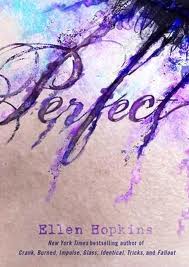
"Perfect" by Ellen Hopkins

**Spoilers!**

Perfect, by Ellen Hopkins, is the story of four high school students struggling with colleges, love, their futures, and what perfect really means.


This was the first book to get me to cry. Ever. I'm so serious. As an ode to how important this fact is, I read The Five People You Meet in Heaven, and The Faults in Our Stars, both of which I like to think of as a downright sad books, and did not cry during those. 

This book was amazing. When I first read the blurb, I thought it was going to be cheesy. But it was so intense and saddening and an amazing mix of poetry and narrative. The stories were so believable it hurt. You could feel all the raw emotion. Hopkins does some of the most amazing things I've ever seen with literature. I loved Crank, probably one of Hopkin's most famous books, but I think this book should be just up there with it.

The ending is what really did me in. It's so impossibly unhappy, but so terribly hopeful. Andre is ready to face his family, but Jenna is raped. Sean's life is permanently messed up and he's borderline crazy thanks to obsession and steroids, Conner dies, but Cara find her true self and finally finds love with Dani. 

Kendra is torn and anorexic (and seems to stay that way), but has seen inside her family and admitted her feelings fully for maybe the first time.

It's the mix of jealousy, desire, love, hate, lust, anger, violence, sadness and maliciousness that make this book such a deliciously dark read, and reel you in. The characters seem to each represent something perfect people want in their lives, each one twisting this image painfully, making you realize how fast cracks can form from perfection. Each character gives you a different approach on perfect in people's lives.

I hated Sean. He was so self-involved, and childish, and by the end of the book, I was afraid of him, and afraid of what he thought was right in his twisted, broken mind. He's so creepy and insane at the end, it's hard to imagine anyone like that. His motives started off so pure. He was so in love with Cara, you feel sorry for the guy that she didn't try to justify herself to him at all. She just broke it off, then even though he was hung up over her and one of her best friends (as she mentions in the first part of the book), she doesn't try to explain anything

Cara was near the most relaxed character. Most of the story, she was just crazy in love, and handling it, or thinking about her older brother. I thought that her realizing she was lesbian was a little too fast (like when they're skiing she just automatically says 'Maybe' she's lesbian when Danielle asks? There is no hint of that she is before that. I think it's amazing that she found what she really wanted, but it was kind of forced, especially if it was her first time with a girl. I think she would have been a little more nervous. Though I also didn't read the first book, which could have exposition to this fact in it), but her sadness at the end of the book was just so real. Her crying, "Mommy" and, "Daddy" when Conner died, even though she hated them most of the time and resented them? It was so raw.

Kendra was in so much denial. I wanted an emotional breach. It was almost hard to get attached to her. Her problem was so much more than her eating disorder. She reminded me of a mild Sean, because she only thought of Conner. She used him to justify her own madness.

Andre was also fairly mild compared to everyone else. He should be himself. I think that his relationship with Jenna really made him interesting. He adored and loved her unconditionally. But she was too childish, and too scarred by her parents to reciprocate. It's almost a relief when you see she realizes this. And when she gets raped right after Andre breaks it off with her, it's so sad. 

THE BOOK IS SAD.


But...
This book is one of my all time favorite, and always will be.

Thursday, March 21, 2013

Update: "After Ever After" by Jordan Sonnenblick

**Spoilers!**

The book, After Ever After, by Jordan Sonnenblick is the sequel to Drums, Girls, and Dangerous Pie, following Jeffrey Alper, after his cancer went into remission, now in his eighth grade year, dealing with many of the same problems Steven Alper, his older brother, did in his eighth grade year in, Drums, Girls...

I really like this book so far. It reminds me a lot of the original story, and has extremely similar tones, probably due to that they're written by the same person, Jordan Sonnenblick. That's a pretty obvious explanation. But I like that Sonnenblick brings out new characters, and though in this story, as the last one, there's still the main boy character, his love interest, and the best friend.

One thing I would like to explore is the best friend in this story, Jeffrey's best friend, Thaddeus, or Tad. Tad is a really antisocial person, often really downright mean to people. He was even snide to Jeffrey when they first met, and to the girl he likes.

I believe that this is Tad's attitude at the beginning of the story, pretty much almost up to the point I'm at now in the book, because he was afraid to get close to people, and he wasn't sure even how long he would live to see them become friends.

Tad's cancer made him feel weak, and it made him afraid he wasn't going to live. This obviously made him look down on the world, probably seeing their problems as more insignificant than his, which explains his cynicism and sarcasm towards many in the book currently.

But I believe also that besides Tad's weakness bringing out this trait, it also made him question how much he wanted to do in his life, or if there was any point to it. He gave up trying to walk, and he was just complacent with the life he had. He knew that he had his best friend to get by with, so he didn't think he needed to go out of his way to be friendly to anyone else. I think that Tad is fully aware that is cancer could return in the story, which it does, so he tries not to get closer to anyone and uses his cynicism as a shield.

This also explains why Tad wants Jeffrey to pass Jeffrey's state tests so much. He wants to make sure that Jeffrey gets to do at least everything Tad does, and make sure that Jeffrey doesn't give up like Tad does. This also shows that Tad is not truly mean, and is actually quite compassionate, spending a lot of his own time working with Jeffrey on math.


Sunday, March 3, 2013

Sonnet

Sonnet

We danced, bright star eyes, but soon we know how
the world crushes most dreams of he who tries.
All we wanted was to have gracious bows,
we end up holding arms with silent cries.

And those who try too hard tend to get hurt.
We are the ones who held our hearts in hands,
begging others not to be so rude, curt.
But hands are not walls, no not at all, and

Soon the tender and sweet heart was burned, by
a known figure with cat eyes and strong heart.
They thought that all were strong like them, a lie,
but the poor star eyed were not so careful.

A heart never hurt is not experienced.
And hearts not hurt fall inexperienced.

Wednesday, February 13, 2013

"Breathing Underwater" by Alex Flinn

**Spoilers!**


Breathing Underwater is the story of Nick, a seemingly perfect and popular high school student who is charged with a restraining order on his ex-girlfriend, Caitlin. But why? Nick doesn't think he did anything wrong. He just taught her a lesson. The book chronicles his journey to his anger management classes that will "help him", and overall just his journey to redemption.

I enjoyed this book a lot. My favorite moments were the letters, and seeing how bad the abuse got in the relationship. I couldn't really imagine anyone besides some alcoholic father (like Nick's dad) abusing anyone, but this really shows me that abuse can happen for lots of reasons, and isn't always the reasons we think. I also was surprised about the relationship itself, and gave me an insight to an abusive relationship. The book showed me a lot about the kind of people who get caught in relationships like this, people like Caitlin who don't think they're good enough because of someone (Caitlin's mom), who think the person will be their only hope at a relationship. Also it was interesting that Nick didn't think he was being that harsh, or that we was wrong. It made me really worried for others who are in situations like this, and how they might not even know what they're doing is wrong.

Also is made me sad that Caitlin's or Nick's friends didn't try to help Caitlin when they saw something wrong about the relationship. I think if I ever saw a friend in trouble I would have to tell them, even if it meant losing a friendship. 

Overall, this book was really interesting and emotional to read, and I enjoyed it. The movement to Nick's "redemption" was well written, as Alex Flinn is awesome. Read it!

Saturday, February 9, 2013

"After" by Amy Efaw

**Spoilers!**

After, by Amy Efaw, tells the story of Devon. Devon has always been the "good girl". Straight A's. Master goalie on the soccer field. Quiet and well-behaved, even with her slightly obnoxious and childish mother who goes through men just a little bit too fast. But when a new-born baby is found in a trash can behind Devon's house, left to die, and Devon is the one to blame, her life will change forever. But how could Devon herself have not known about the baby as she claims? When she was pregnant, gaining weight and throwing up? 


This was actually a really good book. I heard some bad reviews about it and wanted to see if it was as terrible as people were saying. Though really the only thing that bothered me was that Amy Efaw used too many soccer references in it. I'm kind of laughing at that now, because that's a very silly thing to think of a book. But I guess it was very soccer oriented? I did think Devon, as a character was a little useless at times, and some of her motivations were confusing me. But I know very little on the subject of the book, pregnancy and rejecting your child after birth, so I may not have the full picture.

I thought this was a really intriguing book about how far humans will go to keep their personal image. I hated Devon at the beginning. It seemed so obvious that she was pregnant, and all the things that were put up against her as evidence, mostly the details in the flashbacks, shows that she did know that it was likely she was pregnant. She even seemed to hide it from other people actively, which means that she did know! I understand that denial over traumatic events can occur, but it seemed so obvious that she knew that she was with child, and that she could have done something about it.


One of the reasons this book ended up being really satisfying for me is that at the end, Devon does realize all of the things I said above. She knows that even if she was denying it to herself, at some level she knew she was pregnant. She knew what she was subconsciously trying to do when wearing baggy clothes, or what she realized when she had cramps from sit-ups. That she knew that she had to pay and do something about almost killing her child was what really showed that Devon was still Devon. She knew she wanted the baby gone when she gave birth. She knew she was trying to make it go away by hurting the baby. If I tried to do get rid of a child in secret, I wouldn't be able to get it off my mind- that I tried to kill something as precious as a baby, but I didn't pay any consequences.


As I said before as well, I didn't like that there were so many random soccer references in the book. I get that soccer was important to Devon as a character, but would someone realistically think that everything was like soccer? I got all the little anecdotes about hard games and practicing and tough foul shots, but it kind of took me out of a story that was really about what humans can and will do and denial, and made me think it was one of those children's shorter chapter books all about some kid and his baseball team, and the conflict is all about how some other guy on another team cheat and he has to prove it or something. It just felt wrong. It was a weird tonal change in the book. I expect that from sports books, but do even professional soccer players always think in soccer metaphors, similes and analogies?

Sunday, January 13, 2013

Update: "Girl in Translation" by Jean Kwok

Girl in Translation is the story of Kimberly, a Chinese immigrant from Hong Kong who moves to New York City with her mother.

So far, I'm pleasantly surprised by Girl in Translation. Usually, I'm not the greatest fan of historical fiction (even though this is not that far in the past) or immigrant stories. I usually feel like they're too played out and a lot of the time, not that well written. It's really hard to relate to these characters because of their situation for me, which makes me not enjoy the book as much.

In Girl..., possibly because of the relative modern-ness of the story, I can pretty easily relate to Kimberly as a character. She is a smart, aware character who still has normal wants as an eleven or twelve year old, but is not taken over by these actions. She knows the importance of family, another thing I like about Kimberly.

Also layers of the story are interesting. Kim wants to be accepted by her peers at school and in the factory, but her strong Chinese upbringing is keeping her from totally assimilating. She also wants to please her traditionalist Chinese mother, but at the same time it's hard to do that when you're trying to become more American so you can do well in school and make new friends, even talk to your crush. Kim is a torn character, and I can't wait to watch her as she grows and sees which path she takes.

I was also interested in the Aunt's role in this. Kim's Aunt, Paula, seems very reluctant to help her sister and her niece, for reasons that have been hinted at, but not totally explained. The customs of the Chinese don't let Kim's mother complain about her sister not helping them as much as was promised, but I want to see if the sheer terribleness of Kim and her moms condition makes Kim's mother break away from their customs for a little while.

Sunday, December 16, 2012

"Anya's Ghost" by Vera Brosgol

**Lots of Spoilers!**

Anya's Ghost, by Vera Brosgol is a graphic novel about a girl named Anya. Anya is ashamed about standing out in her little New England town, which includes hiding her hard to pronounce Russian last name and keeping the secret that she used to have a weird accent in kindergarten before she went to ESL, let alone dieting to keep off her muffin top. When Anya falls down an old well to discover a 98-year old body of a young woman, she's scared, yeah. But what's scarier is that the ghost of this certain corpse, named Emily Reilly, starts following Anya around...

This is the first graphic novel I read this year, and I'm insanely happy with this book. The story and artistic design of the book was awesome and really entertaining to read. It was dark, but not dark enough to give me nightmares. It also had a nice neat message to all us teenage girls in there. I especially connected with Anya.

The book starts off with Anya being really self-conscious, and not a very nice person. She wants to be accepted by the "cool" crowds at school, and does stuff she doesn't want to do, like smoking or dieting so she can work towards that. She is so embarrassed about her family and heritage, which is a giant part of who someone is, that she lies about her last name.

When Emily's character comes in, this pushes Anya to become the person she wants to be, because now she basically knows everything she could hope to. She has her own personal spy. But this also shows Anya the bad side of the "cool" kids. Sure, Anya may not be popular, but she doesn't cheat on her boyfriend like Sean, Anya's crush, did to his girlfriend Elizabeth. Anya has people she can trust. There's a bad side to everything, and you can't want one part of it and not the whole package.
a little preview of the art style :)

This is what makes Emily's character the antagonist in the end (or the past? I don't know). She can't accept that she can't have what she wants, like Anya did after the party at Matt's house, so Emily snapped. She killed her crush and his girlfriend then died, kind of in the spirit of karma. When she tries to live her life through Anya and that doesn't go the way she wanted it to either, she snaps again, and returns to violence as an answer. Only when Anya explains that you have to be happy with what you have and that you can't have everything you want is when Emily realizes all she's done and leaves the Earth.

Elizabeth, queen bee at Anya's high school, almost did the opposite of Emily, she found out Sean's unfaithfulness and that she couldn't get him the way she wanted, but instead of snapping, she bent so she could still "have" Sean and the image that came with him. She sits idly by while Sean hooks up with other girls. Elizabeth bent so far she broke in a different sense.

 I love the illustration too, because it's simple, but descriptive and clear. The color palate is awesome, matches the story perfectly.

Overall, this was a AMAZING book, with an excellent message. You have to be happy with what you have, and make the best of it. I recommend this book to Neil Gaiman and Hellboy fans and anyone (especially girls) who like a good, dark comic book.

Wednesday, December 5, 2012

"Don't Judge a Girl by Her Cover" by Ally Carter

**Spoilers!**

In Don't Judge a Girl by Her Cover, the third of the Gallagher Girls series by Ally Carter, Cammie and Macey are subjects of a kidnapping attempt over the summer break between their sophomore and junior years. Shaken up more than they have ever been, even for girls who go to a top secret book for aspiring female covert operatives, Cammie has to deal with the trauma and try to protect Macey as best as she can from the same danger as Macey's family goes on campaign for Macey's father's presidency, while trying not to break to many rules.

I know, this book is kind of cheesy and a little lame. THEY'RE MY LITTLE SECRET. I think these books are really fun to read, and though they do not lack in the cheese sometimes, they are well written and always have more than just action and female-empowering main characters.

For one thing, the theme of "fitting in" has a lot to do with this installment of the book. Even the title, Don't Judge a Girl by Her Cover, is talking about how people put on facades for other people. Everyone acts differently around people sometimes, whether you're trying to impress your friends or trying to fit in. The characters in books obviously use covers, mostly as spies, but with example like Macey, she uses them to make her family proud and to do what they want her to do.

The book also deals with losing control of your "cover." An example of this is Cammie is feeling less and less like her trade marked Chameleon nickname, and has to deal with what it's like to stand out, even if it's for a good reason. Macey also deals with fitting in. Even though she has friends, she's two years behind them academically, and as mentioned in the last part of the book, only went to Gallagher Academy because she was a descendant of Gilly Gallagher, and she starts to lose her "cool girl" personality when she shows her real emotions.

I think this book is great example of how not only super-serious books can have great meaning. The characters are believable and fun to follow along, and the series builds up mystery and tension as you read along. I liked this book especially because of the amount of action in it. I love books with good fighting scenes! Can't wait to read the next one.

Monday, November 12, 2012

Update: "The Adoration of Jenna Fox" by Mary E. Pearson

**Spoilers!**

I'm currently reading The Adoration of Jenna Fox, by Mary E. Pearson. Unfortunately, I was not correct with my clone theory. It makes me a little sad, but the alternative I guess, though not as much as a plot twist as Jenna being a clone, makes more sense.

I noticed I was partly right though. Jenna's whole body is basically a clone of herself, and her brain and body has been changed to be more perfect, like how someone could change a clone to perfection.

The conflict that this presents to Jenna is really interesting, and I love watching Jenna grow. Though personally, I don't see anything wrong with her, Jenna first found herself disgusting, and can't trust her own body. Finally, when she comes to accept this and when she was in a state where she could just live her life safely and legally from then on, she lets Allys discover her secret. I know, it's not like Jenna told Allys, but she knew she couldn't hide it, and didn't do anything about it. I don't really understand why Jenna did this. I think it was the fact that Jenna knew that she had to move on from the "perfect" world if she wanted to move on with her life. She couldn't live under her mother and father forever, because they would treat her like a piece of fine art, just put her away and admire her. They wouldn't want her to be used in real life.

I also think Allys, though having a point in her argument against significant biological enhancement, is angry about her own situation. Allys believe that it's unfair that some people should have more than she does. She needed more than limbs, but she couldn't get them, and is dying because of it. She doesn't think anyone should have more than what she did. I do agree that one person, like Jenna, shouldn't be enhanced, and that death should be expected almost as much as life. People can't avoid death forever, and Allys knows that. What Jenna's parents did was wrong, sure, but I think if someone's life is in the balance, and you can pretty much restore them to normal by giving them organs they need, you shouldn't need to consider how many "points" they have to do it.

Allys knew she was dying, and I do believe that she believed what she thought, but I think Allys shouldn't have told her parents that Jenna was illegal just to make her life harder, and that her view points were clouded by her anger towards her own disease and the way it was handled.

Wednesday, November 7, 2012

"Wintergirls" by Laurie Halse Anderson

**Spoilers!!**

I recently finished Wintergirls by Laurie Halse Anderson. Wintergirls tells the story of Lia, a girl whose best friend recently just died. Lia struggles with dealing with the sudden and strange absence in her life, while having to deal with her own problems.

I thought this book was beautiful, and very poetic. It was a lot like Speak, also by Laurie Halse Anderson, but also completely different. This was almost the complete opposite of Speak in writing style, as Speak was mostly in the future, never looking back, straight forwards. Wintergirls led the reader through Lia's whole mind before we can get to her real problems and guilt. Halse Anderson's style still shines through. In some ways, I enjoyed this book more than Speak, for many reasons.

I thought the word wintergirls by itself was amazing. It wrapped up the book in a tight little ribbon. I was really confused about the title at first, but pretty soon I understood way too well.

This book is morbid, and sad, and hopeful, and scary. It broke my heart when Elijah left Lia by herself in the hotel room. He knew what had happened there. He knew she was on the edge of death. He knew she was seeing things, and she lied to him about being "okay." I imagined what it would be like if Lia went with Elijah, because Cassie wouldn't haunt her. I realized that she would probably have gotten better. But Elijah did the right thing. Lia loved her family too much to leave them behind, and she might not have gotten better it she was out on the road, not being able to come to terms with Cassie's death.

Another thing I liked was the strong character voice in the book. In the beginning, Lia shows no remorse. No regret. She wants to be skinny. Halse Anderson doesn't write it from a person free from eating disorders, she writes like she had one. Lia's character never gives herself some slack, or even thinks about stopping while she's at her worst, in the middle of the book.

I really loved this book so much, and recommend it to fans of Speak and 13 Reasons Why. I hope the next book I read lives up to Wintergirls.

Sunday, November 4, 2012

Update: "Wintergirls" by Laurie Halse Anderson

I think so far Wintergirls is a really great book. Like Speak, it deals with really current and modern issues tactfully, but is still truthful, and doesn't sugar-coat them.

One thing I find interesting is the contrast in the eating disorders of Lia and Cassie. Lia doesn't eat at all, and Cassie goes through the cycle of binging and purging. I would think that these two types of eating disorders would depend on the type of person, and that Lia would be grossed out by Cassie. She seems like a neater, secretive person, and her self-infliction shows she's very internal and secretive.

Cassie, on the other hand, seemed more like a wild girl in her character in general, and ate a lot, especially around Lia.

Just their personalities alone shouldn't be really that compatible, but they were still sisters in eating disorder. I don't think they met because of their disorders, but it made them closer. Another thing I'm asking every word I read of this book is how could best friends let each other go through that?

I mean, the drama girl that screamed at Lia before the wake was right in a way. Lia didn't try to help. Of course, the drama girl didn't know that Lia was Cassie's weight loss partner, but didn't they both know it was wrong and unhealthy what they were doing? I mean, Lia is trying to hard in the book to lie about getting better, but she's already incredibly thin for her age. I don't think she's short either, so for her height, she's skinnier than a lot of models.

I think the use of the crossing out words is really effective as well, because it shows that Lia does want to be normal, her subconscious just can't convince her 'skinny side' of it. It delivers emotional lines without the compromising, "I think...", which in my opinion, always brought me out of the scene in the book.

I can't wait to finish Wintergirls really, even though I've barely given time to read it. I really want to see if Halse Anderson is coming out with any other realistic fiction books, or has previously. 

Sunday, October 28, 2012

"Speak", by Laurie Halse Anderson

I think one symbol in Speak by Laurie Halse Anderson is Melinda's lips. They represent Melinda's inability to speak about her traumatic experience, and physically represent the raw and hurt feelings she has towards them.

For instance, when Melinda is still repressing her acceptance that she was raped, her lips are a large part of the book. She always notes people commenting on them, how they're scabbed and chapped. She picks them and bites with them, making it worse by delayed healing. This represents Melinda delaying her healing from her rape by not taking initiative to heal her internal wounds. This makes Melinda's trauma worse, and she wasn't helping herself by avoiding it.

Towards the end of the book, Melinda has almost no thoughts about her lips. The scabbing is not even mentioned, and doesn't bite them anymore. This is also a time where Melinda accepts her experience, and wants to help herself. She starts the healing of her lips and her trauma from her assault. This also makes Melinda more confident and able to cope better, and become part of the society at her high school again.

This also symbolizes Melinda's character development physically, where you can see it if you pay close enough attention.

Speak is an amazing book. It represents a difficult topic well, and that's one of the reasons it became so popular. I loved the book, and really appreciate Halse Anderson's other work. I think that the book is so wittily written, harshly true and really just sad. It's a really strong story of redemption and healing, and shows that when you experience something traumatic it can haunt you forever.

Every should really read this book, and though it's a girl narrator, it's a really easily relatable character in general. I loved it!

Tuesday, October 23, 2012

Update: "The Reckoning" by Kelley Armstrong

I think one of the reasons Derek is so difficult in letting anyone close to him and showing it is that he's afraid he'll hurt them.

His experiences with hurting the boys at his old high school still haunts Derek, shown through his constant guilt. He's afraid he'll physically jeopardize his friends and "team", because he feels like he's a freak or some kind of mutant. When he paralyzed the bullies at his bully it made him appear tough and made others fear him. This was almost the opposite of what he wanted, as Derek just wants to be accepted, like many teens do.

When his dad ran away, Derek lost one of the only people who accepted him fully, and he was able to be himself around. He already believed Simon thought he was a monster of some kind because of his attack on the boys who bullied Simon, even though Derek still loved his brother, and Simon loved him. Derek seemed to have lost a lot of his confidence and became an even more guarded and quiet person. This also caused him to be a more protective of his loved ones, which made him even more aggressive appearing towards others.

This is what made him so unapproachable to Chloe, and any other people his age (besides Simon). Though he doesn't want to be, he's seen as a big, unsocial creep. It's what made Simon seem so annoying to Chloe.

Chloe is also what changes this in Derek. She's able to stand up to him, which makes him feel less of a "bully", a monster, and an intimidating force. She helps him reestablish his self-esteem and makes him want to come out of his shell.

The character change is also caused from the change in Derek's situation. Him moving around and constantly running, needing to depend on others for help and teamwork, makes him change in his solidarity as well.

I can't wait to finish The Reckoning... so excited. It's really great, and love to