I recently began reading, The Faults in Our Stars by John Green (cough cough I am a huge nerdfighter.) ANYWAYS
This is by far one of my favorite books, ever. I have previously read this book, this amazing, deep, philosophical, emotional, touching book, and now I am reading it again for book clubs.
One thing I initially notice about reading TFiOS, as I'm rereading it, is that Hazel doesn't attempt to do very much with her life until Gus shows up. I mean, Hazel has the urge to do things, and wants and desires like everyone else, but I feel like Gus is really the one that enables her, makes her want to do these things that seem ridiculous and impossible beforehand, like meeting the author of An Imperial Affliction and going to Amsterdam.
One reason I think this is is because Hazel is more physically weighed down than Gus is, due to her oxygen tank, so it's a more constant reminder of how she will always be held back by cancer, and how cancer will be forever affecting her life. Gus, though cancer still obviously affected him in huge ways, Gus probably will sometimes forget that he has an amputated leg more than Hazel will forget that she has to drag around a metal tank with her all day.
NOT THAT I'M TRYING TO DISCREDIT amputees. That is, if possible, the exact opposite of what I'm trying to convey. I'm just pointing out, with Gus' dreamer and optimist personality, it's most likely more easy for him to forget his troubles than Hazel is, who has a more serious and down to earth personality, especially since he doesn't have as much trouble as Hazel, let's say, walking up stairs because of a tank he has to carry around.
Gah, this is just a mess. I feel like I'm offending everyone.
Showing posts with label social issues. Show all posts
Showing posts with label social issues. Show all posts
Friday, June 7, 2013

Sunday, March 31, 2013
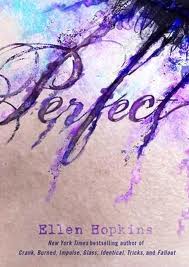
"Perfect" by Ellen Hopkins
**Spoilers!**
Perfect, by Ellen Hopkins, is the story of four high school students struggling with colleges, love, their futures, and what perfect really means.
 This was the first book to get me to cry. Ever. I'm so serious. As an ode to how important this fact is, I read The Five People You Meet in Heaven, and The Faults in Our Stars, both of which I like to think of as a downright sad books, and did not cry during those.
This book was amazing. When I first read the blurb, I thought it was going to be cheesy. But it was so intense and saddening and an amazing mix of poetry and narrative. The stories were so believable it hurt. You could feel all the raw emotion. Hopkins does some of the most amazing things I've ever seen with literature. I loved Crank, probably one of Hopkin's most famous books, but I think this book should be just up there with it.
The ending is what really did me in. It's so impossibly unhappy, but so terribly hopeful. Andre is ready to face his family, but Jenna is raped. Sean's life is permanently messed up and he's borderline crazy thanks to obsession and steroids, Conner dies, but Cara find her true self and finally finds love with Dani.
Kendra is torn and anorexic (and seems to stay that way), but has seen inside her family and admitted her feelings fully for maybe the first time.
It's the mix of jealousy, desire, love, hate, lust, anger, violence, sadness and maliciousness that make this book such a deliciously dark read, and reel you in. The characters seem to each represent something perfect people want in their lives, each one twisting this image painfully, making you realize how fast cracks can form from perfection. Each character gives you a different approach on perfect in people's lives.
I hated Sean. He was so self-involved, and childish, and by the end of the book, I was afraid of him, and afraid of what he thought was right in his twisted, broken mind. He's so creepy and insane at the end, it's hard to imagine anyone like that. His motives started off so pure. He was so in love with Cara, you feel sorry for the guy that she didn't try to justify herself to him at all. She just broke it off, then even though he was hung up over her and one of her best friends (as she mentions in the first part of the book), she doesn't try to explain anything
Cara was near the most relaxed character. Most of the story, she was just crazy in love, and handling it, or thinking about her older brother. I thought that her realizing she was lesbian was a little too fast (like when they're skiing she just automatically says 'Maybe' she's lesbian when Danielle asks? There is no hint of that she is before that. I think it's amazing that she found what she really wanted, but it was kind of forced, especially if it was her first time with a girl. I think she would have been a little more nervous. Though I also didn't read the first book, which could have exposition to this fact in it), but her sadness at the end of the book was just so real. Her crying, "Mommy" and, "Daddy" when Conner died, even though she hated them most of the time and resented them? It was so raw.
Kendra was in so much denial. I wanted an emotional breach. It was almost hard to get attached to her. Her problem was so much more than her eating disorder. She reminded me of a mild Sean, because she only thought of Conner. She used him to justify her own madness.
Andre was also fairly mild compared to everyone else. He should be himself. I think that his relationship with Jenna really made him interesting. He adored and loved her unconditionally. But she was too childish, and too scarred by her parents to reciprocate. It's almost a relief when you see she realizes this. And when she gets raped right after Andre breaks it off with her, it's so sad.
THE BOOK IS SAD.
But...
This book is one of my all time favorite, and always will be.
Perfect, by Ellen Hopkins, is the story of four high school students struggling with colleges, love, their futures, and what perfect really means.
 This was the first book to get me to cry. Ever. I'm so serious. As an ode to how important this fact is, I read The Five People You Meet in Heaven, and The Faults in Our Stars, both of which I like to think of as a downright sad books, and did not cry during those.
 This book was amazing. When I first read the blurb, I thought it was going to be cheesy. But it was so intense and saddening and an amazing mix of poetry and narrative. The stories were so believable it hurt. You could feel all the raw emotion. Hopkins does some of the most amazing things I've ever seen with literature. I loved Crank, probably one of Hopkin's most famous books, but I think this book should be just up there with it.
The ending is what really did me in. It's so impossibly unhappy, but so terribly hopeful. Andre is ready to face his family, but Jenna is raped. Sean's life is permanently messed up and he's borderline crazy thanks to obsession and steroids, Conner dies, but Cara find her true self and finally finds love with Dani.
Kendra is torn and anorexic (and seems to stay that way), but has seen inside her family and admitted her feelings fully for maybe the first time.
It's the mix of jealousy, desire, love, hate, lust, anger, violence, sadness and maliciousness that make this book such a deliciously dark read, and reel you in. The characters seem to each represent something perfect people want in their lives, each one twisting this image painfully, making you realize how fast cracks can form from perfection. Each character gives you a different approach on perfect in people's lives.
I hated Sean. He was so self-involved, and childish, and by the end of the book, I was afraid of him, and afraid of what he thought was right in his twisted, broken mind. He's so creepy and insane at the end, it's hard to imagine anyone like that. His motives started off so pure. He was so in love with Cara, you feel sorry for the guy that she didn't try to justify herself to him at all. She just broke it off, then even though he was hung up over her and one of her best friends (as she mentions in the first part of the book), she doesn't try to explain anything
Cara was near the most relaxed character. Most of the story, she was just crazy in love, and handling it, or thinking about her older brother. I thought that her realizing she was lesbian was a little too fast (like when they're skiing she just automatically says 'Maybe' she's lesbian when Danielle asks? There is no hint of that she is before that. I think it's amazing that she found what she really wanted, but it was kind of forced, especially if it was her first time with a girl. I think she would have been a little more nervous. Though I also didn't read the first book, which could have exposition to this fact in it), but her sadness at the end of the book was just so real. Her crying, "Mommy" and, "Daddy" when Conner died, even though she hated them most of the time and resented them? It was so raw.
Kendra was in so much denial. I wanted an emotional breach. It was almost hard to get attached to her. Her problem was so much more than her eating disorder. She reminded me of a mild Sean, because she only thought of Conner. She used him to justify her own madness.
Andre was also fairly mild compared to everyone else. He should be himself. I think that his relationship with Jenna really made him interesting. He adored and loved her unconditionally. But she was too childish, and too scarred by her parents to reciprocate. It's almost a relief when you see she realizes this. And when she gets raped right after Andre breaks it off with her, it's so sad.
THE BOOK IS SAD.
But...
This book is one of my all time favorite, and always will be.
Wednesday, February 13, 2013
"Breathing Underwater" by Alex Flinn
**Spoilers!**
 I enjoyed this book a lot. My favorite moments were the letters, and seeing how bad the abuse got in the relationship. I couldn't really imagine anyone besides some alcoholic father (like Nick's dad) abusing anyone, but this really shows me that abuse can happen for lots of reasons, and isn't always the reasons we think. I also was surprised about the relationship itself, and gave me an insight to an abusive relationship. The book showed me a lot about the kind of people who get caught in relationships like this, people like Caitlin who don't think they're good enough because of someone (Caitlin's mom), who think the person will be their only hope at a relationship. Also it was interesting that Nick didn't think he was being that harsh, or that we was wrong. It made me really worried for others who are in situations like this, and how they might not even know what they're doing is wrong.
Also is made me sad that Caitlin's or Nick's friends didn't try to help Caitlin when they saw something wrong about the relationship. I think if I ever saw a friend in trouble I would have to tell them, even if it meant losing a friendship.
Overall, this book was really interesting and emotional to read, and I enjoyed it. The movement to Nick's "redemption" was well written, as Alex Flinn is awesome. Read it!
Saturday, January 26, 2013
"Girl in Translation" by Jean Kwok
**Spoilers!!! (MASSIVE SPOILERS!)**
Girl in Translation is the story of Kimberly Chang, a Chinese immigrant from Hong Kong, who travels to New York City with her mother in hopes of a better life. The story follows Kimberly and her mother as they struggle to survive with almost no money and very little opportunity. I really enjoyed this book. I thought it was an interesting and very readable story of a modern immigrant. The characters were interesting to read, and the culture and topic was interesting to learn about.
 One thing I really liked was how Kimberly and Mrs. Chang's culture influenced their decisions. They could have had a much better situation, perhaps as soon as they moved to America, if Mrs. Chang had not felt "in debt" to her sister. Most people in America would think this is strange. Why would you stick around someone who is so obviously not caring about you? Who intentionally hurts your progress towards a better life? But that's the thing about this book, you have to take into account the other culture that is a giant theme and powerful force in the book. I really liked learning about Chinese family dynamic and culture, but thought it wasn't too forced upon the reader. It just let the reader see the logic in the characters minds, and maybe even learn a little like I did.
I usually am not satisfied by endings in stories. However, I was pleased with the ending here. It wasn't shocking or amazing, but it was sweet and short. I really like how the author used the prologue to make is seem as though Kimberly would keep her and Matt's baby that she was pregnant with, and live with Matt. The small twist that she was not living with Matt, but still had the baby at the end of the story as an adult, was also nice.
That's another thing about the book that I like. The author keeps you guessing and reading the entire book. There wasn't one slow part of the book. Kwok had amazing pacing, glazing over whole months to years at a time, but then knowing just when to return to the story. Kwok also knows how to write these sequences, making sure it isn't unsatisfying to be reading something like, "The winter passed quickly...", and just giving enough description so you still know what's happening. It makes the story much more realistic, and easier to follow.
Kwok also sends you a message of you can do what you put your mind to. This book, at it's core, is a classic rags to riches story. She also shows that you can be in tough situations, like poverty, pregnancy, and even sweat shop or other excessive working, and you can still do what you want in school or out of it, and accomplish your goals if you try hard enough. I recommend this book to those who like historical fiction, and just a good realistic fiction story as well.
Girl in Translation is the story of Kimberly Chang, a Chinese immigrant from Hong Kong, who travels to New York City with her mother in hopes of a better life. The story follows Kimberly and her mother as they struggle to survive with almost no money and very little opportunity. I really enjoyed this book. I thought it was an interesting and very readable story of a modern immigrant. The characters were interesting to read, and the culture and topic was interesting to learn about.
 One thing I really liked was how Kimberly and Mrs. Chang's culture influenced their decisions. They could have had a much better situation, perhaps as soon as they moved to America, if Mrs. Chang had not felt "in debt" to her sister. Most people in America would think this is strange. Why would you stick around someone who is so obviously not caring about you? Who intentionally hurts your progress towards a better life? But that's the thing about this book, you have to take into account the other culture that is a giant theme and powerful force in the book. I really liked learning about Chinese family dynamic and culture, but thought it wasn't too forced upon the reader. It just let the reader see the logic in the characters minds, and maybe even learn a little like I did.
I usually am not satisfied by endings in stories. However, I was pleased with the ending here. It wasn't shocking or amazing, but it was sweet and short. I really like how the author used the prologue to make is seem as though Kimberly would keep her and Matt's baby that she was pregnant with, and live with Matt. The small twist that she was not living with Matt, but still had the baby at the end of the story as an adult, was also nice.
That's another thing about the book that I like. The author keeps you guessing and reading the entire book. There wasn't one slow part of the book. Kwok had amazing pacing, glazing over whole months to years at a time, but then knowing just when to return to the story. Kwok also knows how to write these sequences, making sure it isn't unsatisfying to be reading something like, "The winter passed quickly...", and just giving enough description so you still know what's happening. It makes the story much more realistic, and easier to follow.
Kwok also sends you a message of you can do what you put your mind to. This book, at it's core, is a classic rags to riches story. She also shows that you can be in tough situations, like poverty, pregnancy, and even sweat shop or other excessive working, and you can still do what you want in school or out of it, and accomplish your goals if you try hard enough. I recommend this book to those who like historical fiction, and just a good realistic fiction story as well.
Sunday, January 13, 2013
Update: "Girl in Translation" by Jean Kwok
Girl in Translation is the story of Kimberly, a Chinese immigrant from Hong Kong who moves to New York City with her mother.
So far, I'm pleasantly surprised by Girl in Translation. Usually, I'm not the greatest fan of historical fiction (even though this is not that far in the past) or immigrant stories. I usually feel like they're too played out and a lot of the time, not that well written. It's really hard to relate to these characters because of their situation for me, which makes me not enjoy the book as much.
In Girl..., possibly because of the relative modern-ness of the story, I can pretty easily relate to Kimberly as a character. She is a smart, aware character who still has normal wants as an eleven or twelve year old, but is not taken over by these actions. She knows the importance of family, another thing I like about Kimberly.
Also layers of the story are interesting. Kim wants to be accepted by her peers at school and in the factory, but her strong Chinese upbringing is keeping her from totally assimilating. She also wants to please her traditionalist Chinese mother, but at the same time it's hard to do that when you're trying to become more American so you can do well in school and make new friends, even talk to your crush. Kim is a torn character, and I can't wait to watch her as she grows and sees which path she takes.
I was also interested in the Aunt's role in this. Kim's Aunt, Paula, seems very reluctant to help her sister and her niece, for reasons that have been hinted at, but not totally explained. The customs of the Chinese don't let Kim's mother complain about her sister not helping them as much as was promised, but I want to see if the sheer terribleness of Kim and her moms condition makes Kim's mother break away from their customs for a little while.
So far, I'm pleasantly surprised by Girl in Translation. Usually, I'm not the greatest fan of historical fiction (even though this is not that far in the past) or immigrant stories. I usually feel like they're too played out and a lot of the time, not that well written. It's really hard to relate to these characters because of their situation for me, which makes me not enjoy the book as much.
In Girl..., possibly because of the relative modern-ness of the story, I can pretty easily relate to Kimberly as a character. She is a smart, aware character who still has normal wants as an eleven or twelve year old, but is not taken over by these actions. She knows the importance of family, another thing I like about Kimberly.
Also layers of the story are interesting. Kim wants to be accepted by her peers at school and in the factory, but her strong Chinese upbringing is keeping her from totally assimilating. She also wants to please her traditionalist Chinese mother, but at the same time it's hard to do that when you're trying to become more American so you can do well in school and make new friends, even talk to your crush. Kim is a torn character, and I can't wait to watch her as she grows and sees which path she takes.
I was also interested in the Aunt's role in this. Kim's Aunt, Paula, seems very reluctant to help her sister and her niece, for reasons that have been hinted at, but not totally explained. The customs of the Chinese don't let Kim's mother complain about her sister not helping them as much as was promised, but I want to see if the sheer terribleness of Kim and her moms condition makes Kim's mother break away from their customs for a little while.
Sunday, December 16, 2012
"Anya's Ghost" by Vera Brosgol
**Lots of Spoilers!**
Anya's Ghost, by Vera Brosgol is a graphic novel about a girl named Anya. Anya is ashamed about standing out in her little New England town, which includes hiding her hard to pronounce Russian last name and keeping the secret that she used to have a weird accent in kindergarten before she went to ESL, let alone dieting to keep off her muffin top. When Anya falls down an old well to discover a 98-year old body of a young woman, she's scared, yeah. But what's scarier is that the ghost of this certain corpse, named Emily Reilly, starts following Anya around...
 This is the first graphic novel I read this year, and I'm insanely happy with this book. The story and artistic design of the book was awesome and really entertaining to read. It was dark, but not dark enough to give me nightmares. It also had a nice neat message to all us teenage girls in there. I especially connected with Anya.
The book starts off with Anya being really self-conscious, and not a very nice person. She wants to be accepted by the "cool" crowds at school, and does stuff she doesn't want to do, like smoking or dieting so she can work towards that. She is so embarrassed about her family and heritage, which is a giant part of who someone is, that she lies about her last name.
When Emily's character comes in, this pushes Anya to become the person she wants to be, because now she basically knows everything she could hope to. She has her own personal spy. But this also shows Anya the bad side of the "cool" kids. Sure, Anya may not be popular, but she doesn't cheat on her boyfriend like Sean, Anya's crush, did to his girlfriend Elizabeth. Anya has people she can trust. There's a bad side to everything, and you can't want one part of it and not the whole package.
This is what makes Emily's character the antagonist in the end (or the past? I don't know). She can't accept that she can't have what she wants, like Anya did after the party at Matt's house, so Emily snapped. She killed her crush and his girlfriend then died, kind of in the spirit of karma. When she tries to live her life through Anya and that doesn't go the way she wanted it to either, she snaps again, and returns to violence as an answer. Only when Anya explains that you have to be happy with what you have and that you can't have everything you want is when Emily realizes all she's done and leaves the Earth.
Elizabeth, queen bee at Anya's high school, almost did the opposite of Emily, she found out Sean's unfaithfulness and that she couldn't get him the way she wanted, but instead of snapping, she bent so she could still "have" Sean and the image that came with him. She sits idly by while Sean hooks up with other girls. Elizabeth bent so far she broke in a different sense.
I love the illustration too, because it's simple, but descriptive and clear. The color palate is awesome, matches the story perfectly.
Overall, this was a AMAZING book, with an excellent message. You have to be happy with what you have, and make the best of it. I recommend this book to Neil Gaiman and Hellboy fans and anyone (especially girls) who like a good, dark comic book.
Anya's Ghost, by Vera Brosgol is a graphic novel about a girl named Anya. Anya is ashamed about standing out in her little New England town, which includes hiding her hard to pronounce Russian last name and keeping the secret that she used to have a weird accent in kindergarten before she went to ESL, let alone dieting to keep off her muffin top. When Anya falls down an old well to discover a 98-year old body of a young woman, she's scared, yeah. But what's scarier is that the ghost of this certain corpse, named Emily Reilly, starts following Anya around...
This is the first graphic novel I read this year, and I'm insanely happy with this book. The story and artistic design of the book was awesome and really entertaining to read. It was dark, but not dark enough to give me nightmares. It also had a nice neat message to all us teenage girls in there. I especially connected with Anya.The book starts off with Anya being really self-conscious, and not a very nice person. She wants to be accepted by the "cool" crowds at school, and does stuff she doesn't want to do, like smoking or dieting so she can work towards that. She is so embarrassed about her family and heritage, which is a giant part of who someone is, that she lies about her last name.
When Emily's character comes in, this pushes Anya to become the person she wants to be, because now she basically knows everything she could hope to. She has her own personal spy. But this also shows Anya the bad side of the "cool" kids. Sure, Anya may not be popular, but she doesn't cheat on her boyfriend like Sean, Anya's crush, did to his girlfriend Elizabeth. Anya has people she can trust. There's a bad side to everything, and you can't want one part of it and not the whole package.
 |
| a little preview of the art style :) |
This is what makes Emily's character the antagonist in the end (or the past? I don't know). She can't accept that she can't have what she wants, like Anya did after the party at Matt's house, so Emily snapped. She killed her crush and his girlfriend then died, kind of in the spirit of karma. When she tries to live her life through Anya and that doesn't go the way she wanted it to either, she snaps again, and returns to violence as an answer. Only when Anya explains that you have to be happy with what you have and that you can't have everything you want is when Emily realizes all she's done and leaves the Earth.
Elizabeth, queen bee at Anya's high school, almost did the opposite of Emily, she found out Sean's unfaithfulness and that she couldn't get him the way she wanted, but instead of snapping, she bent so she could still "have" Sean and the image that came with him. She sits idly by while Sean hooks up with other girls. Elizabeth bent so far she broke in a different sense.
I love the illustration too, because it's simple, but descriptive and clear. The color palate is awesome, matches the story perfectly.
Overall, this was a AMAZING book, with an excellent message. You have to be happy with what you have, and make the best of it. I recommend this book to Neil Gaiman and Hellboy fans and anyone (especially girls) who like a good, dark comic book.
Saturday, December 1, 2012
"Cinder" by Marissa Meyer
**Slight Spoilers!**
Cinder, by Marissa Meyer, is a futuristic sci-fi retelling of the classic fairy tale Cinderella. Cinder is a cyborg mechanic in New Beijing far in the future. Adopted by her current family from Europe when she was eleven, Cinder has been forced to work for her stay since her adoptive father died fromt the fatal disease lemutosis, or the blue fever. Lemutosis has reached epidemic outbreak levels in the Eastern Commonwealth. Cinder, with her natural affinity for technology, has risen to become the best mechanic in New Beijing, even with her second class citizen position as a cyborg. When the handsome and charming crown prince Kai comes to her shop with an android containing mysterious intel, she begins to learn that not everything is as it seems about her past.
 I LOVED this book so much. For one thing, I love spins on stories. Creative retelling is something I like. It adds a new level to the story. I find that it's also just really fun to read and point out the little reference to the story. I also like spin-off books for this reason. Meyer creates a vivid world that I just want to know more about. Even stuff in real life I wouldn't really be interested in I want to know, like details about the history of each country (all 7 of them), where their borders end, their full relationship with the Lunars, and whether they colonized any other planets. I really liked the characters in this book as well. Cinder is strong as a character, but also has normal wishes and wants. Because she's a cyborg, it makes you want to root for her even more.
The book, because mainly of the cyborg issue, deals with discrimination as well. I would think that people who were part-mechanical (cyborg), though they would be strange, would be accepted. Cinder says in the book all cyborgs were basically just the way they were because of a nearly fatal accident. I would think that because they're not using their condition for their personal advancement, no one would have a problem. This is a little like the discrimination after the Civil Rights Act was passed. The African Americans were still treated badly, though now, legally, they could do whatever white people in American could. I guess even in the future, people are afraid of what they don't understand.
Just a note, I love that the author was a Sailor Moon fan fiction writer before she even published this book, which is her first book. I love the subtle Sailor Moon references too... people with "magical" powers who live on the moon... have a lost princess who lives on Earth... it's awesome.
The next books are equally as exciting as this one. Though, since it's a new series, I have to wait for them to come out (which is the problem with reading new series), they're supposed to be about Little Red Riding Hood, Rapunzel, then Snow White. I'm getting pumped just thinking about it...
I can't wait for Scarlet, the next book in the Lunar Chronicles, to come out in February 2013. I already pre-ordered it, but I'm dying without knowing what happens. I have literally read the first chapter preview twenty times. I recommend this to fans of Wither, Hunger Games, and other futuristic books that follow that pattern... except this one has better characters and background.
Cinder, by Marissa Meyer, is a futuristic sci-fi retelling of the classic fairy tale Cinderella. Cinder is a cyborg mechanic in New Beijing far in the future. Adopted by her current family from Europe when she was eleven, Cinder has been forced to work for her stay since her adoptive father died fromt the fatal disease lemutosis, or the blue fever. Lemutosis has reached epidemic outbreak levels in the Eastern Commonwealth. Cinder, with her natural affinity for technology, has risen to become the best mechanic in New Beijing, even with her second class citizen position as a cyborg. When the handsome and charming crown prince Kai comes to her shop with an android containing mysterious intel, she begins to learn that not everything is as it seems about her past.
I LOVED this book so much. For one thing, I love spins on stories. Creative retelling is something I like. It adds a new level to the story. I find that it's also just really fun to read and point out the little reference to the story. I also like spin-off books for this reason. Meyer creates a vivid world that I just want to know more about. Even stuff in real life I wouldn't really be interested in I want to know, like details about the history of each country (all 7 of them), where their borders end, their full relationship with the Lunars, and whether they colonized any other planets. I really liked the characters in this book as well. Cinder is strong as a character, but also has normal wishes and wants. Because she's a cyborg, it makes you want to root for her even more.The book, because mainly of the cyborg issue, deals with discrimination as well. I would think that people who were part-mechanical (cyborg), though they would be strange, would be accepted. Cinder says in the book all cyborgs were basically just the way they were because of a nearly fatal accident. I would think that because they're not using their condition for their personal advancement, no one would have a problem. This is a little like the discrimination after the Civil Rights Act was passed. The African Americans were still treated badly, though now, legally, they could do whatever white people in American could. I guess even in the future, people are afraid of what they don't understand.
Just a note, I love that the author was a Sailor Moon fan fiction writer before she even published this book, which is her first book. I love the subtle Sailor Moon references too... people with "magical" powers who live on the moon... have a lost princess who lives on Earth... it's awesome.
The next books are equally as exciting as this one. Though, since it's a new series, I have to wait for them to come out (which is the problem with reading new series), they're supposed to be about Little Red Riding Hood, Rapunzel, then Snow White. I'm getting pumped just thinking about it...
I can't wait for Scarlet, the next book in the Lunar Chronicles, to come out in February 2013. I already pre-ordered it, but I'm dying without knowing what happens. I have literally read the first chapter preview twenty times. I recommend this to fans of Wither, Hunger Games, and other futuristic books that follow that pattern... except this one has better characters and background.
Thursday, November 22, 2012
Essay: Child Soliders, Perpetrators of Victims?
“As the nature of armed conflict has changed in recent years, the practice of using children--defined under international law as those under age 18--as soldiers has become far more common and widespread. As many as 300,000 child 17 and under now serve worldwide as combatants,” says P.W. Singer in his book Children at War. The use of child soldiers has become more and more frequent in recent years. Often working for rebel groups in developing countries, child soldiers can be girls, boys, fighters, messenger. Child soldiers is a topic that is very controversial. These are still, as stated, children, but they kill people, a lot of the time innocent people. Some people may argue that child soldiers are perpetrators in their crimes. But I believe that child soldiers are victims.
Many child soldiers are taken advantage of in conflicts situations. In the article, “Armed & Underaged” by Jeffrey Gettleman, he says, “Few adults want to have anything to do with these rebel commanders, so manipulating and abducting children becomes the best way to sustain their organized banditry.” Many children are in fact kidnapped, or as Ishmael Beah says in his interview with Katie Couric on CBS, “forcefully recruited” into the military or as a soldier in their organization. They don’t even have a choice in the matter. It’s comply or be killed. Many children are even given drugs so they follow commands and don’t object to orders. Their addiction slowly grows so they depend on drugs as well. “It is less an army than a drugged-out street gang with military grade weapons,” says Jeffrey Gettleman in “Armed and Underaged”. Even worse, some children are even sold by their own parents into these situations.
For those child soldiers where their decision to join a military group was voluntary, it was most likely out of survival. According to the United Nations on their “Special Concern” website page, child soldiers are most likely to be children who are from “impoverished and marginalized backgrounds, or separated from their families.” Ishmael Beah attempted to go to the military for help, and was forced to be recruited. Many other children may have just seen the opportunity for survival and taken it. These children have very few options, and turn to the life that they don’t necessarily want to participate in. There are very few resources in the countries where conditions like this are occurring, and the chance you’ll be saved by a charity right away is slim.
Children don’t want to kill either. As I said above, children do this for survival, not out of enjoyment. Jeffrey Gettleman says in “Armed & Underaged”, “‘Child soldiers are ideal,’ a military commander from Chad told Human Rights Watch. ‘They don’t complain, they don’t expect to be paid--and when you tell them to kill, they kill.’” Children don’t have an incentive besides to live to join these armies. Children are often traumatized when they first have to kill. P.W. Singer says in Children at War, “‘They trained us to fight,’ the boy continues. ‘The first time I killed someone, I got so sick, I thought I was going to die. But I got better...’” The children may be desensitized to the violence after a while, but it doesn’t mean they ever wanted to kill. Children are even traumatized for other reasons than the horrible killing, coming out of their time serving as child soldiers with drug addiction or trauma from rape or sexual abuse.
Child soldiers are victims, through and through. They are taken advantage of and abused when they’re in situations where they need help, and when they’re not, they become child soldiers to survive, no because they want to, or because they enjoy killing. Children are being left as orphans, then join the very causes that killed their families. Kids are being convinced to become suicide bombers for terrorist organizations without knowing anything about why they’re doing it. There are so many charities and programs, like the military-run detainment facility “Camp Iguana”, trying to help these boys and girls, but they can’t help every child, which is sad. Some ex-child soldiers, even after war, just wandering to find more work as soldiers. It’s the only thing they know how to do. Until renegade, selfish groups that use innocent children for their dirty work is stopped, this will still be a problem. I think it might always be a problem. There are always people who have skewed versions of what is acceptable. These people might not even necessarily want to do this, they might just think it’s needed. But it’s not, and it should never be.
Many child soldiers are taken advantage of in conflicts situations. In the article, “Armed & Underaged” by Jeffrey Gettleman, he says, “Few adults want to have anything to do with these rebel commanders, so manipulating and abducting children becomes the best way to sustain their organized banditry.” Many children are in fact kidnapped, or as Ishmael Beah says in his interview with Katie Couric on CBS, “forcefully recruited” into the military or as a soldier in their organization. They don’t even have a choice in the matter. It’s comply or be killed. Many children are even given drugs so they follow commands and don’t object to orders. Their addiction slowly grows so they depend on drugs as well. “It is less an army than a drugged-out street gang with military grade weapons,” says Jeffrey Gettleman in “Armed and Underaged”. Even worse, some children are even sold by their own parents into these situations.
For those child soldiers where their decision to join a military group was voluntary, it was most likely out of survival. According to the United Nations on their “Special Concern” website page, child soldiers are most likely to be children who are from “impoverished and marginalized backgrounds, or separated from their families.” Ishmael Beah attempted to go to the military for help, and was forced to be recruited. Many other children may have just seen the opportunity for survival and taken it. These children have very few options, and turn to the life that they don’t necessarily want to participate in. There are very few resources in the countries where conditions like this are occurring, and the chance you’ll be saved by a charity right away is slim.
Children don’t want to kill either. As I said above, children do this for survival, not out of enjoyment. Jeffrey Gettleman says in “Armed & Underaged”, “‘Child soldiers are ideal,’ a military commander from Chad told Human Rights Watch. ‘They don’t complain, they don’t expect to be paid--and when you tell them to kill, they kill.’” Children don’t have an incentive besides to live to join these armies. Children are often traumatized when they first have to kill. P.W. Singer says in Children at War, “‘They trained us to fight,’ the boy continues. ‘The first time I killed someone, I got so sick, I thought I was going to die. But I got better...’” The children may be desensitized to the violence after a while, but it doesn’t mean they ever wanted to kill. Children are even traumatized for other reasons than the horrible killing, coming out of their time serving as child soldiers with drug addiction or trauma from rape or sexual abuse.
Child soldiers are victims, through and through. They are taken advantage of and abused when they’re in situations where they need help, and when they’re not, they become child soldiers to survive, no because they want to, or because they enjoy killing. Children are being left as orphans, then join the very causes that killed their families. Kids are being convinced to become suicide bombers for terrorist organizations without knowing anything about why they’re doing it. There are so many charities and programs, like the military-run detainment facility “Camp Iguana”, trying to help these boys and girls, but they can’t help every child, which is sad. Some ex-child soldiers, even after war, just wandering to find more work as soldiers. It’s the only thing they know how to do. Until renegade, selfish groups that use innocent children for their dirty work is stopped, this will still be a problem. I think it might always be a problem. There are always people who have skewed versions of what is acceptable. These people might not even necessarily want to do this, they might just think it’s needed. But it’s not, and it should never be.
"The Faults in Our Stars" by John Green
**Spoilers!!**
I recently finished The Faults in Our Stars by John Green. This book is about Hazel Grace, a sixteen-year old cancer patient who knows she might not live until her next birthday. She meets the charismatic, attractive Augustus Waters at a cancer support group, and her life is changed forever.
 I really loved this book. I loved the narration style and the characters voices, and the ending especially. It was really touching and sad, but really hopeful too.I though it was following Hazel's character that she wouldn't be blubbering over Gus for weeks. She would be sad, but strong and now that he was in terrible pain before, and he wasn't anymore. But she also knew that he would much rather be alive than dead.
I thought a symbol for life in the book was Mr. Van Houten. He was what Hazel was looking forwards to, and thought that he was the best thing that ever happened to her. She ended up seeing that he was often terrible and not fair. For example, Hazel thought he would be smart and kind and a wise, good person. Just by reading his books, she assumed this about him. In reality, he was a kind of crazy messed up old man who didn't know how to handle grief.
This is corresponding with the moment in life Hazel found out she had cancer. She, as a child, was looking forward to life and all it had, but she soon realized that life isn't fair, and most of the time tragic. Following Hazel's attitude towards cancer, she doesn't give up on or to Mr. Van Houten, she stand up to him, and just does what makes her happy. She doesn't pretend as if it doesn't hurt her that Van Houten ended up being annoying and sad, but she knows that she can't change him.
Van Houten represents the main events of Hazel's life in one three-day trip. At the end of the book, after Augustus dies, Van Houten shows that he (or life) is disappointing for reasons, and that it can always redeem itself. The near-redemption of Van Houten is representing Hazel meeting Augustus.
Again, this book is amazing. Really, just amazing, and it's just so... AMAZING. I recommend to fans of books like 13 Reasons Why and definitely any other John Green books. Also, just saying, I was right with my prediction from the last post.
I recently finished The Faults in Our Stars by John Green. This book is about Hazel Grace, a sixteen-year old cancer patient who knows she might not live until her next birthday. She meets the charismatic, attractive Augustus Waters at a cancer support group, and her life is changed forever.
I really loved this book. I loved the narration style and the characters voices, and the ending especially. It was really touching and sad, but really hopeful too.I though it was following Hazel's character that she wouldn't be blubbering over Gus for weeks. She would be sad, but strong and now that he was in terrible pain before, and he wasn't anymore. But she also knew that he would much rather be alive than dead.I thought a symbol for life in the book was Mr. Van Houten. He was what Hazel was looking forwards to, and thought that he was the best thing that ever happened to her. She ended up seeing that he was often terrible and not fair. For example, Hazel thought he would be smart and kind and a wise, good person. Just by reading his books, she assumed this about him. In reality, he was a kind of crazy messed up old man who didn't know how to handle grief.
This is corresponding with the moment in life Hazel found out she had cancer. She, as a child, was looking forward to life and all it had, but she soon realized that life isn't fair, and most of the time tragic. Following Hazel's attitude towards cancer, she doesn't give up on or to Mr. Van Houten, she stand up to him, and just does what makes her happy. She doesn't pretend as if it doesn't hurt her that Van Houten ended up being annoying and sad, but she knows that she can't change him.
Van Houten represents the main events of Hazel's life in one three-day trip. At the end of the book, after Augustus dies, Van Houten shows that he (or life) is disappointing for reasons, and that it can always redeem itself. The near-redemption of Van Houten is representing Hazel meeting Augustus.
Again, this book is amazing. Really, just amazing, and it's just so... AMAZING. I recommend to fans of books like 13 Reasons Why and definitely any other John Green books. Also, just saying, I was right with my prediction from the last post.
Sunday, November 18, 2012
Update: "The Faults in Our Stars" by John Green
**Kind of Spoilers...**
I love The Faults in Our Stars so far. The characters are unique and strong, realistic and lovable. I've liked all of John Green that I have read so far, and I realized something while reading Faults in Our Stars (hereby referred to as Faults). Green uses the same basic theme and building blocks for all his stories. It sure works too, as Paper Towns and Looking for Alaska are big hits.
The "John Green format" is as follows:
1) The Quirky Characters-- the main characters of his books are usually ironic and cynical, kind at heart and down to earth, who have a lower social status. Their counterparts and free-spirited, quirky dreamers who don't care about what others think, who are popular or attractive. The chemistry between these two is so hot you could be physically be burned by them. And guess what- they fall in love!
2) The Adventure- there is always a manic adventure in Green's stories, usually, a search for someone. In Looking for Alaska, it was not necessarily a person, but the journey part still applies. This is maybe the bulk of the story, and often the most fast-paced part of the story.
3) The Loss- there is always a loss or disappointment at the end of Green's stories. It makes the story possibly even more quirky, veering away from the "happily ever after" story. It happened (kind of) in Looking for Alaska, and definitely in Paper Towns.
Don't get me wrong, I write this all out of pure admiration and love, because John Green is really talented young adult writer, and I love his stories. It works, and big enough change in characters and situations can still make the story fresh. It makes for a great read.
The format above is what leads me to believe that there will be a tragedy at the end of Faults. The whole story rotates around patients of cancer, and loss is a normal thing in their lives. They always know they're living on the edge of death and life. Because of Hazel, the main character's, situation, I believe that she will die at the end. Or, possibly, Augustus' cancer will return. This is a morbid theory, but I think it to be true.
One thing in Faults that bothers me so far is the way the characters deal with the tragedy in their lives. This is a really sensitive subject, and I have no experience in terminal illness, so I don't have any evidence. But I think that even though Hazel has been struggling with cancer for a couple years, I don't think she would be so oblivious of it. It changes you life forever, I know that much, and the way Green handles it, with wit and humor, though it makes for a good story, I don't think it accurately shows the pain and horrible things these people have to go through every day so they can survive. But I don't really know. I suppose it's different for everyone, but someone with as bad of a case as Hazel, I think that even in the beginning of the book, where she is for the most part stable, she would have a harder time handling it.
I really can't wait to finish this book, and I love the smart wit that Green sticks every where... Can't wait until they go to Amsterdam!
I love The Faults in Our Stars so far. The characters are unique and strong, realistic and lovable. I've liked all of John Green that I have read so far, and I realized something while reading Faults in Our Stars (hereby referred to as Faults). Green uses the same basic theme and building blocks for all his stories. It sure works too, as Paper Towns and Looking for Alaska are big hits.
The "John Green format" is as follows:
1) The Quirky Characters-- the main characters of his books are usually ironic and cynical, kind at heart and down to earth, who have a lower social status. Their counterparts and free-spirited, quirky dreamers who don't care about what others think, who are popular or attractive. The chemistry between these two is so hot you could be physically be burned by them. And guess what- they fall in love!
2) The Adventure- there is always a manic adventure in Green's stories, usually, a search for someone. In Looking for Alaska, it was not necessarily a person, but the journey part still applies. This is maybe the bulk of the story, and often the most fast-paced part of the story.
3) The Loss- there is always a loss or disappointment at the end of Green's stories. It makes the story possibly even more quirky, veering away from the "happily ever after" story. It happened (kind of) in Looking for Alaska, and definitely in Paper Towns.
Don't get me wrong, I write this all out of pure admiration and love, because John Green is really talented young adult writer, and I love his stories. It works, and big enough change in characters and situations can still make the story fresh. It makes for a great read.
The format above is what leads me to believe that there will be a tragedy at the end of Faults. The whole story rotates around patients of cancer, and loss is a normal thing in their lives. They always know they're living on the edge of death and life. Because of Hazel, the main character's, situation, I believe that she will die at the end. Or, possibly, Augustus' cancer will return. This is a morbid theory, but I think it to be true.
One thing in Faults that bothers me so far is the way the characters deal with the tragedy in their lives. This is a really sensitive subject, and I have no experience in terminal illness, so I don't have any evidence. But I think that even though Hazel has been struggling with cancer for a couple years, I don't think she would be so oblivious of it. It changes you life forever, I know that much, and the way Green handles it, with wit and humor, though it makes for a good story, I don't think it accurately shows the pain and horrible things these people have to go through every day so they can survive. But I don't really know. I suppose it's different for everyone, but someone with as bad of a case as Hazel, I think that even in the beginning of the book, where she is for the most part stable, she would have a harder time handling it.
I really can't wait to finish this book, and I love the smart wit that Green sticks every where... Can't wait until they go to Amsterdam!
Monday, November 12, 2012
Update: "The Adoration of Jenna Fox" by Mary E. Pearson
**Spoilers!**
I'm currently reading The Adoration of Jenna Fox, by Mary E. Pearson. Unfortunately, I was not correct with my clone theory. It makes me a little sad, but the alternative I guess, though not as much as a plot twist as Jenna being a clone, makes more sense.
I noticed I was partly right though. Jenna's whole body is basically a clone of herself, and her brain and body has been changed to be more perfect, like how someone could change a clone to perfection.
The conflict that this presents to Jenna is really interesting, and I love watching Jenna grow. Though personally, I don't see anything wrong with her, Jenna first found herself disgusting, and can't trust her own body. Finally, when she comes to accept this and when she was in a state where she could just live her life safely and legally from then on, she lets Allys discover her secret. I know, it's not like Jenna told Allys, but she knew she couldn't hide it, and didn't do anything about it. I don't really understand why Jenna did this. I think it was the fact that Jenna knew that she had to move on from the "perfect" world if she wanted to move on with her life. She couldn't live under her mother and father forever, because they would treat her like a piece of fine art, just put her away and admire her. They wouldn't want her to be used in real life.
I also think Allys, though having a point in her argument against significant biological enhancement, is angry about her own situation. Allys believe that it's unfair that some people should have more than she does. She needed more than limbs, but she couldn't get them, and is dying because of it. She doesn't think anyone should have more than what she did. I do agree that one person, like Jenna, shouldn't be enhanced, and that death should be expected almost as much as life. People can't avoid death forever, and Allys knows that. What Jenna's parents did was wrong, sure, but I think if someone's life is in the balance, and you can pretty much restore them to normal by giving them organs they need, you shouldn't need to consider how many "points" they have to do it.
Allys knew she was dying, and I do believe that she believed what she thought, but I think Allys shouldn't have told her parents that Jenna was illegal just to make her life harder, and that her view points were clouded by her anger towards her own disease and the way it was handled.
I'm currently reading The Adoration of Jenna Fox, by Mary E. Pearson. Unfortunately, I was not correct with my clone theory. It makes me a little sad, but the alternative I guess, though not as much as a plot twist as Jenna being a clone, makes more sense.
I noticed I was partly right though. Jenna's whole body is basically a clone of herself, and her brain and body has been changed to be more perfect, like how someone could change a clone to perfection.
The conflict that this presents to Jenna is really interesting, and I love watching Jenna grow. Though personally, I don't see anything wrong with her, Jenna first found herself disgusting, and can't trust her own body. Finally, when she comes to accept this and when she was in a state where she could just live her life safely and legally from then on, she lets Allys discover her secret. I know, it's not like Jenna told Allys, but she knew she couldn't hide it, and didn't do anything about it. I don't really understand why Jenna did this. I think it was the fact that Jenna knew that she had to move on from the "perfect" world if she wanted to move on with her life. She couldn't live under her mother and father forever, because they would treat her like a piece of fine art, just put her away and admire her. They wouldn't want her to be used in real life.
I also think Allys, though having a point in her argument against significant biological enhancement, is angry about her own situation. Allys believe that it's unfair that some people should have more than she does. She needed more than limbs, but she couldn't get them, and is dying because of it. She doesn't think anyone should have more than what she did. I do agree that one person, like Jenna, shouldn't be enhanced, and that death should be expected almost as much as life. People can't avoid death forever, and Allys knows that. What Jenna's parents did was wrong, sure, but I think if someone's life is in the balance, and you can pretty much restore them to normal by giving them organs they need, you shouldn't need to consider how many "points" they have to do it.
Allys knew she was dying, and I do believe that she believed what she thought, but I think Allys shouldn't have told her parents that Jenna was illegal just to make her life harder, and that her view points were clouded by her anger towards her own disease and the way it was handled.
Friday, November 9, 2012
Update: "The Adoration of Jenna Fox", by Mary E. Pearson
**Slight Spoilers!**
I'm currently reading The Adoration of Jenna Fox by Mary E. Pearson. So far, I love this book. It's very detail oriented and poetic. It's sci-fi, but has the emotional levels of the realistic fiction book. I love the almost child-like view of the world by Jenna too. It makes the book more and more interesting to read with a character who has a blank slate, and is literally developing before your eyes.
One thing I find really intriguing is the mystery surrounding Jenna Fox's past. Her family refuses to tell her anything, she abruptly relocated right after the accident, was seemingly in a medically induced coma most of her coma, and was awakened at a specific time. This makes the book another level to me, because besides having an interesting premise and being futuristic, it has mystery.
One theory I have about the secrecy about Jenna's past is that the Jenna Fox who is narrating the story is a clone saved at last minute after the accident. The original Jenna is dead, and her brain has been put into the new cloned Jenna (to keep personality), being sustained by using BioGel.
The first thing that led me to this is that on page 31 of the book, Jenna's mother starts to talk about miracles. She says as speaking to her mother, Lily, "Stop! You of all people should understand. If it wasn't for invitro, I wouldn't be here. You always called me your miracle. Why can't I have one too? When do you get to decide when the miracles end?" Though I'm not sure what "invitro" is, I think we can assume it's some technological or medical breakthrough for saving lives in the future, as it saved Jenna's mother's, Claire's, life. Lily continues to say that Jenna is "Not natural." Now why would a grandmother say this about her granddaughter unless she thought she was altered in some way that made her radically different from everyone else? Like cloning.
Also, Lily often talks about how she accepts when she will die around Jenna, something she never says around her daughter, Claire, meaning that she thought Claire should accept losses, possibly of Jenna. At first, I just interpreted this as Jenna losing so much as her life, and not remembering anything, and the random ominous conversation because Lily was kind of random, but as I read on, I saw more and more odd evidence, leaving me to the cloning conclusion.
For instance, the present-day Jenna doesn't have a scar, as she saw in the video of her as a ten year old. A large and obvious scar would at least be slightly visible only ten years later. If a cloned body was made of Jenna, without all her injuries, the scar wouldn't be present. Another reason why I think this is that none of Jenna's friends have tried to contact her. This shows that in the very least, her Claire and Lily, almost abducted Jenna away from her old life in Boston, cutting all connections. Even if this explanation was true, this would raise more questions. If her friends believed her to be dead, then they wouldn't try to find her, or talk to her, right?
Also, when Allys is talking about the control of the school, she leads to the "Federal Science Ethics Board." Through the conversation, she clearly states human cloning was attempted and succeeded. She also expresses her disstress over how far human preservation will go, and how it at one point just becomes too unnatural, which shows some people share a view with Lily. The thing that interested me most was that human brains are the most taboo and expensive organ to be transplanted.
Allys says that "Only biodigital enhancement up to forty-nine percent is allowed to restore some lost function and that's it." This would explain why Jenna lost much of her personality, and all of her memories. On how her family got the permission to take the brain from old-Jenna's body, her father invented BioGel. Lily stated that Jenna's family was "filthy rich", which would probably cover the brain, and be enough to pay to get Jenna cloned and her brain to be put "on ice", so to speak, with BioGel. Who knows, Jenna could even be experimental, which would explain the man at the church spying and photographing her when she was with Ethan.
All this compiled just make me more and more confident that Jenna is some sort of clone. This book makes me excited to read it, and I can't wait to finish it and see what really happened, and see if I got it right.
I'm currently reading The Adoration of Jenna Fox by Mary E. Pearson. So far, I love this book. It's very detail oriented and poetic. It's sci-fi, but has the emotional levels of the realistic fiction book. I love the almost child-like view of the world by Jenna too. It makes the book more and more interesting to read with a character who has a blank slate, and is literally developing before your eyes.
One thing I find really intriguing is the mystery surrounding Jenna Fox's past. Her family refuses to tell her anything, she abruptly relocated right after the accident, was seemingly in a medically induced coma most of her coma, and was awakened at a specific time. This makes the book another level to me, because besides having an interesting premise and being futuristic, it has mystery.
One theory I have about the secrecy about Jenna's past is that the Jenna Fox who is narrating the story is a clone saved at last minute after the accident. The original Jenna is dead, and her brain has been put into the new cloned Jenna (to keep personality), being sustained by using BioGel.
The first thing that led me to this is that on page 31 of the book, Jenna's mother starts to talk about miracles. She says as speaking to her mother, Lily, "Stop! You of all people should understand. If it wasn't for invitro, I wouldn't be here. You always called me your miracle. Why can't I have one too? When do you get to decide when the miracles end?" Though I'm not sure what "invitro" is, I think we can assume it's some technological or medical breakthrough for saving lives in the future, as it saved Jenna's mother's, Claire's, life. Lily continues to say that Jenna is "Not natural." Now why would a grandmother say this about her granddaughter unless she thought she was altered in some way that made her radically different from everyone else? Like cloning.
Also, Lily often talks about how she accepts when she will die around Jenna, something she never says around her daughter, Claire, meaning that she thought Claire should accept losses, possibly of Jenna. At first, I just interpreted this as Jenna losing so much as her life, and not remembering anything, and the random ominous conversation because Lily was kind of random, but as I read on, I saw more and more odd evidence, leaving me to the cloning conclusion.
For instance, the present-day Jenna doesn't have a scar, as she saw in the video of her as a ten year old. A large and obvious scar would at least be slightly visible only ten years later. If a cloned body was made of Jenna, without all her injuries, the scar wouldn't be present. Another reason why I think this is that none of Jenna's friends have tried to contact her. This shows that in the very least, her Claire and Lily, almost abducted Jenna away from her old life in Boston, cutting all connections. Even if this explanation was true, this would raise more questions. If her friends believed her to be dead, then they wouldn't try to find her, or talk to her, right?
Also, when Allys is talking about the control of the school, she leads to the "Federal Science Ethics Board." Through the conversation, she clearly states human cloning was attempted and succeeded. She also expresses her disstress over how far human preservation will go, and how it at one point just becomes too unnatural, which shows some people share a view with Lily. The thing that interested me most was that human brains are the most taboo and expensive organ to be transplanted.
Allys says that "Only biodigital enhancement up to forty-nine percent is allowed to restore some lost function and that's it." This would explain why Jenna lost much of her personality, and all of her memories. On how her family got the permission to take the brain from old-Jenna's body, her father invented BioGel. Lily stated that Jenna's family was "filthy rich", which would probably cover the brain, and be enough to pay to get Jenna cloned and her brain to be put "on ice", so to speak, with BioGel. Who knows, Jenna could even be experimental, which would explain the man at the church spying and photographing her when she was with Ethan.
All this compiled just make me more and more confident that Jenna is some sort of clone. This book makes me excited to read it, and I can't wait to finish it and see what really happened, and see if I got it right.
Wednesday, November 7, 2012
"Wintergirls" by Laurie Halse Anderson
**Spoilers!!**
I recently finished Wintergirls by Laurie Halse Anderson. Wintergirls tells the story of Lia, a girl whose best friend recently just died. Lia struggles with dealing with the sudden and strange absence in her life, while having to deal with her own problems.
 I thought this book was beautiful, and very poetic. It was a lot like Speak, also by Laurie Halse Anderson, but also completely different. This was almost the complete opposite of Speak in writing style, as Speak was mostly in the future, never looking back, straight forwards. Wintergirls led the reader through Lia's whole mind before we can get to her real problems and guilt. Halse Anderson's style still shines through. In some ways, I enjoyed this book more than Speak, for many reasons.
I thought the word wintergirls by itself was amazing. It wrapped up the book in a tight little ribbon. I was really confused about the title at first, but pretty soon I understood way too well.
This book is morbid, and sad, and hopeful, and scary. It broke my heart when Elijah left Lia by herself in the hotel room. He knew what had happened there. He knew she was on the edge of death. He knew she was seeing things, and she lied to him about being "okay." I imagined what it would be like if Lia went with Elijah, because Cassie wouldn't haunt her. I realized that she would probably have gotten better. But Elijah did the right thing. Lia loved her family too much to leave them behind, and she might not have gotten better it she was out on the road, not being able to come to terms with Cassie's death.
Another thing I liked was the strong character voice in the book. In the beginning, Lia shows no remorse. No regret. She wants to be skinny. Halse Anderson doesn't write it from a person free from eating disorders, she writes like she had one. Lia's character never gives herself some slack, or even thinks about stopping while she's at her worst, in the middle of the book.
I really loved this book so much, and recommend it to fans of Speak and 13 Reasons Why. I hope the next book I read lives up to Wintergirls.
I recently finished Wintergirls by Laurie Halse Anderson. Wintergirls tells the story of Lia, a girl whose best friend recently just died. Lia struggles with dealing with the sudden and strange absence in her life, while having to deal with her own problems.
I thought this book was beautiful, and very poetic. It was a lot like Speak, also by Laurie Halse Anderson, but also completely different. This was almost the complete opposite of Speak in writing style, as Speak was mostly in the future, never looking back, straight forwards. Wintergirls led the reader through Lia's whole mind before we can get to her real problems and guilt. Halse Anderson's style still shines through. In some ways, I enjoyed this book more than Speak, for many reasons.I thought the word wintergirls by itself was amazing. It wrapped up the book in a tight little ribbon. I was really confused about the title at first, but pretty soon I understood way too well.
This book is morbid, and sad, and hopeful, and scary. It broke my heart when Elijah left Lia by herself in the hotel room. He knew what had happened there. He knew she was on the edge of death. He knew she was seeing things, and she lied to him about being "okay." I imagined what it would be like if Lia went with Elijah, because Cassie wouldn't haunt her. I realized that she would probably have gotten better. But Elijah did the right thing. Lia loved her family too much to leave them behind, and she might not have gotten better it she was out on the road, not being able to come to terms with Cassie's death.
Another thing I liked was the strong character voice in the book. In the beginning, Lia shows no remorse. No regret. She wants to be skinny. Halse Anderson doesn't write it from a person free from eating disorders, she writes like she had one. Lia's character never gives herself some slack, or even thinks about stopping while she's at her worst, in the middle of the book.
I really loved this book so much, and recommend it to fans of Speak and 13 Reasons Why. I hope the next book I read lives up to Wintergirls.
Subscribe to:
Posts (Atom)