Showing posts with label power. Show all posts

Sunday, April 7, 2013

"White Cat" by Holly Black (Curse Workers Series #1)

I've almost come to the end of the book, "White Cat" by Holly Black, the first book of the Curse Workers series. The book tells the story of Cassel, a non-worker in a well known family of workers who work for one infamous working crime families. In the world of the book, "workers" are gifted individuals who can manipulate certain elements of a person- whether it is their emotions, luck, or even their very life. I've really enjoyed this book so far for multiple reasons.

I really liked the unique mythology and magic in this book, specifically the workers. Though the abilities they possess aren't unique only to the book, the way the author portrays these powers make them very interesting. I like the idea of "blowback" being established in the book, putting a limit on these very powerful powers. I also love that the powers are used in a mob or mafia style setting. In many books using magic, most of the people using this magic are good, but when you think about it, unfortunately, most would be using the magic for their own advantage, such as crime in the mob. People are selfish, it's the bottom line.

I also like how Holly Black wrote the characters in the book. She made the main chara
cter, Cassel, quite weak, but is a boy. It breaks the boundaries of female characters having to be weak, and men always having to save them. In fact, towards the end of the book, a stronger female character mostly controls the events that occur that change the plot. Holly Black as an author, to me, has shown she can write many different kind of characters as well. I've read a lot of her work and am further impressed with the diversity in her characters that make each one of them interesting on their own way. Many authors seem to reuse the same kind of character in each other their books.

As I've mentioned before in posts about Holly Black and her work, she creates an amazing universe around her books, one that makes sense and that you can get lost in, which is one of my favorite parts of her books. I can't wait to read the rest of the series, and to further 'get lost' in the Curse Workers world!

Sunday, March 31, 2013

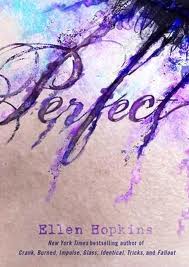
"Perfect" by Ellen Hopkins

**Spoilers!**

Perfect, by Ellen Hopkins, is the story of four high school students struggling with colleges, love, their futures, and what perfect really means.


This was the first book to get me to cry. Ever. I'm so serious. As an ode to how important this fact is, I read The Five People You Meet in Heaven, and The Faults in Our Stars, both of which I like to think of as a downright sad books, and did not cry during those. 

This book was amazing. When I first read the blurb, I thought it was going to be cheesy. But it was so intense and saddening and an amazing mix of poetry and narrative. The stories were so believable it hurt. You could feel all the raw emotion. Hopkins does some of the most amazing things I've ever seen with literature. I loved Crank, probably one of Hopkin's most famous books, but I think this book should be just up there with it.

The ending is what really did me in. It's so impossibly unhappy, but so terribly hopeful. Andre is ready to face his family, but Jenna is raped. Sean's life is permanently messed up and he's borderline crazy thanks to obsession and steroids, Conner dies, but Cara find her true self and finally finds love with Dani. 

Kendra is torn and anorexic (and seems to stay that way), but has seen inside her family and admitted her feelings fully for maybe the first time.

It's the mix of jealousy, desire, love, hate, lust, anger, violence, sadness and maliciousness that make this book such a deliciously dark read, and reel you in. The characters seem to each represent something perfect people want in their lives, each one twisting this image painfully, making you realize how fast cracks can form from perfection. Each character gives you a different approach on perfect in people's lives.

I hated Sean. He was so self-involved, and childish, and by the end of the book, I was afraid of him, and afraid of what he thought was right in his twisted, broken mind. He's so creepy and insane at the end, it's hard to imagine anyone like that. His motives started off so pure. He was so in love with Cara, you feel sorry for the guy that she didn't try to justify herself to him at all. She just broke it off, then even though he was hung up over her and one of her best friends (as she mentions in the first part of the book), she doesn't try to explain anything

Cara was near the most relaxed character. Most of the story, she was just crazy in love, and handling it, or thinking about her older brother. I thought that her realizing she was lesbian was a little too fast (like when they're skiing she just automatically says 'Maybe' she's lesbian when Danielle asks? There is no hint of that she is before that. I think it's amazing that she found what she really wanted, but it was kind of forced, especially if it was her first time with a girl. I think she would have been a little more nervous. Though I also didn't read the first book, which could have exposition to this fact in it), but her sadness at the end of the book was just so real. Her crying, "Mommy" and, "Daddy" when Conner died, even though she hated them most of the time and resented them? It was so raw.

Kendra was in so much denial. I wanted an emotional breach. It was almost hard to get attached to her. Her problem was so much more than her eating disorder. She reminded me of a mild Sean, because she only thought of Conner. She used him to justify her own madness.

Andre was also fairly mild compared to everyone else. He should be himself. I think that his relationship with Jenna really made him interesting. He adored and loved her unconditionally. But she was too childish, and too scarred by her parents to reciprocate. It's almost a relief when you see she realizes this. And when she gets raped right after Andre breaks it off with her, it's so sad. 

THE BOOK IS SAD.


But...
This book is one of my all time favorite, and always will be.

Sunday, February 17, 2013

Martin Espada Essay


Recurring Themes in Martin Espada’s Poetry

Martin Espada is a well known, educated and respected Puerto Rican poet from New York City. His poetry often deals with major issues and have recurring themes, which stretch between poems. One strong theme in Espada’s poetry is the idea of power, and the abuse of it.

For instance, in Espada’s poem, “The New Bathroom Policy at English High School,” the principal abuses his power over the school by banning the speaking of Spanish in the bathrooms. He has no incentive to do so besides the speaking of Spanish, and hearing his name in these conversations, constipating him. The principal in this poem is abusing his power as the principal, cutting of the Spanish speakers in the school of a location where they can express their culture and may speak the language most comfortable to them, if they learned Spanish as a first language. 

Another example of the theme of the abuse of power in Espada’s poetry is in his poem, “Revolutionary Spanish Lesson”. The people mispronouncing the narrators name are either using the power of the narrators name and purposefully mispronouncing it to frustrate him, or just not taking the time to ask them how his or her name is pronounced. When you have a choice to make, like the subjects of the poem mispronouncing the narrators name again, and again, you have power over the situation. Being careless with this power to make better choices is still an abuse of a, even if small power much of the time, power.

Lastly, the theme of abuse of power is an important theme in Martin Espadas poems in the poem, “Two Mexicanos Lynched in Santa Cruz, California, May 3, 1877”. This poem speaks of the lynching of two Mexicans by whites in California. The theme of abuse of power is extremely strong in this poem. Not only is the extreme racism and prejudice obvious in this situation, the “gringos” in the poem had much more power than these Mexicans. There were forty of them present at the hanging of the only two Mexican people, which means that the Mexicanos were almost certainly outnumbered to fight the whites who were trying to kill them. The whites were higher status and have a better situation than the Mexicans. They could've gone on to face little or no repercussions for what they did. It’s murder in every sense of the word, and all murders or deaths are terrible, but the way it was committed makes it even worse. The white subjects in the poem abused their physical and societal powers over the Mexicans. 

In conclusion, the abuse of power is a huge theme in Martin Espada’s poetry. He uses it clearly in three different poems of his, “The New Bathroom Policy at English High School”, “Revolutionary Spanish Lesson”, and “Two Mexicanos Lynched in Santa Cruz, California, May 3, 1877”. Espada used many different forms of abuse of power in his poems, showing that no matter what kind of power you abuse, it’s still wrong if you do it for the wrong reasons.