Wednesday, April 17, 2013

"Romeo and Juliet" by William Shakespeare

I finally have officially finished Romeo and Juliet, by, of course, Shakespeare.

Of course, this is a really famous piece of literature, and set a lot of standards, and is a super-classic, and is one the most produced pieces of theater ever.

I'm going to try to review, respond, whatever these are, to it without acknowledging this.

So first of all, I have to say that personally, I don't really like Romeo... or Juliet... Their characters, I feel, are fairly weak in the overall play. Of course, 'fate' and the 'the stars' are giant themes in this play, but I feel like they barely did anything besides die.

This is some kind of blasphemy, I know it.

But, I suppose some disbelief must be suspended. The time period this was written in was as much superstitiously believing in fate as it was believing in the Church. But still, I think that Romeo and Juliet's characters are mostly whiney and then dead the whole play. Juliet starts out fairly bearable, but gets as bad and bland as Romeo at the end. I'm not saying she didn't love Romeo, she committed suicide for him (though I do believe this was mostly due to her dislike of being controlled by her parents and not making her own decisions. Which is a little funny as the fates control her anyway the whole play.), but I think that if it would have been more interesting for me, as a character, if Juliet had been more active in trying to prevent her wedding to Paris, or more active in reuniting with Romeo. 

Some have claimed that they are the ideal representation of young love and the brashness of teenagers, but I doth protest. I know many teenagers that would have handled any situation similar to those of these Capulets and Montagues better then they would have, and smarter than they would have as well.

I think the rest of the characters were very well built, and all had clear motives and wants for their actions. This made the characters more easy to believe, even with fate intervening. I guess my biggest problem was with fate. I think that's fate hand is too much involved in Romeo and Juliet's relationship forming without enough thought from either one fo them them to make it myself really feel for their hardships or relationship.

This all is, of course, my opinion, which is clearly skewed as I live in a different time than when the play was written. Many of these behaviors were much more normal, such as quick courtships, or arranged marriages (by the stars or by parents). Just this play, to me, in my current postion as a person in this world, is just really touching the surface of what it could have been. I would have loved to see more of Juliet's struggle against marrying Paris (there's really nothing wrong with Paris, and she's known him for longer than Romeo. The only problem I see is that it seems she didn't want to do what her parents wanted her to.), and I think more of how Romeo views his and Juliet's family's quarrel. 

People kept talking about how this play has been relevant for such a long time because of it's themes when I read it with my class, but I think that some of these themes will be less and less easy to relate to as we progress in society and culture. 

Sunday, April 14, 2013

"Half Moon Investigations" by Eoin Colfer

Half Moon Investigations  is by far one of my favorite books. I read this in something like fourth or fifth grade, but I try to reread it every year or so. There are so many reasons why this is a great book, so I'll try to keep is brief.

1) Eoin Colfer. Colfer is a really strong author, and is really well known, in my age group, most likely for the Artemis Fowl Chronicles, or series or whatever it's title is. The reason Colfer is such a successful youth writer is that he can keep the content youth appropriate, but make the story itself mature. What I mean by that is Colfer doesn't over sexual or over dramatize the pre-teen and teen experience to make it a good and still interesting read for teenagers and pre-teens, but doesn't make it hard to believe that these characters are, in fact, teenagers. He's able to make the tone of the story really mature, and develops these characters to be their own person, and doesn't try to make them 'squares.' These children are their own characters with their own wants and desires, that make them really believable.

2) Tone. I love the tone of this book, which has to do with the speil about tone and maturity I wrote up there. This book, to me, pretty much reads as a witty noir for teens. But the best thing about it, no matter how cheesy that may sound, or you may think it will be, Colfer retains really individual and interesting ideas in the story that keep it in modern context and in a relatable place for teenagers. He's able to take a mystery about a fiercely competitive talent show and add at least three fight scenes and menacing kidnapping scene, and a little bit of gore. Talent. Also, this book really makes me want to go to Ireland.

3) Mystery. Colfer is able to write a great mystery story. He leaves enough clues sprinkled around the book for people to deduce it on the own, but keeps you guessing the whole time. This makes the story really a great deal of fun to read, let alone the second or third time, when you start to really notice the little hints Colfer drops throughout the story.

So I guess the point of this was...
Eoin Colfer is a very good writer.

Sunday, April 7, 2013

"White Cat" by Holly Black (Curse Workers Series #1)

I've almost come to the end of the book, "White Cat" by Holly Black, the first book of the Curse Workers series. The book tells the story of Cassel, a non-worker in a well known family of workers who work for one infamous working crime families. In the world of the book, "workers" are gifted individuals who can manipulate certain elements of a person- whether it is their emotions, luck, or even their very life. I've really enjoyed this book so far for multiple reasons.

I really liked the unique mythology and magic in this book, specifically the workers. Though the abilities they possess aren't unique only to the book, the way the author portrays these powers make them very interesting. I like the idea of "blowback" being established in the book, putting a limit on these very powerful powers. I also love that the powers are used in a mob or mafia style setting. In many books using magic, most of the people using this magic are good, but when you think about it, unfortunately, most would be using the magic for their own advantage, such as crime in the mob. People are selfish, it's the bottom line.

I also like how Holly Black wrote the characters in the book. She made the main chara
cter, Cassel, quite weak, but is a boy. It breaks the boundaries of female characters having to be weak, and men always having to save them. In fact, towards the end of the book, a stronger female character mostly controls the events that occur that change the plot. Holly Black as an author, to me, has shown she can write many different kind of characters as well. I've read a lot of her work and am further impressed with the diversity in her characters that make each one of them interesting on their own way. Many authors seem to reuse the same kind of character in each other their books.

As I've mentioned before in posts about Holly Black and her work, she creates an amazing universe around her books, one that makes sense and that you can get lost in, which is one of my favorite parts of her books. I can't wait to read the rest of the series, and to further 'get lost' in the Curse Workers world!

Sunday, March 31, 2013

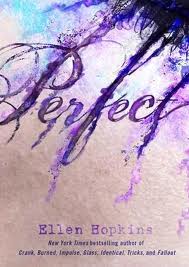
"Perfect" by Ellen Hopkins

**Spoilers!**

Perfect, by Ellen Hopkins, is the story of four high school students struggling with colleges, love, their futures, and what perfect really means.


This was the first book to get me to cry. Ever. I'm so serious. As an ode to how important this fact is, I read The Five People You Meet in Heaven, and The Faults in Our Stars, both of which I like to think of as a downright sad books, and did not cry during those. 

This book was amazing. When I first read the blurb, I thought it was going to be cheesy. But it was so intense and saddening and an amazing mix of poetry and narrative. The stories were so believable it hurt. You could feel all the raw emotion. Hopkins does some of the most amazing things I've ever seen with literature. I loved Crank, probably one of Hopkin's most famous books, but I think this book should be just up there with it.

The ending is what really did me in. It's so impossibly unhappy, but so terribly hopeful. Andre is ready to face his family, but Jenna is raped. Sean's life is permanently messed up and he's borderline crazy thanks to obsession and steroids, Conner dies, but Cara find her true self and finally finds love with Dani. 

Kendra is torn and anorexic (and seems to stay that way), but has seen inside her family and admitted her feelings fully for maybe the first time.

It's the mix of jealousy, desire, love, hate, lust, anger, violence, sadness and maliciousness that make this book such a deliciously dark read, and reel you in. The characters seem to each represent something perfect people want in their lives, each one twisting this image painfully, making you realize how fast cracks can form from perfection. Each character gives you a different approach on perfect in people's lives.

I hated Sean. He was so self-involved, and childish, and by the end of the book, I was afraid of him, and afraid of what he thought was right in his twisted, broken mind. He's so creepy and insane at the end, it's hard to imagine anyone like that. His motives started off so pure. He was so in love with Cara, you feel sorry for the guy that she didn't try to justify herself to him at all. She just broke it off, then even though he was hung up over her and one of her best friends (as she mentions in the first part of the book), she doesn't try to explain anything

Cara was near the most relaxed character. Most of the story, she was just crazy in love, and handling it, or thinking about her older brother. I thought that her realizing she was lesbian was a little too fast (like when they're skiing she just automatically says 'Maybe' she's lesbian when Danielle asks? There is no hint of that she is before that. I think it's amazing that she found what she really wanted, but it was kind of forced, especially if it was her first time with a girl. I think she would have been a little more nervous. Though I also didn't read the first book, which could have exposition to this fact in it), but her sadness at the end of the book was just so real. Her crying, "Mommy" and, "Daddy" when Conner died, even though she hated them most of the time and resented them? It was so raw.

Kendra was in so much denial. I wanted an emotional breach. It was almost hard to get attached to her. Her problem was so much more than her eating disorder. She reminded me of a mild Sean, because she only thought of Conner. She used him to justify her own madness.

Andre was also fairly mild compared to everyone else. He should be himself. I think that his relationship with Jenna really made him interesting. He adored and loved her unconditionally. But she was too childish, and too scarred by her parents to reciprocate. It's almost a relief when you see she realizes this. And when she gets raped right after Andre breaks it off with her, it's so sad. 

THE BOOK IS SAD.


But...
This book is one of my all time favorite, and always will be.

Thursday, March 21, 2013

Update: "After Ever After" by Jordan Sonnenblick

**Spoilers!**

The book, After Ever After, by Jordan Sonnenblick is the sequel to Drums, Girls, and Dangerous Pie, following Jeffrey Alper, after his cancer went into remission, now in his eighth grade year, dealing with many of the same problems Steven Alper, his older brother, did in his eighth grade year in, Drums, Girls...

I really like this book so far. It reminds me a lot of the original story, and has extremely similar tones, probably due to that they're written by the same person, Jordan Sonnenblick. That's a pretty obvious explanation. But I like that Sonnenblick brings out new characters, and though in this story, as the last one, there's still the main boy character, his love interest, and the best friend.

One thing I would like to explore is the best friend in this story, Jeffrey's best friend, Thaddeus, or Tad. Tad is a really antisocial person, often really downright mean to people. He was even snide to Jeffrey when they first met, and to the girl he likes.

I believe that this is Tad's attitude at the beginning of the story, pretty much almost up to the point I'm at now in the book, because he was afraid to get close to people, and he wasn't sure even how long he would live to see them become friends.

Tad's cancer made him feel weak, and it made him afraid he wasn't going to live. This obviously made him look down on the world, probably seeing their problems as more insignificant than his, which explains his cynicism and sarcasm towards many in the book currently.

But I believe also that besides Tad's weakness bringing out this trait, it also made him question how much he wanted to do in his life, or if there was any point to it. He gave up trying to walk, and he was just complacent with the life he had. He knew that he had his best friend to get by with, so he didn't think he needed to go out of his way to be friendly to anyone else. I think that Tad is fully aware that is cancer could return in the story, which it does, so he tries not to get closer to anyone and uses his cynicism as a shield.

This also explains why Tad wants Jeffrey to pass Jeffrey's state tests so much. He wants to make sure that Jeffrey gets to do at least everything Tad does, and make sure that Jeffrey doesn't give up like Tad does. This also shows that Tad is not truly mean, and is actually quite compassionate, spending a lot of his own time working with Jeffrey on math.


Sunday, March 10, 2013

"Evermore" by Alyson Noel

**Spoilers!**

Evermore by Alyson Noel is the story of Ever Bloom, a fairly normal teen, except she can see people's auras, see the dead, and mind read by touch. When Damen transfers to her high school, she is immediately drawn to him, and his terrible secrets.


This book is tired out and predictable. It's the same as Fallen, Twilight, and many other YA fantasy-hottie books that are today. Though, truthfully, this was printed in 2009, as were those other two books, but still, the point stands. If you're ever seen Twilight or read it, the book is boring from the first page. At least Twilight made an impact by being the first really big YA/romance/teenager/angst/fantasy/supernatural book to come out, though, admittedly, Twilight wasn't even remarkably good.

Ever, as many other of the main characters in these types of books, is sullen and a loner, but beautiful, conveniently, and so hot that only if she reached out she could be happy! But sadly, she doesn't, and neither does she try to fix herself. She only has to await the rescuing arms of some hottie (Damen) to do what you would never have thought to do: Actually try to fix your own problems to make you happy, instead of being anti-social and sullen. The things that annoy me the most about books like these is that they make women look like anxious wrecks who need men to come in and save them whenever pretty much anything happens. No girl that I have ever met has not been able to handle at least some of their problems on their own. An all these girls have amazing powers, like reading minds, or talking to the dead, or being vampire proof, or something else that makes them, possibly, the most valuable person in-book universe.

Back to the book...

Take these unmotivated, flailing female character aforementioned, then add some incredibly random BS myths, weirdo, unbelievably unmotivated antagonists, gullible characters, very vague descriptions about pasts of many peoples, and voila, you have a whole book that's extremely repetitive and washed-out.

Why does Noel have to add the random thing with Drina at the end? I hated that part. It was like she needed Drina to blurt out all the exposition she couldn't explain through the narration or through character dialogue, plot points, hints, or anything. And really? Drina pushed the deer in front of her family's car? Why? It's so random. Why doesn't Drina just sneak into her room in the middle of the night and slit her throat, like a normal murderer would? There is also no explanation to why Drina is so obsessed with Damen. He saved her, and they were married. But divorced people find others! They move along? Why does Noel drop the hint of alchemy being involved in Damen being an immortal, but then veers off and doesn't explain jack-squat? So much pointlessness!

Also, really? I don't get in these books how quickly people believe all the stuff their boyfriends tell them.

The book:

''I'm... An Immortal!''

''OMG NO WAY YOU'RE CRAZY''

''Nooo!!!!''

''Back to normal life!... wait oh no I'm being attacked!''

''Here I come to save the day!''

'Thank you! So what's up with you?''

''Oh, I've just been following you around for the past six hundred years because you're so hot... and I've never gotten in your pants, which I keep mentioning and you don't get creeped out at all about!''

''Oh, it's true! I knew it! I'm not skeptical, or need any more clarification! Let's go be together! Also I'm still underage! And you're six-hundred!''

That's basically all you need to know about Evermore.

Why do even bother reading these books anymore.

HOW WAS THIS A BEST SELLER? Thank god for people like John Green. Can we please have more books like Looking for Alaska, or Paper Towns on the best seller lists?

Sunday, March 3, 2013

Sonnet

Sonnet

We danced, bright star eyes, but soon we know how
the world crushes most dreams of he who tries.
All we wanted was to have gracious bows,
we end up holding arms with silent cries.

And those who try too hard tend to get hurt.
We are the ones who held our hearts in hands,
begging others not to be so rude, curt.
But hands are not walls, no not at all, and

Soon the tender and sweet heart was burned, by
a known figure with cat eyes and strong heart.
They thought that all were strong like them, a lie,
but the poor star eyed were not so careful.

A heart never hurt is not experienced.
And hearts not hurt fall inexperienced.