Sunday, March 31, 2013

"Perfect" by Ellen Hopkins

**Spoilers!**

Perfect, by Ellen Hopkins, is the story of four high school students struggling with colleges, love, their futures, and what perfect really means.
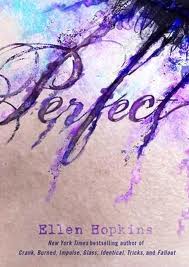

This was the first book to get me to cry. Ever. I'm so serious. As an ode to how important this fact is, I read The Five People You Meet in Heaven, and The Faults in Our Stars, both of which I like to think of as a downright sad books, and did not cry during those. 

This book was amazing. When I first read the blurb, I thought it was going to be cheesy. But it was so intense and saddening and an amazing mix of poetry and narrative. The stories were so believable it hurt. You could feel all the raw emotion. Hopkins does some of the most amazing things I've ever seen with literature. I loved Crank, probably one of Hopkin's most famous books, but I think this book should be just up there with it.

The ending is what really did me in. It's so impossibly unhappy, but so terribly hopeful. Andre is ready to face his family, but Jenna is raped. Sean's life is permanently messed up and he's borderline crazy thanks to obsession and steroids, Conner dies, but Cara find her true self and finally finds love with Dani. 

Kendra is torn and anorexic (and seems to stay that way), but has seen inside her family and admitted her feelings fully for maybe the first time.

It's the mix of jealousy, desire, love, hate, lust, anger, violence, sadness and maliciousness that make this book such a deliciously dark read, and reel you in. The characters seem to each represent something perfect people want in their lives, each one twisting this image painfully, making you realize how fast cracks can form from perfection. Each character gives you a different approach on perfect in people's lives.

I hated Sean. He was so self-involved, and childish, and by the end of the book, I was afraid of him, and afraid of what he thought was right in his twisted, broken mind. He's so creepy and insane at the end, it's hard to imagine anyone like that. His motives started off so pure. He was so in love with Cara, you feel sorry for the guy that she didn't try to justify herself to him at all. She just broke it off, then even though he was hung up over her and one of her best friends (as she mentions in the first part of the book), she doesn't try to explain anything

Cara was near the most relaxed character. Most of the story, she was just crazy in love, and handling it, or thinking about her older brother. I thought that her realizing she was lesbian was a little too fast (like when they're skiing she just automatically says 'Maybe' she's lesbian when Danielle asks? There is no hint of that she is before that. I think it's amazing that she found what she really wanted, but it was kind of forced, especially if it was her first time with a girl. I think she would have been a little more nervous. Though I also didn't read the first book, which could have exposition to this fact in it), but her sadness at the end of the book was just so real. Her crying, "Mommy" and, "Daddy" when Conner died, even though she hated them most of the time and resented them? It was so raw.

Kendra was in so much denial. I wanted an emotional breach. It was almost hard to get attached to her. Her problem was so much more than her eating disorder. She reminded me of a mild Sean, because she only thought of Conner. She used him to justify her own madness.

Andre was also fairly mild compared to everyone else. He should be himself. I think that his relationship with Jenna really made him interesting. He adored and loved her unconditionally. But she was too childish, and too scarred by her parents to reciprocate. It's almost a relief when you see she realizes this. And when she gets raped right after Andre breaks it off with her, it's so sad. 

THE BOOK IS SAD.


But...
This book is one of my all time favorite, and always will be.

Thursday, March 21, 2013

Update: "After Ever After" by Jordan Sonnenblick

**Spoilers!**

The book, After Ever After, by Jordan Sonnenblick is the sequel to Drums, Girls, and Dangerous Pie, following Jeffrey Alper, after his cancer went into remission, now in his eighth grade year, dealing with many of the same problems Steven Alper, his older brother, did in his eighth grade year in, Drums, Girls...

I really like this book so far. It reminds me a lot of the original story, and has extremely similar tones, probably due to that they're written by the same person, Jordan Sonnenblick. That's a pretty obvious explanation. But I like that Sonnenblick brings out new characters, and though in this story, as the last one, there's still the main boy character, his love interest, and the best friend.

One thing I would like to explore is the best friend in this story, Jeffrey's best friend, Thaddeus, or Tad. Tad is a really antisocial person, often really downright mean to people. He was even snide to Jeffrey when they first met, and to the girl he likes.

I believe that this is Tad's attitude at the beginning of the story, pretty much almost up to the point I'm at now in the book, because he was afraid to get close to people, and he wasn't sure even how long he would live to see them become friends.

Tad's cancer made him feel weak, and it made him afraid he wasn't going to live. This obviously made him look down on the world, probably seeing their problems as more insignificant than his, which explains his cynicism and sarcasm towards many in the book currently.

But I believe also that besides Tad's weakness bringing out this trait, it also made him question how much he wanted to do in his life, or if there was any point to it. He gave up trying to walk, and he was just complacent with the life he had. He knew that he had his best friend to get by with, so he didn't think he needed to go out of his way to be friendly to anyone else. I think that Tad is fully aware that is cancer could return in the story, which it does, so he tries not to get closer to anyone and uses his cynicism as a shield.

This also explains why Tad wants Jeffrey to pass Jeffrey's state tests so much. He wants to make sure that Jeffrey gets to do at least everything Tad does, and make sure that Jeffrey doesn't give up like Tad does. This also shows that Tad is not truly mean, and is actually quite compassionate, spending a lot of his own time working with Jeffrey on math.


Sunday, March 10, 2013

"Evermore" by Alyson Noel

**Spoilers!**

Evermore by Alyson Noel is the story of Ever Bloom, a fairly normal teen, except she can see people's auras, see the dead, and mind read by touch. When Damen transfers to her high school, she is immediately drawn to him, and his terrible secrets.


This book is tired out and predictable. It's the same as Fallen, Twilight, and many other YA fantasy-hottie books that are today. Though, truthfully, this was printed in 2009, as were those other two books, but still, the point stands. If you're ever seen Twilight or read it, the book is boring from the first page. At least Twilight made an impact by being the first really big YA/romance/teenager/angst/fantasy/supernatural book to come out, though, admittedly, Twilight wasn't even remarkably good.

Ever, as many other of the main characters in these types of books, is sullen and a loner, but beautiful, conveniently, and so hot that only if she reached out she could be happy! But sadly, she doesn't, and neither does she try to fix herself. She only has to await the rescuing arms of some hottie (Damen) to do what you would never have thought to do: Actually try to fix your own problems to make you happy, instead of being anti-social and sullen. The things that annoy me the most about books like these is that they make women look like anxious wrecks who need men to come in and save them whenever pretty much anything happens. No girl that I have ever met has not been able to handle at least some of their problems on their own. An all these girls have amazing powers, like reading minds, or talking to the dead, or being vampire proof, or something else that makes them, possibly, the most valuable person in-book universe.

Back to the book...

Take these unmotivated, flailing female character aforementioned, then add some incredibly random BS myths, weirdo, unbelievably unmotivated antagonists, gullible characters, very vague descriptions about pasts of many peoples, and voila, you have a whole book that's extremely repetitive and washed-out.

Why does Noel have to add the random thing with Drina at the end? I hated that part. It was like she needed Drina to blurt out all the exposition she couldn't explain through the narration or through character dialogue, plot points, hints, or anything. And really? Drina pushed the deer in front of her family's car? Why? It's so random. Why doesn't Drina just sneak into her room in the middle of the night and slit her throat, like a normal murderer would? There is also no explanation to why Drina is so obsessed with Damen. He saved her, and they were married. But divorced people find others! They move along? Why does Noel drop the hint of alchemy being involved in Damen being an immortal, but then veers off and doesn't explain jack-squat? So much pointlessness!

Also, really? I don't get in these books how quickly people believe all the stuff their boyfriends tell them.

The book:

''I'm... An Immortal!''

''OMG NO WAY YOU'RE CRAZY''

''Nooo!!!!''

''Back to normal life!... wait oh no I'm being attacked!''

''Here I come to save the day!''

'Thank you! So what's up with you?''

''Oh, I've just been following you around for the past six hundred years because you're so hot... and I've never gotten in your pants, which I keep mentioning and you don't get creeped out at all about!''

''Oh, it's true! I knew it! I'm not skeptical, or need any more clarification! Let's go be together! Also I'm still underage! And you're six-hundred!''

That's basically all you need to know about Evermore.

Why do even bother reading these books anymore.

HOW WAS THIS A BEST SELLER? Thank god for people like John Green. Can we please have more books like Looking for Alaska, or Paper Towns on the best seller lists?

Sunday, March 3, 2013

Sonnet

Sonnet

We danced, bright star eyes, but soon we know how
the world crushes most dreams of he who tries.
All we wanted was to have gracious bows,
we end up holding arms with silent cries.

And those who try too hard tend to get hurt.
We are the ones who held our hearts in hands,
begging others not to be so rude, curt.
But hands are not walls, no not at all, and

Soon the tender and sweet heart was burned, by
a known figure with cat eyes and strong heart.
They thought that all were strong like them, a lie,
but the poor star eyed were not so careful.

A heart never hurt is not experienced.
And hearts not hurt fall inexperienced.

Sunday, February 24, 2013

"Scarlet" by Marissa Meyer

**Spoilers!**

In the book, Scarlet, by Marissa Meyer, she continues to expand the story and world she set in Cinder, the first book in the Lunar Chronicles. Scarlet focuses on a retelling of the "Little Red Riding Hood" fairytale, introducing Scarlet Benoit, a young woman whose grandmother has mysteriously disappeared. Soon, Scarlet realizes that this mystery is much larger than just her grandmother, and enfolds years of agression and tension built up between Earth and the Lunars, as well as the one person who could stop the threat of war. The missing Lunar, Princess Selene.

I finally read it! Yeah me!

So this book has been sitting on my Nook for weeks, and last week, I finally started to read it. I was so excited, and the book lived up to my expectations greatly.

As I mentioned in the first Lunar Chronicles book, the books are futuristic retellings of some of the most familiar fairytales, Cinderella, Little Red Riding Hood, Rapunzel, and Snow White. One of my favorite part of these books so far is the imaginative setting revamp. The world of the five nations in future-Earth is so vivid and well planned out. The prejudices, actions and thoughts of them as a society have been really thought out and still resonated clearly in Scarlet, which was interesting. I thought maybe because it was a whole different country, and each country was so large, the cultures would vary largely country to country.

One thing I did want to learn a little more about was France, specifically, in the book. We learned a lot about New Beijing in the first book, and had vivid imagery to go along with the new culture we learned about. Though this book was still descriptive, I wanted to learn more about Paris, farmland area France, and customs of the French in this universe.

Another thing I wanted to see, though less of, is the Wolf-Scarlet romance. I enjoy the relationship, and it was fun to see grow, and I have nothing against it, it was a little cheesy to see the last couple scenes with them and even the middle of the book. They barely know each other, but almost seem ready to get married. I get that the Prince Kai-Cinder relationship couldn't continue as a key plot point, but it kind of set the mood of the story. This is a series about girls not obsessed with love, ready to do what is important overall first. Scarlet is a strong character, but how fast she changes from not trusting Wolf, at all, to being head-over-heels for him, seems completely out of the character established at the beginning of the book. The Wolf and Scarlet relationship made this feel a little bit like Twilight. Oh no!

Overall, I still loved the book, and would recommend it to fans of the Hunger Games, fairytales, and sci-fi. Please, if you find this interesting, read the first book first. It won't make much sense otherwise!

Sunday, February 17, 2013

Martin Espada Essay


Recurring Themes in Martin Espada’s Poetry

Martin Espada is a well known, educated and respected Puerto Rican poet from New York City. His poetry often deals with major issues and have recurring themes, which stretch between poems. One strong theme in Espada’s poetry is the idea of power, and the abuse of it.

For instance, in Espada’s poem, “The New Bathroom Policy at English High School,” the principal abuses his power over the school by banning the speaking of Spanish in the bathrooms. He has no incentive to do so besides the speaking of Spanish, and hearing his name in these conversations, constipating him. The principal in this poem is abusing his power as the principal, cutting of the Spanish speakers in the school of a location where they can express their culture and may speak the language most comfortable to them, if they learned Spanish as a first language. 

Another example of the theme of the abuse of power in Espada’s poetry is in his poem, “Revolutionary Spanish Lesson”. The people mispronouncing the narrators name are either using the power of the narrators name and purposefully mispronouncing it to frustrate him, or just not taking the time to ask them how his or her name is pronounced. When you have a choice to make, like the subjects of the poem mispronouncing the narrators name again, and again, you have power over the situation. Being careless with this power to make better choices is still an abuse of a, even if small power much of the time, power.

Lastly, the theme of abuse of power is an important theme in Martin Espadas poems in the poem, “Two Mexicanos Lynched in Santa Cruz, California, May 3, 1877”. This poem speaks of the lynching of two Mexicans by whites in California. The theme of abuse of power is extremely strong in this poem. Not only is the extreme racism and prejudice obvious in this situation, the “gringos” in the poem had much more power than these Mexicans. There were forty of them present at the hanging of the only two Mexican people, which means that the Mexicanos were almost certainly outnumbered to fight the whites who were trying to kill them. The whites were higher status and have a better situation than the Mexicans. They could've gone on to face little or no repercussions for what they did. It’s murder in every sense of the word, and all murders or deaths are terrible, but the way it was committed makes it even worse. The white subjects in the poem abused their physical and societal powers over the Mexicans. 

In conclusion, the abuse of power is a huge theme in Martin Espada’s poetry. He uses it clearly in three different poems of his, “The New Bathroom Policy at English High School”, “Revolutionary Spanish Lesson”, and “Two Mexicanos Lynched in Santa Cruz, California, May 3, 1877”. Espada used many different forms of abuse of power in his poems, showing that no matter what kind of power you abuse, it’s still wrong if you do it for the wrong reasons.

Wednesday, February 13, 2013

"Breathing Underwater" by Alex Flinn

**Spoilers!**


Breathing Underwater is the story of Nick, a seemingly perfect and popular high school student who is charged with a restraining order on his ex-girlfriend, Caitlin. But why? Nick doesn't think he did anything wrong. He just taught her a lesson. The book chronicles his journey to his anger management classes that will "help him", and overall just his journey to redemption.

I enjoyed this book a lot. My favorite moments were the letters, and seeing how bad the abuse got in the relationship. I couldn't really imagine anyone besides some alcoholic father (like Nick's dad) abusing anyone, but this really shows me that abuse can happen for lots of reasons, and isn't always the reasons we think. I also was surprised about the relationship itself, and gave me an insight to an abusive relationship. The book showed me a lot about the kind of people who get caught in relationships like this, people like Caitlin who don't think they're good enough because of someone (Caitlin's mom), who think the person will be their only hope at a relationship. Also it was interesting that Nick didn't think he was being that harsh, or that we was wrong. It made me really worried for others who are in situations like this, and how they might not even know what they're doing is wrong.

Also is made me sad that Caitlin's or Nick's friends didn't try to help Caitlin when they saw something wrong about the relationship. I think if I ever saw a friend in trouble I would have to tell them, even if it meant losing a friendship. 

Overall, this book was really interesting and emotional to read, and I enjoyed it. The movement to Nick's "redemption" was well written, as Alex Flinn is awesome. Read it!